Artificial intelligence is transforming the way businesses develop software, manage information, communicate with customers, analyse data, and automate operations. AI-powered applications can now generate content, write code, identify patterns, detect fraud, support research, and interact with external software systems. As these capabilities expand, organisations are becoming increasingly dependent on AI technologies for important business activities.
However, the growing adoption of artificial intelligence also creates new security challenges. AI systems can be targeted by attackers, manipulated through malicious inputs, exploited through insecure integrations, or exposed to data leakage. An attacker may attempt to manipulate an AI assistant into revealing confidential information, compromise the infrastructure hosting a model, poison the data used during training, or exploit an AI agent that has excessive access to business applications.
Traditional cybersecurity practices remain essential, but they are not always sufficient to address the unique risks introduced by AI. Organisations must understand how machine learning models behave, how AI applications process information, how external tools are connected, and how attackers can manipulate the interaction between users, models, data, and software systems.
This is where AI security becomes important.
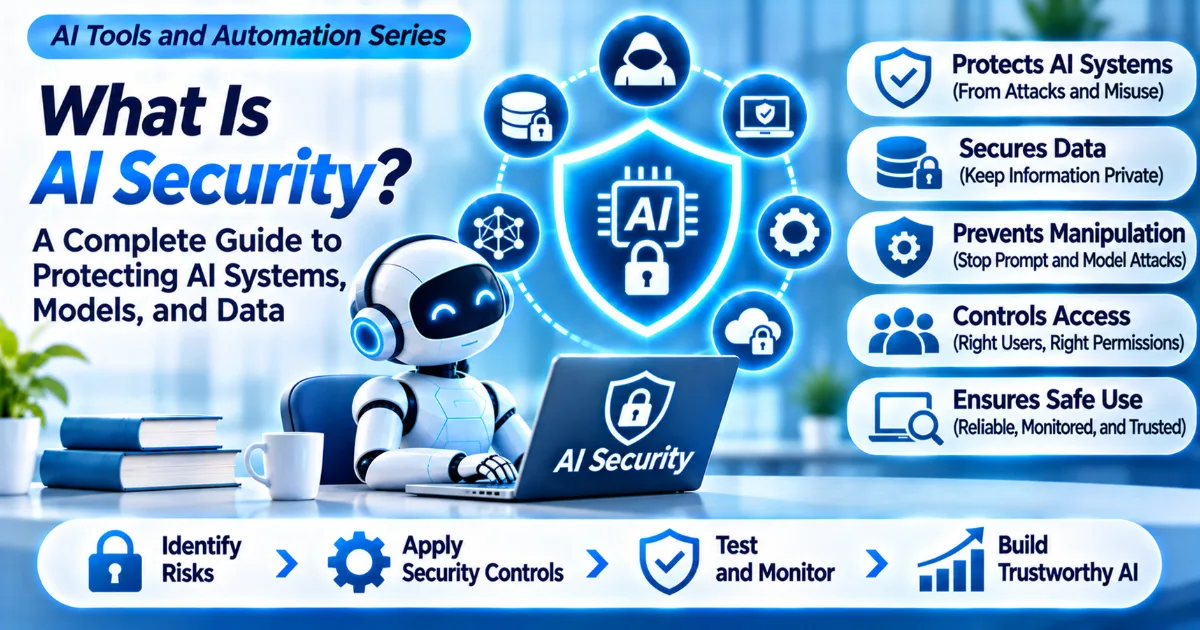
AI security focuses on protecting artificial intelligence systems, models, datasets, infrastructure, applications, and connected services against unauthorised access, manipulation, exploitation, and other security threats. It includes securing the entire AI lifecycle, from data collection and model development to deployment, integration, monitoring, and retirement.
Continue Reading
In this guide, we will explore what AI security means, why it matters, the most common threats targeting AI systems, how attackers exploit vulnerabilities, and what developers and businesses can do to build more secure AI applications.
What Is AI Security?
AI security is the practice of protecting artificial intelligence systems and their supporting infrastructure from cyberattacks, unauthorised access, data exposure, manipulation, and malicious use.
It involves securing the different components that make an AI application work, including training datasets, machine learning models, APIs, cloud infrastructure, user interfaces, external integrations, and automated agents.
Consider a company that develops an AI-powered customer support assistant. The application may connect to a language model, retrieve information from an internal knowledge base, access customer records, and communicate with a customer relationship management system.
Each component creates a potential security concern.
An attacker might attempt to manipulate the assistant through a carefully designed message, gain access to customer information, exploit an insecure API, or compromise the database containing internal documents.
AI security aims to prevent these incidents through appropriate technical controls, secure architecture, testing, monitoring, and incident response.
It is important to understand that AI security is not limited to protecting AI models from hackers. It also involves protecting the information used by models, preventing unauthorised changes to their behaviour, securing the applications built around them, and controlling the actions they can perform.
An AI system may use a highly capable model and still be insecure if its application allows unauthorised users to access sensitive information.
Similarly, a well-secured cloud server does not guarantee that an AI application is safe if attackers can manipulate its prompts or exploit weaknesses in its retrieval system.
AI security therefore requires a comprehensive approach that considers both traditional cybersecurity risks and threats specific to artificial intelligence.
Why Is AI Security Important?
AI systems increasingly process valuable information and participate in important business operations. A security failure can affect customers, employees, business partners, and the organisation itself.
Protecting Sensitive Data
AI applications may process personal information, financial records, customer conversations, internal reports, source code, business strategies, and confidential documents.
If an attacker gains access to this information, the consequences may include privacy violations, financial losses, regulatory problems, and reputational damage.
For example, an AI assistant connected to an internal company database must ensure that employees can retrieve only the information they are authorised to access.
Without proper access controls, an employee might accidentally receive confidential information belonging to another department or customer.
Preventing Model Manipulation
AI models depend on data and learned patterns. Attackers may attempt to manipulate these elements to influence how a model behaves.
They may introduce poisoned training data, manipulate inputs during operation, or exploit weaknesses in model interfaces.
A manipulated model could produce incorrect predictions, misclassify information, or behave in ways that undermine the purpose of the application.
Protecting Business Operations
Businesses increasingly use AI for fraud detection, customer support, software development, marketing, forecasting, and workflow automation.
If attackers compromise these systems, they may disrupt operations, manipulate business information, or interfere with automated processes.
An AI system connected to financial or operational software may create particularly serious risks if its permissions are not properly restricted.
Preventing Financial Losses
AI security incidents can result in direct financial losses through fraud, service disruption, data theft, recovery costs, and legal expenses.
For example, an attacker who manipulates an AI-powered payment support workflow may attempt to trigger unauthorised refunds or access account information.
Security controls help reduce the possibility and impact of these incidents.
Maintaining Customer Trust
Customers expect organisations to protect the information they provide.
If a company uses AI to process customer information, it must take reasonable steps to ensure that the system is secure.
A data breach involving an AI application can damage customer confidence and make people reluctant to use the organisation's digital services.
Securing Autonomous AI Agents
AI agents introduce additional security concerns because they can interact with external tools and perform actions.
An agent may be able to send emails, access documents, update databases, create records, or execute business workflows.
If attackers manipulate an agent or compromise its credentials, they may exploit the agent's permissions to perform unauthorised activities.
Securing AI agents requires strict access controls, action restrictions, monitoring, and approval mechanisms.
Understanding the AI Attack Surface
The attack surface of an AI system includes all the components, interfaces, data sources, and connections that attackers may attempt to exploit.
Traditional applications often have attack surfaces involving websites, databases, servers, APIs, authentication systems, and user devices.
AI applications include these components but may also introduce additional elements.
Training Data
Training data influences what a model learns. If attackers can manipulate the data used during training, they may influence the model's future behaviour.
AI Models
Models may contain valuable intellectual property and learned information. Attackers may attempt to extract, copy, reverse engineer, or manipulate them.
Prompts and Inputs
AI systems process instructions and user-provided information. Carefully crafted inputs may cause models to behave unexpectedly or violate intended restrictions.
Retrieval Systems
Retrieval-augmented generation applications connect language models to external information sources. Weak access controls or poorly designed retrieval processes may expose confidential documents.
APIs and Integrations
AI applications often connect to databases, payment systems, cloud platforms, business software, and third-party services.
Every integration creates another point that must be secured.
User Interfaces
Chat interfaces, file upload features, administrative dashboards, and public endpoints may be targeted through conventional web application attacks or AI-specific manipulation techniques.
Autonomous Tools
AI agents may use browsers, terminals, APIs, databases, and other tools. Their permissions and execution environments must be carefully controlled.
Understanding this attack surface is the first step towards developing an effective AI security strategy.
What Are the Most Common AI Security Threats?
AI systems face several types of security threats. Some are adaptations of traditional cyberattacks, while others exploit the distinctive behaviour of machine learning and generative AI.
Prompt Injection Attacks
Prompt injection is one of the most discussed security threats affecting large language model applications.
It occurs when malicious instructions are introduced into information processed by an AI system, attempting to influence the system's behaviour.
For example, a company may build an AI assistant that reads uploaded documents and answers employee questions. An attacker could create a document containing instructions that attempt to override the assistant's intended task.
If the application does not properly separate trusted instructions from untrusted document content, the assistant may follow the malicious instructions.
Prompt injection can occur through direct user messages or indirectly through webpages, emails, documents, and other external content.
The risk becomes more serious when an AI system has access to confidential information or tools that can perform actions.
Organisations can reduce this risk through input handling, strict tool permissions, content isolation, action validation, and human approval for sensitive operations.
However, prompt injection is not solved simply by adding a warning to the system prompt. It requires security controls throughout the application architecture.
Training Data Poisoning
Training data poisoning occurs when an attacker deliberately introduces malicious or misleading information into the data used to train or fine-tune an AI model.
Because machine learning models learn from data, manipulated examples may influence their behaviour.
For example, an attacker might attempt to introduce incorrectly labelled images into a dataset used to train an image classification system.
If enough poisoned examples influence the training process, the resulting model may become less reliable or behave incorrectly under particular conditions.
Data poisoning can affect traditional machine learning systems as well as some generative AI training and fine-tuning processes.
Organisations should protect data collection pipelines, verify dataset sources, review labelling processes, maintain dataset records, and monitor unexpected model behaviour.
Model Inversion Attacks
Model inversion attacks attempt to infer information about the data used to train or operate a model by analysing its outputs.
In some situations, attackers may attempt to reconstruct sensitive attributes or information associated with training examples.
For example, an attacker interacting with a model trained on sensitive personal records might attempt to infer information that should remain private.
The feasibility of these attacks depends on the model, its outputs, the information available to the attacker, and the surrounding security controls.
Data minimisation, privacy-preserving training techniques, access restrictions, and careful output management can reduce the risk.
Model Extraction Attacks
Model extraction occurs when an attacker attempts to reproduce or approximate a machine learning model by repeatedly querying it and analysing its responses.
A commercial AI provider may invest significant resources in developing a specialised model. If attackers can make large numbers of queries and obtain detailed outputs, they may attempt to create a competing approximation.
Model extraction can threaten intellectual property and increase the provider's operating costs.
Possible safeguards include API authentication, query limits, usage monitoring, abuse detection, and careful management of model output details.
Membership Inference Attacks
Membership inference attacks attempt to determine whether a particular data record was included in a model's training dataset.
This can create privacy risks when the training data contains sensitive information.
For example, an attacker might attempt to determine whether a person's medical record was used to train a particular model.
The success of such attacks depends on factors such as model behaviour, training methods, available information, and the attacker's access.
Privacy-aware training, controlled model access, and appropriate evaluation can help reduce exposure.
Adversarial Machine Learning
Adversarial machine learning examines how attackers can manipulate machine learning systems through deliberately crafted inputs.
An adversarial example is an input designed to cause a model to make an incorrect prediction.
In image classification, carefully altered image pixels may cause a model to misidentify an object even though the image still appears unchanged to a human observer.
In other applications, attackers may manipulate text, audio, or other data to influence model predictions.
Defending against adversarial attacks requires robust model evaluation, input validation, adversarial testing, and monitoring.
Data Leakage Through AI Applications
AI applications may unintentionally expose information through prompts, generated responses, retrieval systems, logs, or integrations.
For example, an AI assistant may retrieve internal documents without checking whether the requesting employee has permission to access them.
Another risk occurs when employees share confidential business information with public AI services without understanding how their information may be processed.
Organisations should define approved tools, enforce access controls, review provider data practices, and train employees on safe AI usage.
Insecure API Integrations
AI applications often depend on APIs to retrieve information or perform actions.
If APIs are poorly protected, attackers may exploit weak authentication, excessive permissions, insecure endpoints, or inadequate input validation.
An AI agent with access to a business API can become an entry point into sensitive systems if its credentials are exposed or its actions are not restricted.
Secure API design, authentication, authorisation, rate limiting, logging, and secret management remain essential.
Supply Chain Attacks
AI applications frequently depend on third-party models, libraries, datasets, cloud platforms, plugins, and development tools.
A vulnerability or compromise in one of these dependencies may affect the entire application.
For example, an organisation may use a third-party model package that has been modified to include malicious code.
Software supply chain security practices should therefore be applied to AI development.
Organisations should verify dependency sources, maintain inventories, review provider security practices, and monitor vulnerabilities.
What Is the OWASP Top 10 for Large Language Model Applications?
The OWASP is known for publishing security guidance and resources for application developers.
Its guidance for large language model applications identifies important security risks that developers should understand when building generative AI systems.
The categories commonly highlighted in its LLM application security guidance include the following.
Prompt Injection: Malicious instructions manipulate an AI system's behaviour or cause it to disregard intended boundaries.
Sensitive Information Disclosure: The application exposes confidential or personal information through outputs, retrieval, or insecure processing.
Supply Chain Vulnerabilities: Third-party models, datasets, libraries, and services introduce security weaknesses.
Data and Model Poisoning: Manipulated training or fine-tuning data influences model behaviour.
Improper Output Handling: An application trusts AI-generated output without validating or safely processing it, potentially creating downstream vulnerabilities.
Excessive Agency: An AI system receives too much authority to perform actions or access resources.
System Prompt Leakage: Attackers attempt to extract system instructions or other information embedded in application prompts.
Vector and Embedding Weaknesses: Retrieval systems and embedding-based applications introduce risks through weak access controls, insecure data handling, or manipulation.
Misinformation: AI applications generate or present inaccurate information that users may incorrectly trust.
Unbounded Consumption: Poorly controlled usage can lead to excessive resource consumption, service disruption, or unexpected costs.
These categories are useful for developers because they connect AI-specific behaviour with practical application security concerns.
The OWASP guidance should be treated as a security reference rather than a complete substitute for a system-specific threat assessment. Organisations should verify the current version of the guidance when using it for formal security work.
How to Secure an AI Application
Securing an AI application requires multiple layers of protection. No single tool or configuration can eliminate every risk.
Secure the Development Environment
AI development environments may contain source code, datasets, credentials, model files, and configuration information.
Developers should use secure repositories, restrict access, protect credentials, review dependencies, and apply appropriate development security practices.
Development, testing, and production environments should be separated so that experimentation does not accidentally affect live business systems.
Protect API Keys and Credentials
AI applications frequently use API keys, access tokens, and service credentials to communicate with models and external services.
These credentials should never be hardcoded into publicly accessible source code or exposed in frontend applications.
Use secure secret-management systems, restrict permissions, rotate credentials when appropriate, and monitor suspicious usage.
Apply Strong Authentication
Only authorised users and services should be able to access AI applications and their supporting resources.
Use appropriate authentication mechanisms, secure session management, and multi-factor authentication for sensitive administrative functions.
Where possible, organisations should integrate AI access with their existing identity and access management systems.
Implement Role-Based Access Control
Different users should have different levels of access depending on their responsibilities.
For example, an ordinary employee may be allowed to ask questions about approved company policies, while an administrator may manage knowledge sources and system configurations.
Role-based access control helps prevent unnecessary exposure of sensitive information.
Use the Principle of Least Privilege
Every component should receive only the permissions required to perform its function.
An AI assistant that retrieves information from a database should not automatically receive permission to modify or delete records.
An AI agent that prepares reports should not receive unrestricted access to payment systems.
Limiting permissions reduces the potential impact of compromised components and unexpected behaviour.
Validate Inputs
AI applications should treat user inputs and external content as potentially untrusted.
Input validation can help prevent conventional application vulnerabilities and reduce certain forms of malicious manipulation.
For example, applications should validate uploaded files, restrict unsupported formats, enforce size limits, and apply appropriate processing rules.
Prompt injection requires additional architectural safeguards because ordinary input validation alone cannot reliably distinguish all malicious instructions from legitimate content.
Validate AI Outputs
Applications should not automatically trust model-generated content.
AI output may need validation before it is displayed, stored, executed, or passed to another system.
For example, generated SQL queries should not be executed directly against a production database without appropriate validation and permission controls.
Similarly, AI-generated HTML should be sanitised before being rendered in a browser.
Secure External Integrations
Every external service connected to an AI application should be reviewed for security.
Use authenticated connections, restricted permissions, secure communication, and appropriate logging.
Integrations should be designed so that compromising one component does not automatically provide unrestricted access to other systems.
Monitor System Activity
Security monitoring helps organisations identify suspicious behaviour and investigate incidents.
Monitor unusual API usage, repeated authentication failures, unexpected tool calls, unusual data retrieval patterns, and excessive resource consumption.
Logs should capture sufficient information for investigation while respecting privacy and data protection requirements.
Securing Retrieval-Augmented Generation Systems
Retrieval-Augmented Generation, commonly called RAG, connects a language model to an external information source.
Instead of relying only on information learned during training, the system retrieves relevant documents and uses them to generate an answer.
RAG is useful for enterprise assistants, document search, customer support, and internal knowledge management.
However, it introduces additional security risks.
Document-Level Access Control
A RAG application should retrieve only documents that the requesting user is authorised to access.
Suppose a company has separate documents for finance, human resources, sales, and engineering.
An employee from the sales department should not automatically receive access to confidential human resources records merely because those documents are stored in the same vector database.
Permissions should be enforced during retrieval rather than relying only on the language model to avoid disclosing restricted information.
Secure Data Ingestion
Documents entering a RAG knowledge base should be checked for their source, integrity, relevance, and permission status.
Malicious documents may contain instructions designed to manipulate the AI assistant.
Organisations should maintain trusted ingestion processes and review suspicious content before adding it to knowledge repositories.
Protect Embeddings and Vector Databases
Embeddings represent information as numerical vectors that can be used for similarity search.
Vector databases may contain information derived from confidential documents.
They should therefore be protected with authentication, access restrictions, encryption where appropriate, and secure network configuration.
Prevent Cross-User Data Exposure
Multi-user RAG applications must ensure that retrieved information remains isolated according to user permissions.
The application should not assume that documents retrieved for one user can safely be reused in another user's conversation.
Monitor Retrieval Behaviour
Unexpected retrieval patterns may indicate an attempt to access restricted information.
Monitoring can help identify suspicious queries, unusual document access, and potential weaknesses in permission enforcement.
AI Security for Autonomous AI Agents
AI agents introduce a different level of security complexity because they can interact with external tools and perform multi-step operations.
A chatbot primarily generates responses. An AI agent may also execute actions.
For example, a business agent might retrieve customer information, create a support ticket, send an email, update a record, and schedule a follow-up task.
If the agent is compromised or manipulated, the attacker may attempt to use its capabilities to access or modify business resources.
Restrict Agent Permissions
Give agents access only to the tools and data required for their assigned tasks.
An agent responsible for summarising customer conversations should not automatically receive permission to issue refunds or modify payment information.
Require Approval for Sensitive Actions
Actions with significant consequences should require explicit approval from an authorised person.
Examples include transferring money, deleting records, changing account permissions, sending sensitive external communications, and modifying production systems.
Separate Planning From Execution
An AI agent may propose a sequence of actions, but the application should independently validate whether those actions are permitted.
The model should not be the only authority deciding whether an operation can proceed.
For example, an agent may request access to a customer record, but the application should check the user's permissions before returning the information.
Use Sandboxed Execution
Code execution and other potentially dangerous operations should take place in controlled environments.
A sandbox can restrict access to files, networks, operating system resources, and other services.
This helps limit the consequences of unsafe generated code or unintended actions.
Maintain Action Logs
Record important agent activities, including tool requests, permissions, approvals, execution results, and errors.
These records help security teams understand what happened during an incident.
Provide Emergency Controls
Organisations should be able to stop an agent, revoke its credentials, disable specific tools, and suspend automated workflows when suspicious behaviour is detected.
The ability to interrupt an autonomous system is an important security requirement.
What Is a Secure AI Development Lifecycle?
Security should be incorporated into every stage of AI development rather than treated as a final testing activity.
A secure AI development lifecycle provides a structured approach to managing risks from planning through retirement.
1. Planning and Requirements
Start by defining the AI application's purpose, users, information requirements, and potential security risks.
Identify which systems the application will connect to and what actions it may perform.
Security requirements should be established before development begins.
2. Data Collection and Preparation
Identify the sources of training and operational data.
Verify that the organisation has appropriate rights to use the information and that the datasets are protected from unauthorised changes.
Apply data minimisation and appropriate privacy controls.
3. Model Selection and Development
Evaluate models according to their intended use, security characteristics, limitations, provider practices, and deployment requirements.
Developers should review dependencies and ensure that model configurations follow secure practices.
4. Testing and Evaluation
Test the application for accuracy, robustness, privacy, security, and misuse potential.
Conduct adversarial testing and examine how the system behaves when users provide unusual or malicious inputs.
5. Deployment
Secure the infrastructure, APIs, authentication systems, model endpoints, and external integrations.
Apply appropriate permissions and ensure that monitoring is enabled.
6. Operation and Monitoring
Monitor system activity, model performance, API usage, and security events.
Investigate unusual behaviour and update safeguards as new risks are discovered.
7. Maintenance and Retirement
Review the system when models, datasets, integrations, or operating conditions change.
When an AI application is retired, securely remove unnecessary data, revoke credentials, and decommission supporting services.
AI Security Tools and Technologies
Different tools can support AI security, but organisations should select them according to their architecture and risks.
Identity and Access Management
Identity and access management systems control who can access applications, models, datasets, and connected services.
They support authentication, authorisation, role management, and access reviews.
Data Loss Prevention
Data loss prevention tools help detect and control the movement of sensitive information.
They may be used to prevent confidential data from being uploaded to unauthorised services or shared through inappropriate channels.
Web Application Firewalls
Web application firewalls help protect web-facing applications against common attacks.
They can provide an additional security layer for AI applications exposed through public interfaces.
API Security Tools
API security solutions help identify exposed endpoints, weak authentication, excessive permissions, unusual traffic, and other integration risks.
AI Red-Teaming Tools
Specialised testing tools can help evaluate AI applications for prompt injection, unsafe outputs, data exposure, and other weaknesses.
These tools should be combined with manual testing and application-specific security assessments.
Model Monitoring Platforms
Model monitoring tools help organisations track model performance, changes in behaviour, and operational issues.
Depending on the platform, they may also support monitoring for data drift, model quality, and unusual usage patterns.
Secrets Management
Secrets management systems protect API keys, credentials, certificates, and other sensitive configuration information.
They reduce the risk of credentials being exposed through source code or insecure deployment processes.
Cloud Security Platforms
Cloud security tools help protect the infrastructure used to host AI applications, datasets, and models.
They may support configuration monitoring, access management, vulnerability detection, and threat monitoring.
No security product should be treated as a complete solution. Effective AI security depends on architecture, configuration, operational practices, and continuous evaluation.
AI Security Challenges for Small Businesses and Startups
Large organisations may have dedicated cybersecurity teams, but smaller businesses often have limited resources.
This does not mean AI security should be ignored. In fact, smaller companies may be attractive targets when their systems contain valuable customer data or have weak security controls.
Limited Security Expertise
A startup may have developers who understand AI application development but limited experience in cybersecurity.
Basic secure development practices, regular security reviews, and external assessments can help address this gap.
Dependence on Third-Party Providers
Small businesses frequently rely on external AI APIs, cloud services, and software platforms.
They should review provider security practices, understand data handling terms, and avoid sending unnecessary confidential information to external services.
Inadequate Access Controls
A small team may share administrative credentials or give employees broad access to business systems.
As the company grows, these practices can create significant security risks.
Each employee and service should have an individual identity and only the permissions needed for its responsibilities.
Uncontrolled AI Tool Usage
Employees may adopt free or inexpensive AI tools without understanding their data practices.
Businesses should provide approved alternatives and communicate clear rules about confidential information.
Limited Monitoring
A startup may not have a dedicated security operations team.
It can still establish basic monitoring for login failures, unusual API activity, unexpected resource consumption, and suspicious administrative actions.
Security practices should grow alongside the business and the complexity of its AI systems.
Practical AI Security Checklist for Developers and Businesses
Before deploying an AI application, organisations can use the following checklist to review important security considerations.
Have all AI components and external dependencies been identified?
Are training and operational datasets obtained from trusted sources?
Are sensitive data sources protected by appropriate permissions?
Are API keys and credentials stored securely?
Is authentication required for protected AI services?
Are role-based access controls implemented?
Does every component follow the principle of least privilege?
Are user inputs and uploaded files handled safely?
Are AI-generated outputs validated before execution or rendering?
Has the application been tested for prompt injection?
Have retrieval permissions been tested in multi-user environments?
Are external integrations authenticated and restricted?
Are AI agents prevented from performing unauthorised actions?
Do sensitive operations require human approval?
Are logs available for important system activities?
Is suspicious API usage monitored?
Are dependencies and model providers reviewed?
Is there a documented incident response procedure?
Can the organisation disable compromised AI functionality?
Are security reviews repeated after significant system changes?
This checklist is a starting point. The security requirements for a public chatbot, internal knowledge assistant, financial application, and autonomous business agent will differ considerably.
What Should Organisations Do After an AI Security Incident?
Even well-designed systems can experience security incidents. Organisations should be prepared to respond quickly and methodically.
Identify the Incident
Determine what happened, which system was affected, when the incident began, and whether sensitive information or business operations were involved.
Contain the Threat
Depending on the incident, containment may involve disabling an API endpoint, suspending an AI agent, revoking credentials, restricting access, or isolating affected infrastructure.
Investigate the Root Cause
Examine relevant logs, application behaviour, access records, configuration changes, and external dependencies.
Determine whether the incident resulted from a vulnerability, compromised credentials, malicious input, unsafe permissions, or another cause.
Assess the Impact
Identify which users, datasets, applications, and business processes may have been affected.
Where personal information is involved, assess applicable notification and reporting obligations.
Restore Secure Operations
Fix the underlying weakness, verify the effectiveness of the corrective measures, rotate compromised credentials where necessary, and carefully restore affected services.
Learn and Improve
Document the incident and use the findings to improve security policies, development practices, employee training, and monitoring.
An incident should not be considered fully resolved simply because the application is running again. The organisation must also address the weaknesses that allowed the incident to occur.
The Future of AI Security
AI security will become more important as models gain capabilities, AI agents receive greater autonomy, and organisations integrate AI into critical business systems.
Several developments are likely to shape the future of this field.
More Sophisticated AI Attacks
Attackers will continue exploring new methods to manipulate models, exploit AI integrations, and automate parts of their operations.
Security teams will need to understand how AI changes both the attack surface and the techniques used by attackers.
Security for Autonomous AI Agents
As agents gain access to browsers, databases, software development environments, and enterprise applications, protecting their permissions and actions will become a major security priority.
Organisations will need better methods for verifying agent identity, controlling actions, monitoring behaviour, and interrupting unsafe operations.
Greater Focus on AI Supply Chains
AI systems depend on models, datasets, software packages, cloud infrastructure, and third-party services.
Supply chain security will become increasingly important as organisations seek to understand where their AI components come from and how they are maintained.
Privacy-Preserving AI Technologies
Research into techniques such as federated learning, differential privacy, and secure computation may help organisations develop AI systems that reduce exposure of sensitive information.
These techniques have different strengths, limitations, and implementation requirements. They should be selected according to the application's privacy needs.
Automated Security Testing
AI-assisted security tools may help developers identify vulnerabilities, generate test cases, analyse code, and investigate suspicious activity.
However, AI-generated security findings should still be validated because automated tools can produce false positives, miss important weaknesses, or provide incomplete recommendations.
Stronger Security Standards and Regulation
Governments, standards organisations, and industry groups will continue developing guidance for protecting AI systems and managing related risks.
Organisations will need to follow applicable cybersecurity, privacy, and sector-specific requirements while adapting their controls to new technologies.
Security as a Core AI Product Feature
Customers will increasingly evaluate AI products based on their security practices, privacy protections, reliability, and ability to control automated actions.
Security will become an important part of product design and business competitiveness rather than an afterthought.
Conclusion: AI Innovation Needs Strong Security Foundations
Artificial intelligence is creating new opportunities for businesses, developers, researchers, and individuals. However, every new capability can introduce security responsibilities that must be understood and managed.
AI security protects the models, data, infrastructure, applications, and integrations that make modern AI systems possible. It addresses threats such as prompt injection, data poisoning, model extraction, privacy leakage, adversarial manipulation, insecure APIs, and excessive agent permissions.
Effective protection requires more than installing security software. Organisations must build secure development processes, control access, validate inputs and outputs, protect credentials, monitor system activity, and prepare for incidents.
Developers should treat AI models as components within a larger application security architecture. Businesses should establish clear policies and ensure that employees understand how to use AI tools safely. Startups should adopt basic security practices early rather than waiting until their systems become large and complex.
As AI becomes more autonomous and connected to important services, security must become a fundamental part of how these systems are designed and operated.
The future of artificial intelligence will depend not only on building more capable models but also on protecting those models from misuse, manipulation, and exploitation.
Secure AI is not simply about protecting technology. It is about protecting the people, information, organisations, and systems that depend on it.
Join the Discussion
Which AI security threat concerns you the most: prompt injection, data leakage, model poisoning, insecure APIs, or attacks targeting autonomous AI agents?
Do you think small businesses should conduct security assessments before integrating AI into their operations? What security measures should every AI-powered application include from its first release?
Share your thoughts, experiences, and questions with others interested in artificial intelligence, cybersecurity, and automation.
#AISecurity #Cybersecurity #ArtificialIntelligence #PromptInjection #DataProtection