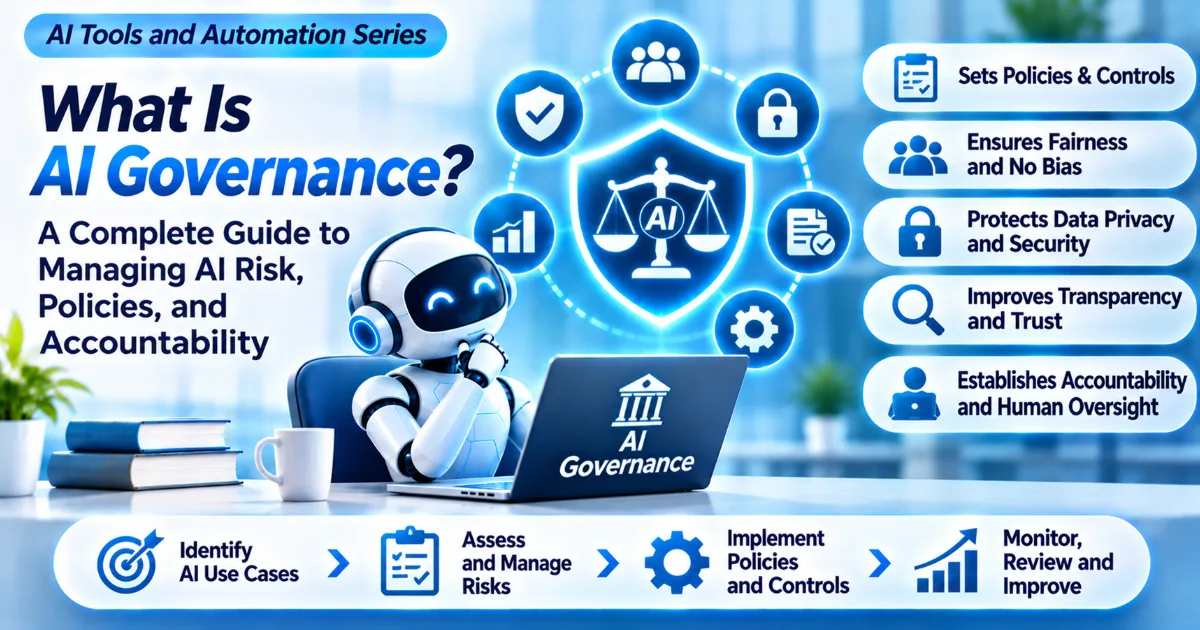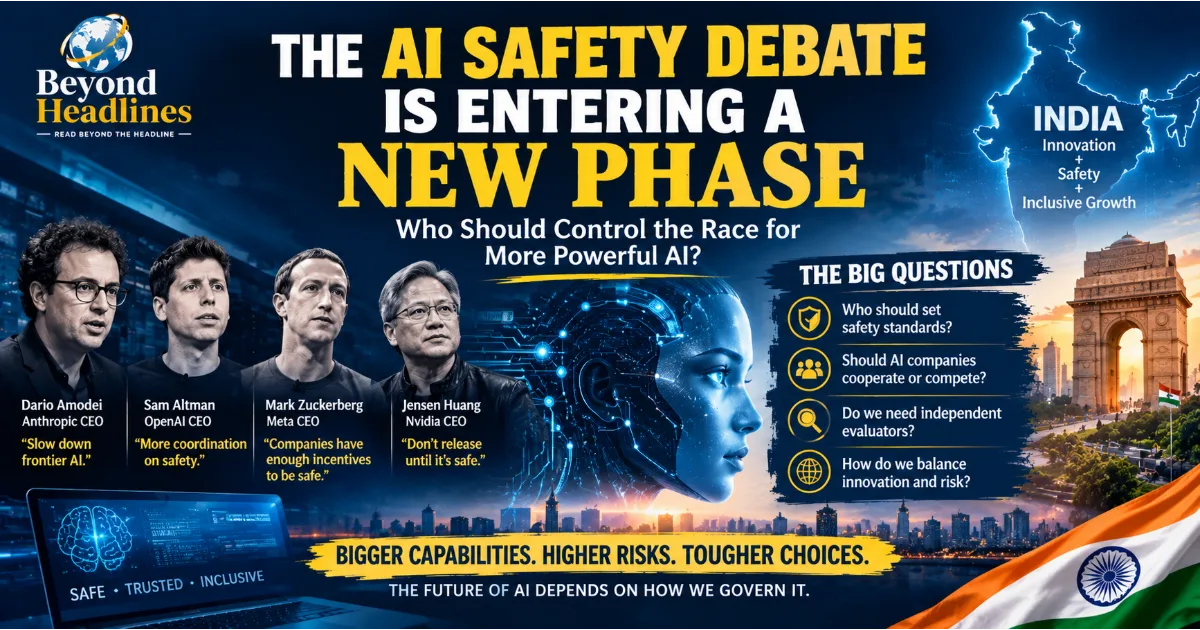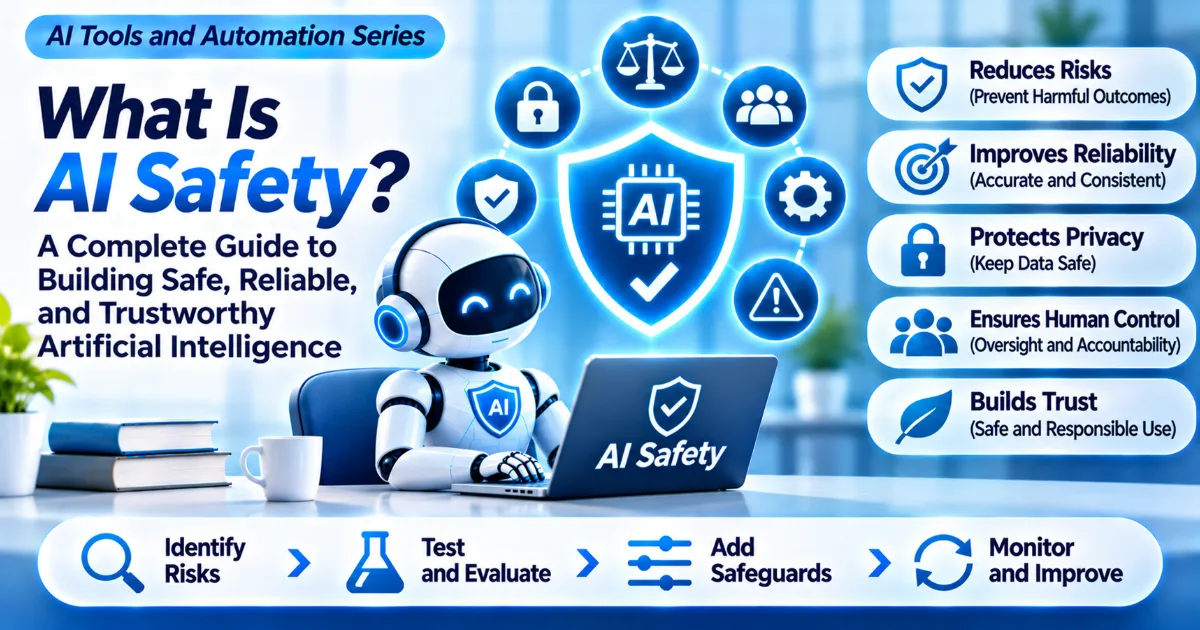
Artificial intelligence is becoming an essential part of modern business, technology, education, healthcare, finance, manufacturing, and public services. Organisations are using AI to automate repetitive activities, analyse large volumes of information, improve customer experiences, support decision-making, and develop new products. Generative AI and autonomous AI agents are expanding these possibilities by enabling systems to create content, interact with software, retrieve information, and execute multi-step tasks.
However, adopting artificial intelligence also introduces risks that organisations must understand before relying on it. An AI model may generate inaccurate information, expose confidential data, produce biased recommendations, or make an inappropriate prediction. An automated agent may execute an action without sufficient approval. A third-party AI service may introduce privacy or security concerns. Even a system that performs well during testing may behave differently when it encounters unfamiliar information or real-world operating conditions.
These challenges make AI risk management an important part of responsible artificial intelligence adoption.
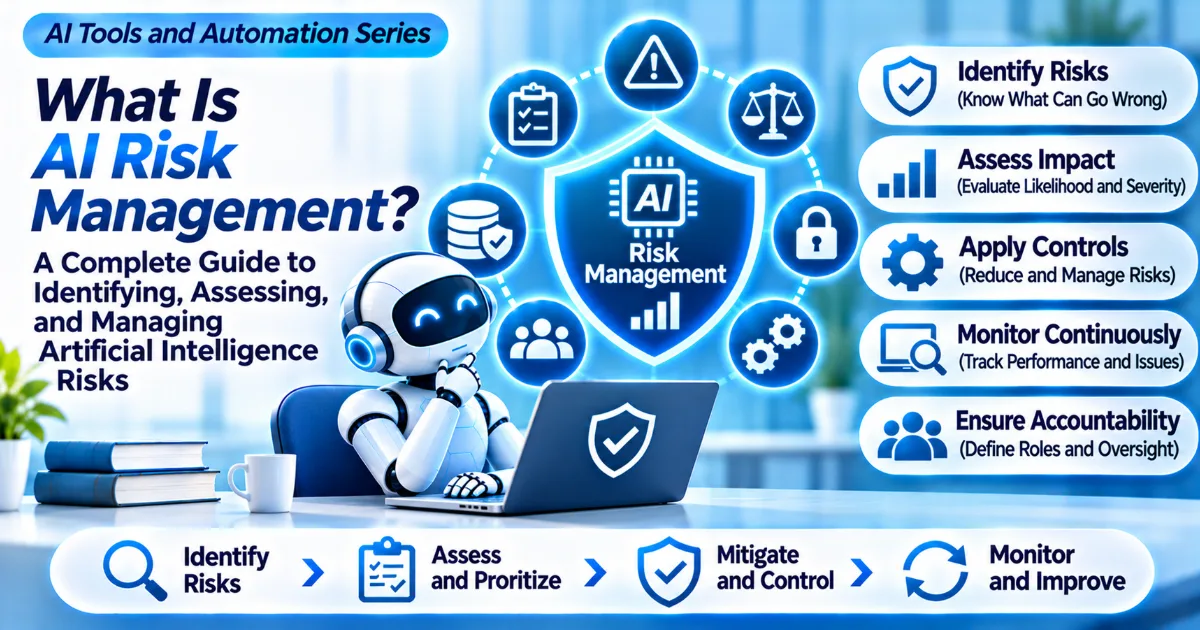
AI risk management is the structured process of identifying, analysing, evaluating, treating, and monitoring risks associated with AI systems throughout their lifecycle. It helps organisations understand what could go wrong, how serious the consequences might be, which safeguards are necessary, and who is responsible for managing potential problems.
AI risk management is not limited to preventing cyberattacks or improving model accuracy. It also considers privacy, fairness, legal obligations, operational reliability, human oversight, transparency, financial exposure, reputational consequences, and the impact of AI decisions on individuals and society.
Continue Reading
For example, a company introducing an AI recruitment tool must consider whether the system evaluates applicants fairly, protects personal information, produces reliable recommendations, and allows human decision-makers to review its results. A business using an AI customer support agent must consider whether the agent can access confidential records, provide incorrect policy information, or perform unauthorised actions.
In this article, we will explore what AI risk management means, why it matters, the different categories of AI risks, how organisations can assess and prioritise them, and how to build a practical AI risk management framework.
What Is AI Risk Management?
AI risk management is the systematic approach used to identify, assess, control, and monitor potential negative outcomes associated with artificial intelligence systems.
It involves understanding the technology, its intended purpose, the people affected by it, the information it processes, the decisions it influences, and the consequences of system failure or misuse.
The objective is not necessarily to eliminate every possible risk. That may be impossible, particularly for complex AI systems operating in changing environments. Instead, the objective is to understand risks, reduce them to acceptable levels, establish appropriate safeguards, and ensure that organisations can respond effectively when problems occur.
Consider a business that uses an AI-powered financial forecasting application. The application analyses historical sales, expenses, market information, and other business data to predict future performance.
Several risks may arise. The data may be incomplete, the model may fail to recognise a major market change, the application may expose confidential financial information, or managers may treat its predictions as guaranteed outcomes.
An effective risk management process identifies these possibilities before they create serious problems. It establishes data validation procedures, tests model performance, restricts access to financial records, communicates uncertainty, and ensures that important financial decisions receive human review.
AI risk management therefore connects technical safeguards with business responsibilities and organisational decision-making.
Why Is AI Risk Management Important?
Artificial intelligence can create significant benefits, but those benefits must be balanced against the consequences of errors, misuse, and unexpected behaviour.
Preventing Harm to Individuals
AI systems can influence decisions involving employment, education, healthcare, financial services, insurance, and access to public services.
An inaccurate or biased system may affect someone's opportunities, privacy, finances, or well-being.
Risk management helps organisations identify these potential consequences and introduce appropriate safeguards before deploying AI in sensitive situations.
Protecting Business Information
AI applications frequently process confidential documents, customer records, source code, internal communications, and financial information.
Without suitable controls, sensitive information may be exposed through insecure integrations, inappropriate access permissions, or careless use of external AI services.
Risk management helps organisations determine which information can be processed, where it can be stored, who can access it, and how it should be protected.
Reducing Operational Disruptions
Businesses may depend on AI systems for customer service, inventory planning, fraud detection, document processing, software development, and other important operations.
If these systems become unavailable or produce unreliable results, normal business activities may be disrupted.
Organisations need contingency plans, monitoring procedures, alternative workflows, and recovery arrangements.
Managing Financial Exposure
AI failures can create direct and indirect financial costs.
These may include incorrect transactions, fraud, regulatory penalties, legal disputes, service interruptions, customer compensation, and the expense of investigating security incidents.
Risk management helps organisations identify financial exposure and decide whether the expected benefits of an AI application justify its potential costs.
Supporting Legal and Regulatory Compliance
AI applications may be subject to privacy laws, consumer protection requirements, employment regulations, cybersecurity obligations, and sector-specific rules.
Requirements differ according to the country, industry, application, and type of information being processed.
A structured risk management process helps organisations identify applicable obligations and establish evidence that appropriate controls are in place.
Building Trust
Customers, employees, partners, and regulators need confidence that organisations are using AI responsibly.
A business that understands its AI risks, communicates limitations, protects information, and provides meaningful human oversight is better positioned to establish trust.
Supporting Responsible Innovation
Risk management should not be viewed only as a restriction on AI adoption.
It helps organisations understand which applications can be deployed safely, which require additional safeguards, and which should not be introduced under current conditions.
This makes it possible to pursue innovation with a clearer understanding of its consequences.
What Are the Main Categories of AI Risk?
AI risk is not a single problem. It includes several categories that may overlap and influence one another.
Accuracy and Reliability Risks
Accuracy risk occurs when an AI system produces incorrect, incomplete, or misleading results.
For example, an AI assistant may provide an incorrect explanation of a company's refund policy, while a forecasting model may underestimate demand because its historical data does not represent current market conditions.
Reliability risk also includes inconsistent behaviour, unexpected system failures, and poor performance when inputs differ from those used during testing.
Organisations should define performance requirements, evaluate systems using representative data, monitor output quality, and establish procedures for handling errors.
Bias and Fairness Risks
AI systems can reproduce or amplify unfair patterns present in training data, historical decisions, or system design.
For example, an AI recruitment model trained on historical hiring records may learn patterns that disadvantage certain applicants.
Bias can also arise when training datasets do not adequately represent the people who will use or be affected by a system.
Risk management should examine whether the data and evaluation methods are suitable, test outcomes across relevant groups, and provide processes for reviewing potentially unfair decisions.
Privacy Risks
Privacy risk occurs when AI systems collect, process, retain, or disclose personal information in inappropriate ways.
An AI application may process customer names, addresses, medical information, financial details, or employee records.
Problems can arise when organisations collect more information than necessary, share data with unauthorised services, retain it for excessive periods, or fail to enforce access restrictions.
Privacy risk management includes data minimisation, appropriate consent and legal bases where required, access controls, retention policies, and secure processing.
Cybersecurity Risks
AI systems can be targeted through traditional cyberattacks as well as attacks that exploit machine learning and generative AI behaviour.
Threats may include prompt injection, training data poisoning, model extraction, adversarial inputs, insecure APIs, and compromised dependencies.
Organisations should assess the security of models, infrastructure, datasets, integrations, and connected tools.
Ethical and Social Risks
AI systems may create consequences that go beyond technical performance.
For example, automated content moderation may restrict legitimate speech, workplace monitoring may affect employee privacy, and AI-generated media may contribute to misinformation.
Ethical risk management considers human rights, dignity, inclusion, accessibility, transparency, and broader social consequences.
Operational Risks
Operational risk arises when an AI system fails to perform reliably within the organisation's actual business environment.
A system may become unavailable, produce unexpected outputs after an update, depend on an unreliable external service, or fail to integrate correctly with existing software.
Organisations should establish operational monitoring, backup arrangements, maintenance procedures, and clear responsibilities.
Legal and Regulatory Risks
AI applications may create legal exposure if they violate applicable privacy, consumer protection, intellectual property, employment, or industry requirements.
For example, a company using AI-generated content may need to consider ownership and licensing questions. A business using automated decision-making may need to understand applicable transparency and review obligations.
Legal risks should be assessed according to the relevant jurisdiction and intended use.
Reputational Risks
An AI-related incident can damage public confidence even when the direct financial impact is limited.
Examples include publishing fabricated information, exposing customer records, producing discriminatory recommendations, or deploying an AI assistant that communicates inappropriately.
Organisations should consider how stakeholders may perceive AI failures and prepare clear communication and incident response procedures.
Third-Party and Supply Chain Risks
Many organisations rely on external AI providers, model marketplaces, cloud platforms, datasets, plugins, and software libraries.
A weakness in a third-party component can affect the organisation's own application.
Risk management should examine provider reliability, security practices, data handling, service availability, contractual responsibilities, and dependency management.
Autonomy and Control Risks
AI agents can perform actions through connected tools and applications.
An agent may send messages, update records, access files, or initiate workflows.
If it receives excessive permissions or misunderstands an instruction, it may cause consequences that are difficult to reverse.
Organisations should restrict agent capabilities, validate actions, maintain logs, and require human approval for sensitive operations.
Understanding the AI Risk Management Lifecycle
AI risk management should be a continuous process rather than a one-time assessment.
A system may become riskier when its model changes, new data sources are added, additional tools are connected, or its intended purpose expands.
A practical lifecycle includes the following stages.
1. Establish the Context
The first step is understanding why the AI system is being introduced and how it will operate.
Organisations should document the intended purpose, users, affected individuals, data sources, business processes, technical architecture, and expected benefits.
They should also identify the decisions the system may influence and the actions it can perform.
For example, an AI assistant designed to summarise internal documents has a different risk profile from an AI system that automatically approves customer loan applications.
The context determines which risks are relevant and how seriously they should be treated.
2. Identify Potential Risks
Once the system's purpose is clear, identify what could go wrong.
Consider normal operation, unusual circumstances, deliberate misuse, technical failure, human error, and changes in the operating environment.
For an AI customer support system, potential risks might include inaccurate answers, unauthorised access to customer records, prompt injection, inappropriate automated refunds, and service interruptions.
Risk identification should involve people with different perspectives, including developers, security specialists, business owners, legal teams, operational employees, and representatives familiar with affected users.
3. Analyse the Risks
Risk analysis examines the likelihood of an incident, its potential consequences, the systems involved, and the effectiveness of existing controls.
For example, a company may identify that an AI assistant can access confidential employee documents.
The assessment should examine how likely unauthorised access is, how many records could be exposed, how sensitive the information is, and whether current permissions are adequate.
Risk analysis should consider both the probability of an event and the severity of its consequences.
4. Evaluate and Prioritise Risks
Not every identified risk requires the same level of attention.
Organisations should compare risks against their defined acceptance criteria and prioritise those that could cause serious harm.
For example, a minor formatting error in an internal brainstorming tool may have limited consequences. An incorrect recommendation from a system influencing medical treatment may have much greater consequences.
Prioritisation helps organisations allocate resources to the most important problems.
5. Treat the Risks
Risk treatment involves selecting and implementing measures to reduce, transfer, avoid, or consciously accept identified risks.
For example, an organisation may reduce data exposure by introducing role-based access controls. It may reduce inaccurate outputs by connecting the system to approved knowledge sources and requiring verification.
In some cases, an organisation may decide not to deploy an AI application because the risks cannot be reduced to an acceptable level.
6. Monitor and Review
AI risk management continues after deployment.
Organisations should monitor model behaviour, security events, user complaints, system changes, and the effectiveness of safeguards.
They should also reassess risks when the model is updated, new integrations are introduced, or the application begins supporting additional activities.
7. Document and Communicate
Risk assessments, decisions, controls, approvals, and incidents should be documented.
Documentation helps establish accountability, support audits, explain decisions, and preserve knowledge when employees or suppliers change.
Relevant stakeholders should understand the system's limitations, responsibilities, and procedures for reporting problems.
How to Assess AI Risks
Risk assessment provides a structured way to understand and prioritise potential problems.
A basic risk assessment can examine several important dimensions.
Probability of Occurrence
Probability describes how likely a particular risk is to occur.
An organisation may use categories such as rare, unlikely, possible, likely, and almost certain.
For example, if an AI application is publicly accessible and accepts unrestricted file uploads, malicious input attempts may be considered more likely than in a tightly controlled internal application.
Probability estimates should be based on available evidence, operational experience, threat intelligence, and system design rather than unsupported assumptions.
Severity of Impact
Severity measures the consequences if an incident occurs.
Possible categories include minor, moderate, major, and critical.
A temporary inconvenience caused by a formatting problem may have low impact. Exposure of sensitive customer information or an incorrect high-impact decision may have much greater consequences.
Exposure
Exposure considers how many people, systems, records, or business processes could be affected.
A problem affecting a single internal report may be less extensive than one affecting a public-facing AI service used by thousands of customers.
Existing Controls
The assessment should examine which safeguards already exist.
These may include access controls, data encryption, output verification, human review, monitoring, and incident response procedures.
Controls should be evaluated for their actual effectiveness rather than simply listed in a policy document.
Residual Risk
Residual risk is the level of risk that remains after controls have been implemented.
For example, restricting access to an AI application may reduce the possibility of data exposure, but it may not eliminate the risk entirely.
Organisations should document residual risks and determine whether they are acceptable.
Understanding an AI Risk Matrix
A risk matrix is a practical tool for comparing risks according to their likelihood and potential impact.
It helps decision-makers identify which problems require immediate attention and which can be managed through ordinary operational controls.
The following is a simplified example.
Likelihood | Low impact | Medium impact | High impact |
|---|---|---|---|
Unlikely | Low | Low | Medium |
Possible | Low | Medium | High |
Likely | Medium | High | Critical |
Suppose a business identifies three risks in its AI customer support application.
The first is occasional incorrect formatting in generated responses. This may be possible but have low impact.
The second is the possibility that the assistant provides incorrect information about a company policy. This may have medium impact depending on the consequences.
The third is unauthorised access to confidential customer records. If the application has weak access controls and handles sensitive information, this could be a high-impact risk.
The organisation should prioritise its resources accordingly.
A risk matrix is useful for communication, but it should not replace detailed analysis. Two risks with the same rating may require different safeguards, and low-probability events may still deserve significant attention when their potential consequences are severe.
What Is an AI Risk Management Framework?
An AI risk management framework provides a structured set of principles, processes, and activities that organisations can use to manage AI-related risks consistently.
It helps organisations define responsibilities, identify risks, evaluate systems, implement safeguards, and monitor results.
Several recognised frameworks and standards can support this work.
NIST AI Risk Management Framework
The National Institute of Standards and Technology (NIST) developed the AI Risk Management Framework to help organisations manage risks associated with AI systems.
Its central functions are:
Govern: Establish organisational policies, responsibilities, culture, and accountability for AI risk management.
Map: Understand the context in which an AI system operates, including its intended purpose, stakeholders, and potential impacts.
Measure: Evaluate and analyse AI risks using appropriate testing, assessment, and monitoring methods.
Manage: Prioritise risks and implement actions to reduce, respond to, or otherwise address them.
These functions are designed to work together throughout the AI lifecycle.
The framework can help organisations create a more consistent approach to AI risk management without assuming that every AI application has the same risk profile.
ISO/IEC 42001
ISO/IEC 42001 is an international standard for establishing, implementing, maintaining, and continually improving an AI management system.
It provides an organisational management approach to AI governance and responsible AI practices.
An AI management system can help an organisation define its policies, responsibilities, objectives, operational processes, and continual improvement activities.
It is particularly relevant to organisations seeking a structured management approach rather than relying on isolated technical controls.
ISO/IEC 23894
ISO/IEC 23894 provides guidance on risk management for artificial intelligence.
It helps organisations consider how established risk management principles can be applied to AI-specific characteristics and challenges.
It can support organisations in identifying, analysing, evaluating, and treating AI-related risks.
OECD AI Principles
The Organisation for Economic Co-operation and Development (OECD) has developed principles for trustworthy AI.
These principles emphasise inclusive growth, human-centred values, transparency, robustness, security, safety, and accountability.
They provide a policy-oriented foundation for organisations and governments considering responsible AI development and deployment.
EU AI Act
The European Union's AI Act establishes a regulatory framework for AI based on different categories of risk and associated requirements.
Its obligations depend on the system, its intended use, the organisations involved, and applicable implementation timelines.
Businesses operating in or serving the European market should assess whether their AI activities fall within its scope and seek appropriate legal guidance.
Choosing the Right Framework
Organisations do not necessarily need to adopt every framework or standard.
The appropriate choice depends on the organisation's size, industry, regulatory environment, AI maturity, and intended applications.
Some organisations may use the NIST framework as a practical risk management structure, while others may integrate ISO management standards into existing governance processes.
The important objective is to establish a consistent and evidence-based process that fits the organisation's needs.
AI Risk Management for Generative AI
Generative AI introduces risks that differ from those associated with many traditional software applications.
These systems can generate content that appears convincing even when it is inaccurate, and their behaviour may depend heavily on the instructions and context they receive.
Managing Hallucinations
Generative AI models may produce fabricated facts, references, explanations, and recommendations.
Organisations should identify where accuracy is essential and introduce verification procedures.
For example, AI-generated legal summaries should be reviewed by qualified professionals before being used for important legal decisions.
Retrieval-augmented generation can help provide access to approved information, but it does not guarantee that every generated response will be correct.
Managing Prompt Injection
Prompt injection can manipulate a model through malicious instructions contained in user messages or external content.
Organisations should separate trusted instructions from untrusted information, restrict tool permissions, and validate actions independently.
Systems should not rely solely on model instructions to enforce security boundaries.
Protecting Confidential Information
Employees may accidentally include private information in prompts or upload confidential documents to services that are not approved for such use.
Organisations should establish clear policies about which tools may process sensitive data and provide secure alternatives.
Managing Copyright and Content Risks
AI-generated material may create questions about intellectual property, licensing, originality, and the use of third-party content.
Organisations should review content before publication or commercial use and establish procedures for addressing rights-related concerns.
Controlling Automated Publishing
An AI system that drafts content creates different risks from one that automatically publishes content.
If a system can publish articles, send marketing messages, or respond publicly to customers, organisations should establish approval processes, content policies, and monitoring.
AI Risk Management for Autonomous Agents
Autonomous agents can create additional risks because they may plan and execute multi-step activities.
An agent may access external applications, retrieve information, write files, update databases, or initiate workflows.
The risks depend not only on what the model can generate but also on what the connected application allows it to do.
Define the Agent's Scope
Every agent should have a clearly defined purpose.
An agent responsible for preparing meeting summaries should not automatically be authorised to approve expenses, modify employee records, or send confidential documents.
The organisation should document permitted activities and prohibited actions.
Apply Least-Privilege Access
Agents should receive only the permissions needed for their assigned tasks.
Where possible, use separate credentials and restricted service accounts rather than broad administrative access.
Require Human Approval
High-impact or irreversible actions should require appropriate approval.
Examples include deleting records, transferring money, changing access permissions, issuing refunds, and sending sensitive communications.
Validate Every Important Action
The application should independently verify that an agent's requested action is allowed.
For example, before updating a customer record, the application should check the user's permissions, validate the requested fields, and confirm that the operation follows business rules.
Monitor Agent Behaviour
Organisations should record important agent activities, including tool usage, action requests, approvals, errors, and execution results.
Monitoring can help identify unusual behaviour and provide evidence during incident investigations.
Establish Emergency Controls
An organisation should be able to suspend an agent, revoke its credentials, disable connected tools, or stop a workflow when necessary.
The ability to interrupt an autonomous system is an important part of managing its operational risk.
Building an AI Risk Register
An AI risk register is a document used to record identified risks, their possible consequences, existing safeguards, responsible owners, and planned actions.
It provides a central record that organisations can use to monitor risks over time.
A basic AI risk register may include the following fields.
Field | Purpose |
|---|---|
Risk ID | Unique reference for each identified risk |
AI system | Name of the affected application or model |
Risk description | Explanation of what could go wrong |
Risk category | Privacy, security, accuracy, fairness, operational, or legal |
Likelihood | Estimated probability of occurrence |
Impact | Potential severity of consequences |
Existing controls | Safeguards currently implemented |
Risk owner | Person responsible for managing the risk |
Treatment plan | Actions required to reduce the risk |
Residual risk | Remaining risk after controls |
Review date | Date for reassessment |
For example, a company using an AI-powered internal knowledge assistant may record a risk involving unauthorised retrieval of confidential documents.
Its treatment plan could include document-level access control, permission checks during retrieval, security testing, and monitoring.
The register should be reviewed regularly, particularly when the system changes or new risks are discovered.
Who Is Responsible for AI Risk Management?
AI risk management requires cooperation across an organisation.
It should not be treated as the responsibility of developers alone because AI systems can affect legal obligations, business processes, customers, employees, and organisational reputation.
Senior Leadership
Senior leaders establish the organisation's risk appetite, approve policies, allocate resources, and ensure that AI adoption supports business objectives.
They should also ensure that high-impact AI applications receive appropriate oversight.
AI and Machine Learning Teams
Technical teams are responsible for model development, data quality, evaluation, performance monitoring, and technical safeguards.
They should document system limitations and communicate important risks to decision-makers.
Cybersecurity Teams
Security professionals assess vulnerabilities, protect infrastructure, manage access, monitor threats, and coordinate security incident response.
They should also evaluate AI-specific attack methods.
Legal and Compliance Teams
Legal and compliance professionals help identify applicable laws, regulations, contractual obligations, and documentation requirements.
They can support assessments involving privacy, employment, consumer protection, intellectual property, and sector-specific rules.
Business Owners
Business owners understand how AI systems are used in actual workflows.
They should define operational requirements, identify affected stakeholders, approve appropriate uses, and ensure that employees follow established procedures.
Employees and End Users
Employees who interact with AI systems should understand their limitations and follow organisational policies.
They should report unexpected behaviour, suspicious outputs, privacy concerns, and possible incidents.
External Providers
AI providers and technology suppliers may have responsibilities for model security, infrastructure protection, service reliability, and data handling.
Organisations should clarify these responsibilities through appropriate agreements and supplier assessments.
Common AI Risk Management Mistakes
Even organisations with good intentions can make mistakes when adopting AI.
Treating Risk Assessment as a One-Time Exercise
An AI system can change significantly after deployment.
New data sources, model updates, software integrations, and changes in usage can introduce risks that were not present during the initial assessment.
Risk assessments should therefore be repeated throughout the system lifecycle.
Focusing Only on Cybersecurity
Cybersecurity is important, but AI risk management must also consider accuracy, fairness, privacy, legal compliance, operational reliability, and human impact.
An application may be technically secure while still producing discriminatory or misleading outcomes.
Assuming Human Review Solves Everything
Adding a human approval step does not automatically make an AI system safe.
Reviewers need sufficient information, relevant expertise, time, and authority to challenge the system's recommendations.
Human oversight should be meaningful rather than merely procedural.
Ignoring Third-Party Risks
Organisations may assume that an external AI provider has already handled every security and compliance concern.
However, the organisation remains responsible for understanding how it uses the service and how the service fits into its own systems and obligations.
Measuring Only Model Accuracy
A model may achieve high accuracy on a benchmark but still be unsuitable for a particular business application.
Evaluation should also consider robustness, fairness, privacy, security, usability, and consequences of failure.
Giving AI Systems Excessive Permissions
Developers may connect AI agents to powerful tools for convenience.
This can create serious risks if an agent misunderstands instructions or is manipulated.
Permissions should be restricted according to the task.
Failing to Document Decisions
Without documentation, organisations may struggle to explain why a system was approved, what risks were identified, and which safeguards were implemented.
Good documentation supports accountability and continuous improvement.
A Practical AI Risk Management Example
Consider a medium-sized company planning to introduce an AI assistant for customer support.
The assistant will answer questions about products, retrieve approved policy documents, summarise customer conversations, and create support tickets.
The organisation begins by defining the system's purpose and identifying its users.
It then maps the information sources, including product documentation, customer support records, and the ticketing platform.
During risk identification, the team identifies several concerns.
The assistant may provide inaccurate information about company policies. It may retrieve a document that a particular employee should not access. A malicious customer may attempt prompt injection. The system may expose personal information through generated responses. It may also create duplicate support tickets.
The organisation evaluates these risks according to their likelihood and impact.
It introduces approved knowledge sources, document-level access controls, restricted API permissions, output validation, and monitoring.
The assistant is initially deployed to a limited group of employees. Its responses are reviewed, and users can report incorrect information.
Sensitive actions remain under human control. The assistant can draft or prepare certain actions, but it cannot independently issue refunds or modify payment details.
After deployment, the organisation monitors response quality, access patterns, user feedback, and operational incidents.
When the company later introduces a new model or connects an additional customer database, it reassesses the risks.
This example demonstrates that effective AI risk management is a continuous combination of technical safeguards, organisational decisions, and operational monitoring.
Measuring the Effectiveness of AI Risk Management
Organisations need ways to determine whether their risk management activities are actually working.
Possible indicators include:
Model reliability: Measures whether the AI system meets defined accuracy and performance requirements.
Security incidents: Tracks security events involving AI models, data, APIs, infrastructure, and integrations.
Data protection incidents: Measures privacy violations, unauthorised access, and accidental exposure of sensitive information.
Human intervention rate: Tracks how often human reviewers need to correct, reject, or override AI-generated recommendations.
Bias and fairness results: Evaluates whether the system produces unacceptable differences in outcomes across relevant groups.
Policy violations: Measures how frequently the AI system produces outputs or performs actions that violate organisational requirements.
Time to detect incidents: Measures how quickly unusual behaviour or security incidents are identified.
Time to resolve incidents: Tracks how quickly the organisation contains and resolves identified problems.
Risk treatment completion: Measures whether planned safeguards are implemented and reviewed.
Stakeholder feedback: Captures the experiences of employees, customers, and other affected users.
Metrics should be selected according to the system's purpose and risk profile. A single score cannot represent every dimension of AI risk.
Organisations should also avoid treating improvements in one metric as proof that the entire system is safe.
How Small Businesses and Startups Can Start Managing AI Risks
AI risk management does not need to begin with an expensive enterprise programme.
Small businesses and startups can establish a practical foundation by taking several steps.
First, create an inventory of the AI tools and applications used by the organisation. Include public AI services, internally developed applications, automated agents, and third-party integrations.
Second, identify what information each system processes. Determine whether it handles customer records, financial data, employee information, confidential documents, or source code.
Third, define acceptable and unacceptable uses. Employees should understand which tools are approved and what information they must not share.
Fourth, introduce basic access controls. Use individual accounts, strong authentication, restricted permissions, and secure credential storage.
Fifth, evaluate important outputs. AI-generated business information, customer communications, and operational recommendations should receive appropriate review.
Sixth, document important risks and assign responsibility. Even a simple spreadsheet can serve as an initial risk register.
Seventh, establish a reporting process. Employees should know how to report suspicious outputs, data exposure, security concerns, or unexpected automated actions.
Finally, review the programme as the organisation grows. New AI tools and integrations should be assessed before they become part of critical workflows.
Starting with clear responsibilities and basic safeguards is more effective than adopting AI without understanding its risks.
The Future of AI Risk Management
AI technology is developing rapidly, and risk management practices will need to evolve alongside it.
Several developments are likely to shape the future of this field.
Continuous AI Risk Monitoring
Traditional assessments often take place at specific points in a project. As AI systems become more dynamic, organisations will increasingly need continuous monitoring.
Automated systems may help identify changes in model performance, unusual behaviour, unexpected access patterns, and emerging operational problems.
Greater Attention to Autonomous Systems
AI agents will increasingly interact with business applications and external services.
Organisations will need stronger methods for evaluating agent permissions, validating actions, monitoring decisions, and maintaining human control.
More Integrated AI Governance
AI risk management will increasingly become part of broader enterprise risk management, cybersecurity, privacy, compliance, and business continuity programmes.
This will help organisations avoid treating AI as an isolated technology concern.
Improved Model Evaluation
Evaluation methods will expand beyond basic accuracy and benchmark performance.
Organisations will need to assess robustness, fairness, privacy, security, reliability, and behaviour under unusual conditions.
Stronger Third-Party Assessments
As businesses depend on external AI providers, supplier assessments will become more important.
Organisations will want clearer information about model development, data handling, security controls, service availability, and incident responsibilities.
Increased Focus on AI Impact Assessments
Organisations will need better methods for understanding how AI systems affect individuals and society.
This may involve examining human rights, accessibility, fairness, environmental considerations, and the distribution of benefits and risks.
Risk Management as a Business Capability
AI risk management will become an ongoing organisational capability rather than a task performed only by compliance teams.
Businesses that integrate risk management into product development and operational decision-making will be better positioned to adopt AI responsibly.
Conclusion: Better AI Adoption Begins With Understanding Risk
Artificial intelligence offers significant opportunities to improve productivity, support decision-making, automate workflows, and develop innovative products and services. However, its benefits cannot be separated from the responsibilities involved in deploying it.
AI risk management provides a structured approach to understanding these responsibilities. It helps organisations identify possible failures, evaluate their consequences, prioritise important risks, implement appropriate safeguards, and monitor systems throughout their lifecycle.
The process must consider more than model accuracy. Privacy, security, fairness, transparency, legal compliance, operational reliability, human oversight, and third-party dependencies all contribute to the overall risk profile of an AI application.
For developers, this means considering risk during architecture, data preparation, model evaluation, and deployment. For businesses, it means establishing policies, assigning ownership, reviewing suppliers, and ensuring that employees understand how to use AI responsibly. For leadership teams, it means making informed decisions about where AI should be adopted, what safeguards are required, and when a system should not be used.
Risk management should not prevent useful innovation. It should make innovation more informed, controlled, and sustainable.
As AI systems become increasingly capable and integrated into everyday activities, organisations will need to demonstrate not only what their AI systems can accomplish but also how they understand, manage, and remain accountable for the risks involved.
The future of responsible AI belongs to organisations that combine technological ambition with thoughtful risk management.
Join the Discussion
What do you think is the most difficult AI risk for organisations to manage today: privacy, cybersecurity, bias, inaccurate outputs, regulatory compliance, or autonomous AI agents?
Should every business conduct an AI risk assessment before introducing AI into important workflows? Which framework or practical safeguard do you think should be the starting point for small businesses?
Share your thoughts, questions, and experiences with others interested in artificial intelligence, automation, and responsible technology.
#AIRiskManagement #ArtificialIntelligence #AIGovernance #ResponsibleAI #EnterpriseAI