Artificial intelligence is becoming an important part of how businesses operate, governments deliver services, educational institutions support learning, and individuals complete everyday tasks. AI systems can analyse large volumes of information, generate content, recommend decisions, automate workflows, identify patterns, and interact with customers. As these capabilities become more powerful, organisations must think beyond what AI can accomplish and consider how it should be developed, deployed, monitored, and controlled.
This is where AI governance becomes essential. AI governance provides the policies, processes, responsibilities, standards, and oversight mechanisms that help ensure artificial intelligence is used responsibly and effectively. It helps organisations manage risks such as inaccurate outputs, discrimination, privacy violations, security vulnerabilities, lack of transparency, and excessive dependence on automated decisions.
Imagine a company introducing an AI system to screen job applications. The system may save recruiters time by analysing thousands of applications, identifying relevant qualifications, and ranking candidates. However, what happens if the system unfairly disadvantages applicants from particular backgrounds? Who checks whether its recommendations are accurate? Can candidates challenge decisions? What information is being collected and stored? Who is responsible when the system makes a harmful recommendation?
These are not simply technical questions. They involve organisational responsibility, legal compliance, ethics, human rights, security, and business accountability. AI governance provides a structured approach to answering them.
In this guide, we will explore what AI governance means, why it matters, how it works, which principles organisations should follow, what frameworks can support implementation, and how businesses can establish practical governance systems for artificial intelligence.
Continue Reading
What Is AI Governance?
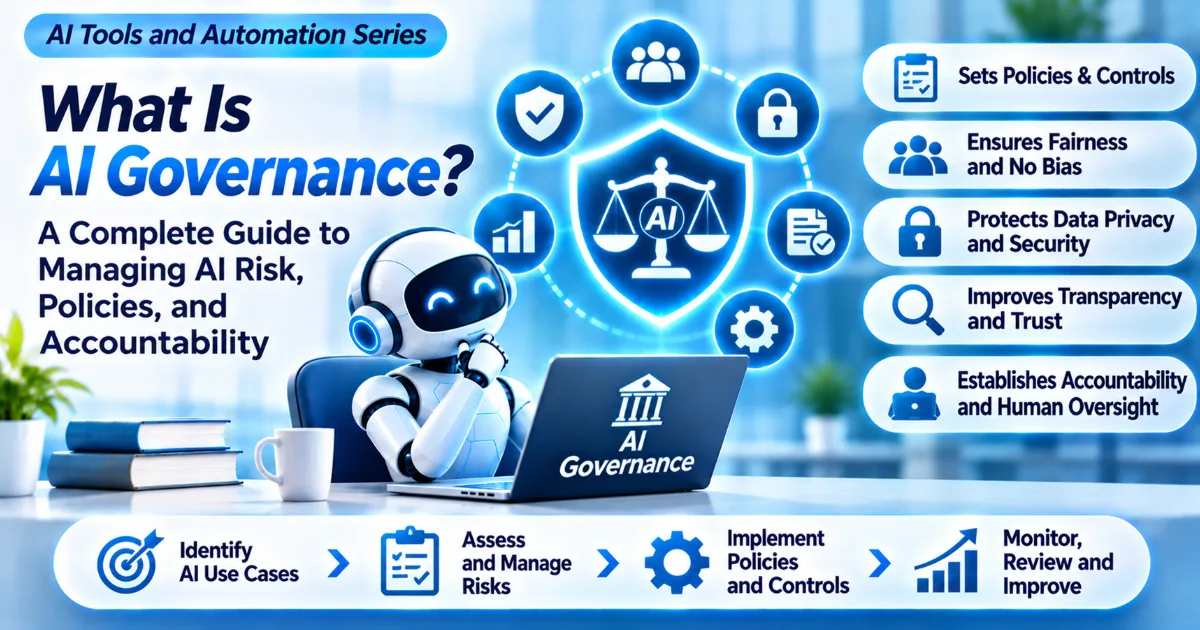
AI governance refers to the collection of policies, procedures, standards, roles, controls, and monitoring practices used to manage artificial intelligence throughout its lifecycle. Its purpose is to ensure that AI systems are developed, purchased, deployed, and operated in ways that are safe, responsible, transparent, fair, secure, and aligned with applicable laws and organisational objectives.
AI governance is not limited to software developers or technical teams. It involves leadership, legal departments, compliance professionals, data scientists, cybersecurity specialists, product managers, employees, and other stakeholders who influence how AI is used.
A governance system defines what an organisation permits AI to do, which activities require human approval, what information AI systems can access, how outputs should be verified, and who is accountable for decisions.
For example, a company may allow employees to use AI tools to draft internal documents but prohibit them from uploading confidential customer information into unapproved public AI services. Similarly, an organisation may permit AI to recommend loan applications for further review but require authorised employees to make final lending decisions.
AI governance therefore establishes boundaries around AI usage while allowing organisations to benefit from innovation.
Why Is AI Governance Important?
Artificial intelligence can produce significant benefits, but its impact depends on how it is designed and used. Without appropriate governance, organisations may introduce systems that create legal, financial, operational, ethical, and reputational problems.
Preventing Unfair and Discriminatory Decisions
AI systems learn patterns from data. If their training data contains historical inequalities or incomplete representations of certain groups, the systems may reproduce those patterns in their outputs.
Consider an AI recruitment tool trained on historical hiring records. If the organisation historically selected candidates from a narrow group of educational institutions, the system may learn to favour similar candidates even when applicants from other institutions have equally relevant skills.
AI governance requires organisations to examine training data, evaluate model behaviour, test outcomes across different groups, and establish procedures for addressing unfair results.
Protecting Personal and Confidential Information
AI systems may process personal information, financial records, medical data, business documents, customer conversations, and other sensitive information.
If employees upload confidential information to an unapproved AI tool, the organisation may lose control over how that information is processed or retained.
Governance policies establish which AI tools are approved, what information can be shared, how data should be protected, and who is authorised to access particular systems.
Improving Accuracy and Reliability
AI-generated answers can be incorrect, incomplete, outdated, or misleading. Even systems that perform well in testing may produce unexpected results when users provide unusual inputs or when operating conditions change.
Governance introduces testing, verification, performance monitoring, and escalation procedures. These practices help organisations identify unreliable outputs before they create serious consequences.
Establishing Accountability
When an AI system produces a harmful result, organisations must be able to identify who is responsible for the system, who approved its deployment, who monitors it, and who can intervene.
Without clearly assigned responsibilities, AI-related incidents can become difficult to investigate and resolve.
AI governance establishes ownership at different stages, from initial approval to ongoing operation.
Supporting Legal and Regulatory Compliance
Governments and regulatory authorities are developing rules that address AI safety, data protection, transparency, discrimination, and accountability.
Organisations operating across different countries may need to consider multiple legal requirements.
AI governance helps businesses identify applicable obligations, maintain documentation, assess risks, and establish controls that support compliance.
Building Customer and Employee Trust
People are more likely to accept AI systems when they understand how those systems are being used and know that appropriate safeguards exist.
For example, a customer may be more comfortable interacting with an AI-powered support assistant if the organisation clearly explains when AI is involved and provides an option to contact a human representative.
Trust is not created simply by announcing that a company uses responsible AI. It must be supported by consistent practices, transparent communication, and effective accountability.
What Are the Main Principles of AI Governance?
An effective AI governance framework is built around several interconnected principles. Organisations may describe these principles differently, but the underlying objectives are broadly similar.
Transparency
Transparency means providing appropriate information about how an AI system is used, what it is designed to accomplish, and what limitations it has.
Transparency does not necessarily mean publishing every technical detail or exposing confidential intellectual property. Instead, it means ensuring that relevant stakeholders receive enough information to understand the system's role and implications.
For example, an organisation using AI to generate customer support responses should establish whether customers need to be informed that they are interacting with an automated system.
Accountability
Accountability means assigning clear responsibility for AI-related decisions, risks, and outcomes.
An organisation should know who owns each AI system, who approves its use, who reviews its performance, and who responds when something goes wrong.
Accountability also requires maintaining records of important decisions, assessments, approvals, and changes.
Fairness and Non-Discrimination
AI systems should be evaluated to identify unfair treatment or disproportionate negative impacts on individuals and groups.
This requires more than checking whether the training dataset appears balanced. Organisations should examine actual system outcomes, investigate potential sources of bias, and determine whether the system is appropriate for its intended purpose.
Fairness may involve different evaluation methods depending on the application and the people affected.
Privacy and Data Protection
AI governance must address how personal information is collected, processed, stored, shared, and deleted.
Organisations should collect only information necessary for a legitimate purpose, restrict access, apply appropriate security controls, and follow relevant data protection requirements.
Privacy should be considered during system design rather than added only after deployment.
Safety and Reliability
AI systems should operate within clearly defined limits and be tested under realistic conditions.
Safety measures may include accuracy testing, security assessments, human review, output restrictions, fallback procedures, and incident response plans.
A system used for entertainment may require a different level of assurance from one that influences medical treatment or financial decisions.
Human Oversight
Human oversight ensures that people retain meaningful authority over AI systems when the consequences of errors or automated decisions could be significant.
This may involve requiring human approval, allowing users to challenge decisions, or providing employees with the ability to stop an automated process.
Human oversight should be practical. A person who is expected to approve hundreds of complex AI decisions without enough time or information may not provide meaningful supervision.
Security
AI systems can introduce new cybersecurity risks. Attackers may attempt to manipulate inputs, extract sensitive information, exploit connected tools, or interfere with model behaviour.
Governance should therefore include access management, secure development practices, monitoring, vulnerability management, and incident response.
Inclusiveness and Accessibility
AI systems should be designed with different users and abilities in mind.
Organisations should consider language differences, accessibility requirements, varying levels of digital literacy, and the possibility that certain groups may experience different outcomes.
An AI service that works well only for a narrow group of users may fail to deliver its intended value.
How Does AI Governance Work?
AI governance is not a single approval meeting or policy document. It is an ongoing process that covers the entire lifecycle of an AI system.
A typical governance process includes the following stages.
1. Identifying AI Use Cases
The organisation first identifies where AI is being used or where it is being considered.
This includes internally developed AI applications, third-party AI software, generative AI assistants, automated decision-making tools, and AI features embedded in existing business platforms.
Maintaining an inventory is important because organisations may have more AI systems in operation than leadership realises.
For example, a marketing department may use an AI writing assistant, the finance department may use automated forecasting, and the customer support team may use an AI chatbot. All three applications should be included in the organisation's governance process.
2. Classifying AI Systems by Risk
Not every AI application creates the same level of risk.
An AI tool that suggests blog title ideas generally has different implications from a system that influences employment, credit, healthcare, or access to essential services.
Risk classification helps organisations decide how much testing, documentation, monitoring, and human oversight each system requires.
A simple internal classification might include low-risk, moderate-risk, high-risk, and prohibited-use categories. These categories are useful for internal management, but they should not be confused with the legal classifications used by particular regulations.
3. Conducting Risk Assessments
After classification, the organisation evaluates potential risks associated with the system.
Questions may include whether the system processes personal information, whether its outputs could influence important decisions, whether it may produce discriminatory outcomes, whether it is vulnerable to manipulation, and whether users can challenge its recommendations.
The assessment should consider both the probability of harm and the potential severity of its consequences.
4. Establishing Policies and Controls
The organisation then defines the rules governing the AI system.
These rules may cover approved use cases, prohibited activities, data access, user permissions, human approval requirements, output verification, recordkeeping, and incident reporting.
Policies should be practical enough for employees to understand and follow.
5. Testing Before Deployment
AI systems should be tested before they become part of important business processes.
Testing may examine accuracy, reliability, fairness, security, privacy, robustness, and performance under different conditions.
The organisation should also establish acceptable performance thresholds and define what happens when a system fails to meet them.
6. Approving Deployment
Before deployment, authorised stakeholders review whether the system satisfies the organisation's requirements.
Depending on the level of risk, approval may involve technical teams, legal professionals, compliance officers, cybersecurity specialists, business owners, and senior management.
High-impact systems should receive stronger review than ordinary productivity applications.
7. Monitoring After Deployment
AI governance continues after a system is launched.
Models may become less accurate as data changes, new vulnerabilities may appear, and users may discover unexpected ways to interact with the system.
Continuous monitoring helps identify performance changes, security incidents, unusual outputs, and emerging risks.
8. Reviewing and Updating the System
AI systems should be reviewed periodically and whenever significant changes occur.
Changes may include updates to the model, new data sources, additional integrations, expanded user groups, or changes to the system's intended purpose.
An AI application approved for one use case should not automatically be considered suitable for every new use case.
Understanding AI Governance Frameworks
AI governance frameworks provide structured guidance for managing risks and responsibilities. They help organisations move from broad principles to practical policies, assessments, and controls.
Several international frameworks and regulatory approaches are particularly relevant.
NIST AI Risk Management Framework
The NIST AI Risk Management Framework provides guidance for organisations seeking to manage AI-related risks throughout the system lifecycle.
Its central functions are:
Govern: Establish organisational structures, policies, responsibilities, and a culture that supports responsible AI risk management.
Map: Understand the context in which an AI system operates, including its intended purpose, users, affected stakeholders, and potential impacts.
Measure: Analyse and evaluate AI risks through testing, assessment, monitoring, and measurement.
Manage: Prioritise risks and implement appropriate actions to reduce, respond to, or otherwise manage them.
The framework is useful because it connects organisational governance with technical risk assessment. It can be adapted to different industries and organisational sizes.
OECD AI Principles
The OECD AI Principles provide guidance for developing and using trustworthy AI.
They emphasise inclusive growth, sustainable development, human-centred values, fairness, transparency, robustness, security, safety, and accountability.
These principles help governments and organisations think about AI beyond immediate commercial benefits.
They also encourage responsible innovation that considers the broader social and economic impact of artificial intelligence.
UNESCO Recommendation on the Ethics of Artificial Intelligence
The UNESCO Recommendation on the Ethics of Artificial Intelligence addresses the ethical implications of AI across areas such as human rights, dignity, fairness, privacy, environmental sustainability, and social well-being.
It highlights the importance of protecting people and communities while encouraging responsible technological development.
The recommendation is particularly useful for understanding AI governance from a human-centred and global perspective.
ISO/IEC 42001
ISO/IEC 42001 is an international standard that specifies requirements for establishing, implementing, maintaining, and continually improving an AI management system.
It helps organisations create structured processes for AI-related responsibilities, policies, risk management, and continuous improvement.
An organisation can use the standard to build a formal AI management system that fits its operational context.
The European Union AI Act
The European Union AI Act establishes a legal framework for AI based on different categories of risk.
It includes prohibited AI practices, requirements for certain high-risk AI systems, transparency obligations for specified applications, and rules for general-purpose AI models.
The Act has phased implementation dates, so organisations should check which requirements apply to their particular systems and activities.
Businesses that develop, provide, import, distribute, or deploy AI systems in relevant contexts should assess their responsibilities under the regulation.
India's Approach to AI Governance
India's AI policy environment includes initiatives focused on responsible AI, digital public infrastructure, innovation, data protection, and the development of domestic AI capabilities.
The IndiaAI Mission supports the country's AI ecosystem through areas such as computing infrastructure, datasets, innovation, skills, and application development.
India's approach also includes broader digital governance and data protection considerations. Organisations operating in India should assess applicable requirements, including relevant provisions of the Digital Personal Data Protection framework and other laws that apply to their activities.
AI governance in India must balance innovation and accessibility with privacy, safety, accountability, and public trust.
AI Governance vs AI Ethics vs AI Regulation
These three concepts are closely connected, but they are not interchangeable.
AI ethics focuses on the values and principles that should guide the development and use of artificial intelligence. It asks whether an AI application is fair, respectful of human rights, transparent, and socially responsible.
AI governance translates principles and obligations into organisational structures, processes, policies, controls, and accountability mechanisms. It explains how an organisation manages AI in practice.
AI regulation refers to laws and legally enforceable requirements established by governments or authorised regulatory bodies. It defines obligations that relevant organisations must follow.
For example, fairness may be an ethical principle. A company's process for testing AI recruitment outcomes may be part of its governance system. A law prohibiting certain forms of discrimination may establish a legal obligation.
An organisation needs to understand all three. Ethical intentions alone do not guarantee responsible outcomes, internal policies cannot replace legal compliance, and regulatory compliance does not automatically resolve every ethical concern.
What Is an AI Governance Committee?
An AI governance committee is a group responsible for overseeing an organisation's approach to artificial intelligence.
It helps ensure that AI adoption is aligned with business goals, organisational values, risk tolerance, and applicable requirements.
The committee may include representatives from several departments.
Senior leadership provides strategic direction and ensures that AI governance receives sufficient resources.
Technical teams explain system architecture, model performance, data requirements, and technical limitations.
Legal and compliance teams assess regulatory obligations, contractual risks, and relevant legal responsibilities.
Cybersecurity specialists evaluate threats, access controls, vulnerabilities, and incident response requirements.
Business owners explain the purpose of each AI application and remain responsible for its operational use.
Human resources teams may be involved when AI affects recruitment, performance evaluation, employee monitoring, or workforce decisions.
The committee's responsibilities may include reviewing proposed AI applications, approving high-risk use cases, monitoring incidents, maintaining governance policies, and reviewing changes to existing systems.
Smaller organisations do not necessarily need a large committee. They can assign these responsibilities to a designated AI governance owner supported by relevant specialists.
Practical Examples of AI Governance in Different Industries
AI governance becomes easier to understand when examined through real-world business applications.
AI Governance in Healthcare
Healthcare organisations may use AI to analyse medical images, assist with clinical documentation, identify potential health risks, or support treatment planning.
These applications can affect patient safety and privacy.
A healthcare provider should evaluate whether an AI system is appropriate for its intended clinical use, whether it has been properly validated, how patient information is protected, and when a qualified professional must review its output.
An AI-generated recommendation should not automatically replace professional medical judgement.
Governance should also establish procedures for reporting inaccurate outputs and investigating incidents that could affect patient care.
AI Governance in Banking and Financial Services
Banks may use AI for fraud detection, credit assessment, customer support, and financial forecasting.
A credit assessment system could unintentionally produce unfair outcomes if its data or design creates inappropriate disadvantages for particular groups.
Governance should include data quality checks, fairness assessments, security controls, explainability where required, and appropriate human review.
Customers should also have access to applicable complaint and correction procedures.
AI Governance in Recruitment
Recruitment platforms may use AI to organise applications, identify relevant skills, summarise CVs, and assist recruiters.
However, automated candidate ranking can introduce bias or obscure why a candidate was rejected.
Organisations should test recruitment systems for discriminatory outcomes, document how recommendations are used, and ensure that hiring decisions receive appropriate human oversight.
AI should support recruitment professionals rather than become an unquestioned authority over employment opportunities.
AI Governance in Education
Educational institutions may use AI tutors, automated assessment tools, personalised learning systems, and content-generation applications.
Governance should address student privacy, academic integrity, accuracy, accessibility, and age-appropriate use.
For example, an AI system that evaluates student writing should be tested for consistency and should not be treated as the only basis for important academic decisions.
Students and teachers should understand when AI is being used and what limitations it has.
AI Governance in E-Commerce
Online businesses may use AI for product recommendations, customer segmentation, demand forecasting, dynamic pricing, and customer support.
Governance should examine whether personal information is being used appropriately, whether recommendations are misleading, and whether pricing practices create unacceptable outcomes.
It should also establish how AI-generated product descriptions and customer support answers are checked for accuracy.
AI Governance in Software Development
Software companies increasingly use AI coding assistants, automated testing tools, code review systems, and AI agents connected to development environments.
These tools can improve productivity but may also generate insecure code, introduce licensing concerns, expose proprietary information, or make unauthorised changes.
Governance should define which tools developers can use, what source code can be shared, which actions require approval, and how AI-generated code is reviewed before release.
How to Build an AI Governance Framework for Your Business
An organisation does not need to begin with a complicated governance programme. It can develop a practical framework gradually, starting with visibility and clear responsibilities.
Step 1: Create an AI Inventory
Identify all AI systems used across the organisation.
Include approved enterprise software, public AI services, internally developed models, third-party integrations, and AI features embedded in existing tools.
Record the system's owner, purpose, users, data sources, provider, and operational status.
This inventory helps leadership understand the organisation's actual AI exposure.
Step 2: Define Acceptable and Prohibited Uses
Create an AI usage policy that explains what employees can and cannot do.
For example, employees may be permitted to use approved AI tools for brainstorming, summarising non-confidential documents, and improving writing.
The same policy may prohibit uploading confidential customer records into unapproved services or using AI to make certain high-impact decisions without authorised review.
Policies should explain how employees can request approval for new AI applications.
Step 3: Introduce Risk Classification
Develop a simple process for categorising AI systems according to their potential impact.
A low-risk application might generate internal meeting summaries. A higher-risk application might influence employee selection, credit decisions, or access to important services.
Risk classification should determine the level of review, testing, documentation, and monitoring required.
Step 4: Assign Ownership
Every AI application should have an accountable business owner.
Technical ownership and business accountability may be assigned to different people, but their responsibilities should be documented.
Employees should know whom to contact when they identify an issue or want to introduce a new AI tool.
Step 5: Establish Data Protection Requirements
Define rules for the collection, processing, sharing, storage, and deletion of information used by AI systems.
Use access restrictions, encryption where appropriate, secure integrations, and data minimisation.
Review the terms and security practices of third-party AI providers before using them for sensitive business activities.
Step 6: Introduce Testing and Approval Procedures
Create a repeatable process for assessing AI systems before deployment.
The review should consider the intended purpose, data quality, performance, fairness, security, privacy, and foreseeable misuse.
Document the results and obtain approval from the appropriate stakeholders.
Step 7: Train Employees
Employees need to understand both the opportunities and limitations of AI.
Training should explain how to use approved tools, protect confidential information, verify outputs, identify possible bias, and report suspicious behaviour.
Training should be relevant to each department rather than limited to general awareness presentations.
Step 8: Monitor and Review
Establish performance indicators and monitoring procedures for important AI systems.
Review incidents, user complaints, model changes, security issues, and unexpected outputs.
Update policies and controls when business requirements, technology, or applicable regulations change.
Common AI Governance Challenges
Although AI governance offers important benefits, implementing it can be difficult.
Rapidly Changing Technology
AI tools and capabilities evolve quickly. A policy that was appropriate for one generation of tools may not address newer systems that can access files, use external services, or execute actions.
Organisations need regular reviews rather than assuming that governance policies will remain effective indefinitely.
Lack of AI Expertise
Smaller businesses may not have dedicated AI risk professionals, data scientists, or compliance specialists.
They can begin with clear usage rules, approved tools, basic risk classification, and external expertise when necessary.
The important thing is to establish accountability rather than allowing AI usage to develop without oversight.
Balancing Innovation and Control
Excessive restrictions may prevent employees from exploring useful applications. Insufficient controls may expose the organisation to serious risks.
A risk-based approach helps create a reasonable balance. Low-risk activities can receive simpler approval processes, while sensitive or high-impact applications require stronger safeguards.
Shadow AI
Shadow AI refers to the use of AI tools without the knowledge or approval of an organisation's authorised IT, security, or governance teams.
Employees may adopt public AI services because they are convenient or appear more productive.
Organisations should respond by providing accessible approved alternatives, communicating clear policies, and making it easy for employees to request new tools.
Measuring Governance Effectiveness
It can be difficult to measure whether AI governance is working.
Organisations should not evaluate success only by counting policies or training sessions. They should examine whether systems are reliable, incidents are handled effectively, risks are reduced, and employees understand their responsibilities.
Measuring the Success of an AI Governance Programme
A governance programme should have measurable objectives.
Possible indicators include the percentage of AI systems recorded in the inventory, the percentage of high-risk applications assessed before deployment, the number of employees completing AI training, and the time required to investigate AI-related incidents.
Organisations can also monitor the number of unauthorised AI tools discovered, the frequency of privacy or security incidents, model performance changes, and the completion of scheduled reviews.
Qualitative feedback is equally important. Employees, customers, and other affected stakeholders can help identify problems that technical measurements may overlook.
For example, an AI customer support system may achieve a high automated resolution rate but still frustrate customers if they cannot reach a human representative when necessary.
Governance should therefore measure not only system performance but also the quality and consequences of the experience.
The Role of Human Oversight in AI Governance
Human oversight is one of the most important elements of responsible AI management.
AI systems can process information at a scale and speed that humans cannot easily match. However, speed and scale do not guarantee sound judgement.
People must be able to understand when an AI system is operating, recognise when its recommendations may be unreliable, and intervene when necessary.
Meaningful oversight requires access to relevant information, appropriate training, sufficient decision-making authority, and enough time to review important outputs.
For example, if an AI system recommends rejecting a job applicant, a recruiter should have the ability to examine the relevant information and consider whether the recommendation is appropriate.
Simply asking an employee to approve every AI decision without meaningful review does not create effective oversight.
Organisations should also provide channels through which affected individuals can ask questions, challenge decisions, and request human assistance where applicable.
AI Governance and Generative AI
Generative AI introduces additional governance challenges because these systems can create new content rather than simply classify existing information.
Employees may use generative AI to draft reports, write software, create images, summarise documents, generate marketing material, and interact with customers.
However, generated content may contain fabricated information, biased language, confidential data, or copyrighted material that requires careful review.
Organisations should establish rules covering content verification, disclosure, intellectual property, data handling, and permitted use cases.
For example, a marketing team may use generative AI to create an initial product description, but a human editor should verify product specifications and remove unsupported claims before publication.
Similarly, a software development team may use an AI coding assistant, but developers should inspect the generated code, test it, and follow established security and review procedures.
Generative AI governance should also address systems that connect to company databases or external tools. These integrations can expand the potential impact of incorrect instructions, unauthorised access, or unintended actions.
AI Governance for AI Agents and Autonomous Systems
AI agents can perform more complex tasks than ordinary text-generation tools. Depending on their design and permissions, they may search information, interact with applications, update records, execute workflows, or coordinate multiple operations.
This creates a need for stronger operational controls.
An AI agent connected to a customer relationship management system, for example, might retrieve customer information, draft follow-up messages, update records, and schedule tasks.
Governance should define exactly which actions the agent can perform, which data it can access, and which operations require human approval.
High-impact actions such as issuing refunds, changing account permissions, deleting records, or sending sensitive communications may require explicit authorisation.
Organisations should also maintain activity logs, restrict agent permissions, test failure scenarios, and provide a reliable way to stop an agent when unexpected behaviour occurs.
The more authority an AI system receives, the more important it becomes to establish clear limits and accountability.
The Future of AI Governance
AI governance will become increasingly important as artificial intelligence moves from individual productivity tools into business-critical operations and public services.
Several developments are likely to shape its future.
Governance by Design
Organisations will increasingly incorporate governance requirements into the design and development of AI systems.
Instead of waiting until deployment to examine privacy, fairness, or security, teams will consider these requirements from the beginning.
Continuous AI Monitoring
Traditional software governance often focuses on development and release approvals. AI systems may require more continuous evaluation because their performance can change with new data, model updates, and evolving operating conditions.
Monitoring tools and automated testing will play a greater role in identifying problems.
Greater Focus on AI Agents
As AI agents gain access to business applications and operational systems, governance will increasingly focus on permissions, action boundaries, human approvals, audit trails, and control over autonomous behaviour.
More Detailed Regulatory Requirements
Governments and regulatory bodies will continue developing approaches to AI risk, transparency, data protection, and accountability.
Organisations will need to understand how these requirements apply to their roles, systems, markets, and use cases.
AI Governance as a Business Capability
AI governance will increasingly be viewed as part of business management rather than merely a technical compliance activity.
Companies that can demonstrate responsible AI practices may be better positioned to earn customer trust, work with enterprise clients, and adopt AI at scale.
Greater Importance of Independent Evaluation
For certain applications, organisations may increasingly rely on independent assessments, external audits, certification programmes, and specialised testing.
Independent evaluation can provide additional confidence that internal governance controls are working as intended.
Practical AI Governance Checklist for Businesses
Before introducing or expanding an AI application, organisations can use the following questions to evaluate their readiness.
Is the purpose of the AI system clearly documented?
Is the system included in an organisation-wide AI inventory?
Has its potential impact and risk level been assessed?
Is there a clearly identified business owner?
Are data sources and information-sharing practices understood?
Are privacy and security requirements being followed?
Has the system been tested for accuracy and reliability?
Have relevant fairness and bias risks been evaluated?
Are users informed about the system's role and limitations where appropriate?
Is human oversight available for important decisions?
Are employees trained to use the system responsibly?
Are performance and security monitored after deployment?
Is there a process for reporting and investigating incidents?
Can the organisation suspend or disable the system if necessary?
Are significant changes reviewed before they are introduced?
Have applicable legal and regulatory requirements been considered?
This checklist is a starting point rather than a complete compliance assessment. The controls required will depend on the system, its purpose, the people affected, and the laws that apply.
Conclusion: Responsible AI Needs More Than Powerful Technology
Artificial intelligence is changing how organisations work, compete, communicate, and make decisions. Its capabilities create opportunities for productivity, innovation, improved services, and new business models. However, the benefits of AI cannot be separated from the responsibilities that come with using it.
AI governance provides the structure needed to manage those responsibilities. It establishes policies, defines accountability, evaluates risks, protects information, supports fairness, and ensures that appropriate human oversight remains in place.
Effective governance does not mean preventing organisations from adopting AI. It means enabling them to adopt it with a clear understanding of what their systems can do, what they should not do, and what safeguards are necessary.
Businesses do not need to wait until they have hundreds of AI systems before establishing governance. They can begin by identifying the tools they already use, creating practical policies, assigning ownership, training employees, and introducing risk-based reviews.
The most successful organisations will not necessarily be those that adopt AI the fastest. They will be those that learn how to use it responsibly, measure its impact, protect the people affected by it, and maintain accountability as the technology evolves.
AI governance is therefore not simply a compliance requirement or a technical exercise. It is a foundation for building trustworthy, sustainable, and responsible AI-powered organisations.
Join the Discussion
How should businesses balance AI innovation with safety, privacy, fairness, and accountability? Should every organisation have a formal AI governance policy, even if it uses only basic AI tools? What responsibilities should companies retain when they allow AI systems to make recommendations or perform tasks automatically?
Share your thoughts, practical experiences, and questions with others interested in artificial intelligence, technology, and responsible innovation.
#AIGovernance #ResponsibleAI #ArtificialIntelligence #AIRiskManagement #AI Ethics