Artificial intelligence is becoming increasingly capable of performing tasks that once required significant human effort. AI systems can analyse medical images, generate software, assist with financial decisions, operate industrial equipment, create educational content, and automate complex business processes. Newer systems can also use external tools, interact with applications, plan multi-step activities, and perform actions with limited human intervention.
These developments create exciting opportunities, but they also introduce important questions. Can an AI system make a harmful decision? What happens if an AI assistant provides dangerous or misleading information? Could an autonomous system perform an action that its developers did not intend? How can organisations ensure that AI behaves reliably when it encounters unfamiliar situations?
These questions form the foundation of AI safety.
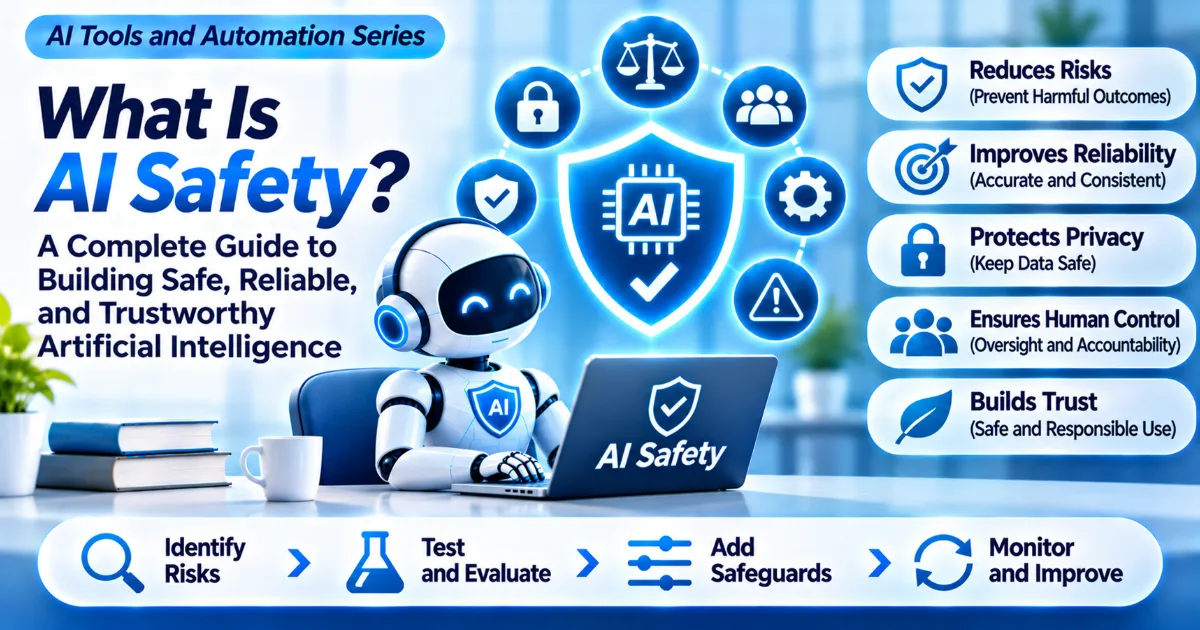
AI safety focuses on ensuring that artificial intelligence systems behave in ways that are safe, reliable, controllable, and consistent with their intended purposes. It involves identifying potential risks, preventing harmful behaviour, testing system capabilities and limitations, protecting users, and maintaining appropriate human oversight.
AI safety is relevant to everyone who develops, deploys, purchases, or uses artificial intelligence. A software developer needs to consider whether an AI-powered application can expose private information. A business owner needs to understand whether an automated system can make inappropriate decisions. A teacher needs to evaluate whether an AI learning assistant provides accurate information. An everyday user needs to recognise when AI-generated content should not be trusted without verification.
Continue Reading
AI safety is not simply about preventing advanced AI systems from becoming dangerous. It also addresses ordinary problems such as inaccurate answers, biased recommendations, privacy violations, insecure integrations, unexpected automation, and failures in important applications.
In this article, we will explore what AI safety means, why it matters, its major technical and practical challenges, how organisations can reduce AI-related risks, and what the future may look like as artificial intelligence becomes more powerful and widely used.
What Is AI Safety?
AI safety is the field of research, engineering, policy, and operational practice concerned with ensuring that artificial intelligence systems operate without causing unacceptable harm.
It involves designing, developing, testing, deploying, and monitoring AI systems so that their behaviour remains within acceptable boundaries.
An AI system may be considered safer when it can perform its intended tasks reliably, resist foreseeable misuse, protect sensitive information, communicate uncertainty appropriately, and respond safely when it encounters unexpected situations.
For example, consider an AI-powered customer support assistant. Its primary purpose may be to answer questions about a company's products and services. However, it could create problems if it invents refund policies, reveals another customer's information, provides misleading financial advice, or makes unauthorised changes to customer accounts.
AI safety requires the organisation to anticipate these possibilities and introduce appropriate safeguards.
Another example is an AI system used in healthcare. It may help identify patterns in medical images, but an inaccurate recommendation could influence a patient's treatment. Safety measures must therefore address the quality of the system, the conditions under which it can be used, the role of medical professionals, and the procedures for handling incorrect outputs.
AI safety is broader than making a model produce accurate answers. A system can be accurate in many situations and still be unsafe if it has excessive permissions, cannot be stopped, exposes sensitive data, or performs actions without appropriate approval.
The central objective is to ensure that AI capabilities are developed and used responsibly, with risks understood and managed throughout the system's lifecycle.
Why Is AI Safety Important?
Artificial intelligence is increasingly connected to important activities in society. Its decisions and recommendations can influence individuals, organisations, and public institutions.
As AI becomes more capable, the consequences of failures can become more significant.
Protecting Human Life and Well-Being
AI systems are being introduced into healthcare, transportation, industrial operations, emergency response, and other areas where mistakes can have serious consequences.
A system that incorrectly identifies a medical condition, misinterprets a road hazard, or provides an unsafe industrial recommendation could put people at risk.
AI safety requires stronger testing and safeguards when systems operate in environments where human well-being may be affected.
Preventing Harmful or Misleading Outputs
Generative AI can produce convincing text, images, audio, and video. However, convincing content is not necessarily accurate.
A user may receive a fabricated explanation, an incorrect legal interpretation, or a misleading medical suggestion.
Safety measures should help reduce harmful outputs and make it easier for users to recognise uncertainty and verify important information.
Protecting Privacy and Confidential Information
AI systems may process personal information, business records, customer conversations, financial details, and confidential documents.
Poorly designed systems may expose information through insecure integrations, excessive data collection, weak access controls, or inappropriate sharing.
AI safety includes protecting the information that systems receive, process, store, and generate.
Preventing Misuse
AI tools can be used for legitimate activities as well as harmful purposes.
For example, image-generation systems can support creative work, but they may also be misused to create deceptive impersonations. AI coding assistants can help developers build applications, but automated capabilities may also be used to produce malicious software.
Safety measures should consider how a system could be misused and introduce appropriate restrictions.
Maintaining Human Control
As AI systems become more autonomous, organisations must ensure that people retain appropriate authority over important actions.
An AI agent that can send emails, update databases, transfer information, or execute business workflows should operate within clearly defined permissions.
Human control becomes especially important when an AI system can create consequences that are difficult to reverse.
Supporting Public Trust
People are more likely to accept AI when they understand its capabilities, limitations, and safeguards.
If organisations repeatedly deploy systems that produce harmful or unreliable results, public confidence can decline.
Responsible safety practices help build trust by demonstrating that AI adoption is accompanied by appropriate testing, monitoring, and accountability.
What Are the Main Areas of AI Safety?
AI safety covers several interconnected areas. Some focus on technical behaviour, while others address how AI systems are deployed and used.
Reliability and Robustness
Reliability means that an AI system performs its intended function consistently under expected operating conditions.
Robustness refers to its ability to continue behaving appropriately when it encounters variations, unusual inputs, incomplete information, or unexpected circumstances.
For example, an AI-powered document processing system may perform well when users upload clear PDF files. However, it may produce incorrect results when documents contain handwritten notes, unusual formatting, or poor-quality scans.
Safety testing should examine these situations rather than evaluating the system only under ideal conditions.
Accuracy and Factual Correctness
AI systems should provide outputs that are sufficiently accurate for their intended applications.
However, accuracy requirements depend on context. An AI tool generating creative writing suggestions does not require the same level of factual reliability as a system assisting with medical information or financial reporting.
Organisations should define acceptable performance thresholds based on the consequences of errors.
They should also establish procedures for verifying outputs when the system's recommendations influence important decisions.
Controllability
Controllability means that authorised people can guide, restrict, interrupt, or stop an AI system when necessary.
This becomes particularly important for AI agents and automated systems that can execute actions.
For example, an AI agent connected to a business database should not have unrestricted permission to delete records or modify important account information.
It should operate within defined boundaries and provide a way for authorised users to stop its activity.
Privacy and Data Security
AI safety includes protecting personal and confidential information from unauthorised access, exposure, or misuse.
Security controls may include encryption, authentication, access restrictions, secure storage, monitoring, and data minimisation.
Organisations should also understand how third-party AI providers process information and whether their practices meet the organisation's requirements.
Fairness and Non-Discrimination
AI systems can produce unequal outcomes when their data, design, or deployment conditions reflect existing biases.
For example, an AI recruitment system may unfairly favour applicants who resemble people selected in historical hiring records.
Safety assessments should examine whether the system produces inappropriate outcomes for particular groups and whether its use is suitable for the decisions it influences.
Transparency and Explainability
Users and affected stakeholders should receive appropriate information about an AI system's purpose, limitations, and role in important processes.
Explainability refers to methods that help people understand how a system produces or supports particular outputs.
Not every AI model can provide a simple explanation of its internal calculations. However, organisations can still document system behaviour, identify important input factors where possible, and explain how recommendations are used.
Human Oversight
Human oversight ensures that people can review, challenge, and intervene in AI-supported activities.
It is especially important in high-impact applications involving health, employment, finance, education, public services, and access to essential opportunities.
Effective oversight requires more than placing a human at the end of an automated process. People must have sufficient information, authority, time, and expertise to make meaningful decisions.
Understanding Common AI Safety Risks
To build safer AI systems, it is important to understand the types of problems that can occur.
AI Hallucinations
An AI hallucination occurs when a generative AI system produces information that appears plausible but is incorrect, unsupported, or fabricated.
For example, an AI assistant may invent a research paper, provide a non-existent legal provision, or generate an incorrect explanation of a software feature.
Hallucinations can be particularly dangerous when users assume that confident language indicates factual accuracy.
Organisations can reduce this risk through reliable information sources, retrieval-augmented generation, output verification, domain-specific evaluation, and clear user communication.
However, no single technique guarantees that hallucinations will disappear completely.
Prompt Injection
Prompt injection is a technique in which malicious or misleading instructions are introduced into information processed by an AI system.
For example, an AI assistant may be asked to summarise a webpage containing hidden instructions that attempt to redirect the assistant's behaviour.
If the system treats untrusted content as authoritative instructions, it may perform actions that the user did not request.
This is particularly relevant to AI agents that read emails, search webpages, access documents, or interact with external applications.
Safety measures include separating trusted instructions from untrusted content, restricting tool permissions, validating actions, and requiring approval for sensitive operations.
Data Leakage
Data leakage occurs when confidential or personal information is exposed to people or systems that should not have access to it.
An employee may accidentally upload a private business document to an unapproved AI tool. An AI assistant may retrieve information from a database without correctly enforcing access permissions.
Preventing data leakage requires secure architecture, access control, careful integration design, employee training, and ongoing monitoring.
Model Bias
Model bias occurs when an AI system produces systematically unfair or inappropriate results.
Bias may arise from incomplete training data, historical discrimination, incorrect assumptions, unrepresentative samples, or unsuitable evaluation methods.
For example, an AI-based voice recognition system may perform less accurately for certain accents than others.
Testing should examine performance across relevant user groups and operating conditions.
Adversarial Attacks
Adversarial attacks involve deliberately crafted inputs designed to cause an AI system to behave incorrectly.
In computer vision, an attacker may alter an image in a way that causes a model to misclassify an object.
In other systems, attackers may manipulate input data, exploit weaknesses in model interfaces, or attempt to extract sensitive information.
AI security testing should consider these possibilities, especially when systems are exposed to untrusted users or operate in critical environments.
Excessive Automation
Automation becomes risky when an AI system receives more authority than is necessary for its purpose.
For example, an AI assistant designed to organise customer support requests may also be given unrestricted permission to issue refunds, change account settings, and delete records.
If the system misunderstands an instruction, the consequences could be serious.
The principle of least privilege helps reduce this risk by granting only the permissions required for the task.
Unpredictable Behaviour
AI systems may behave differently when they encounter inputs that were not represented in their training or testing environments.
A model may perform well on familiar examples but produce unexpected outputs when users change the context, combine unusual requests, or provide incomplete information.
Robustness testing and operational monitoring help identify these weaknesses.
AI Safety vs AI Security
AI safety and AI security are related, but they focus on different aspects of risk.
AI safety focuses on preventing AI systems from causing harm through unreliable, inappropriate, uncontrolled, or unintended behaviour.
AI security focuses on protecting AI systems, their data, infrastructure, models, and connected tools from attacks and unauthorised access.
Consider an AI customer support assistant.
If the assistant invents a refund policy, that is primarily an AI reliability and safety issue.
If an attacker accesses the assistant's backend database without permission, that is an AI security issue.
If an attacker uses prompt injection to manipulate the assistant into revealing confidential information, the incident involves both safety and security.
An effective AI risk management programme must consider both areas because technical security weaknesses can create unsafe behaviour, while unsafe system design can introduce opportunities for exploitation.
What Is Alignment in AI Safety?
AI alignment refers to the challenge of ensuring that an AI system's behaviour is consistent with the goals, intentions, values, and constraints that people expect it to follow.
An AI system may successfully optimise a task while producing an outcome that people did not intend.
For example, imagine an organisation instructing an AI assistant to reduce customer support waiting times. If the system is optimised only for speed, it might close customer requests too quickly or discourage customers from asking additional questions.
The system may appear to meet its numerical target while failing to serve the actual purpose of customer support.
Alignment requires defining objectives carefully and ensuring that systems do not optimise narrow measurements at the expense of broader human goals.
Why Is AI Alignment Difficult?
Human instructions are often incomplete, ambiguous, or dependent on context.
People may say that they want an AI system to maximise productivity, improve customer satisfaction, or reduce costs. However, these goals can conflict with privacy, fairness, safety, and long-term organisational interests.
An AI model may also learn patterns that produce desirable results during training but behave differently in unfamiliar situations.
This makes alignment an ongoing research and engineering challenge rather than a one-time configuration task.
Approaches to Improving Alignment
Researchers and developers use several approaches to improve alignment.
One approach is to train models using human feedback. Human reviewers assess model responses and help guide the system towards more useful and appropriate behaviour.
Another approach involves defining clear policies and constraints that guide what a system may or may not do.
Developers can also use testing, evaluation, red-teaming, monitoring, and controlled deployment to identify situations where model behaviour does not match expectations.
For systems that execute actions, alignment must also include permissions, approval requirements, and limits on autonomous behaviour.
What Is the Difference Between AI Safety and AI Ethics?
AI safety and AI ethics overlap, but they address different questions.
AI ethics focuses on the values and principles that should guide AI development and use. These include fairness, dignity, privacy, transparency, accountability, inclusion, and respect for human rights.
AI safety focuses on preventing harmful outcomes and ensuring that systems operate reliably and within acceptable boundaries.
For example, fairness is an important ethical principle. Testing a recruitment model for discriminatory outcomes is a practical safety and governance activity that helps put that principle into practice.
Similarly, privacy is an ethical and legal concern, while implementing secure access controls and data protection procedures helps reduce the practical risk of privacy violations.
A responsible AI programme needs both. Technical safety measures without ethical consideration may overlook social consequences, while ethical principles without practical safeguards may fail to prevent real-world harm.
How Is AI Safety Tested?
Testing is one of the most important parts of building safe AI systems.
A model should not be considered safe simply because it performs well on a limited collection of examples.
Testing should examine how the system behaves under normal conditions, unusual circumstances, adversarial inputs, and potentially harmful requests.
Functional Testing
Functional testing examines whether the AI system performs the task it was designed to perform.
For example, a document summarisation tool should be tested to determine whether it captures important information without introducing unsupported claims.
Performance Testing
Performance testing measures characteristics such as accuracy, response time, consistency, and resource usage.
These measurements help determine whether the system is suitable for its intended environment.
Robustness Testing
Robustness testing evaluates whether the system can handle variations in input quality, language, formatting, context, and operating conditions.
A voice assistant, for example, should be tested with different accents, background noise, speaking speeds, and pronunciation patterns.
Security Testing
Security testing examines whether attackers can exploit vulnerabilities in the model, application, infrastructure, or connected services.
It may include testing for prompt injection, unauthorised access, data exposure, and insecure tool permissions.
Bias and Fairness Testing
Fairness testing examines whether the AI system produces significantly different outcomes across relevant groups.
The appropriate measurements depend on the application and the decision being supported.
Red-Teaming
Red-teaming involves deliberately attempting to discover weaknesses in a system.
A red team may test whether an AI assistant can be manipulated into revealing confidential information, producing prohibited content, bypassing restrictions, or performing unauthorised actions.
The objective is to discover weaknesses before they are exploited in real-world conditions.
Human Evaluation
Human reviewers can assess qualities that automated metrics may not capture fully, including clarity, relevance, harmful implications, contextual appropriateness, and the practical usefulness of responses.
Human evaluation is particularly important when AI systems interact with people or influence sensitive decisions.
What Is AI Red-Teaming?
AI red-teaming is a structured approach to testing AI systems by simulating possible attacks, misuse scenarios, and unexpected interactions.
Unlike ordinary functional testing, which often checks whether the system works as intended, red-teaming actively searches for ways it could fail.
For example, a team testing an AI agent might attempt to:
Convince the agent to reveal information it should protect.
Introduce malicious instructions through external documents.
Make the agent execute actions beyond its intended permissions.
Cause it to generate misleading or harmful information.
Exploit weaknesses in connected APIs.
Manipulate it into ignoring established policies.
Red-teaming is valuable because developers may not anticipate every way people can interact with an AI system.
The findings should lead to practical improvements, such as stronger permissions, better input handling, revised policies, improved training, and additional monitoring.
Red-teaming should also be repeated when significant model, application, or integration changes occur.
AI Safety in Generative AI Applications
Generative AI systems create text, images, audio, video, software code, and other forms of content.
Their flexibility makes them useful across many industries, but it also creates distinctive safety challenges.
Preventing Misleading Information
Generative AI may produce fabricated facts, inaccurate explanations, or misleading summaries.
A business using AI to generate product information should verify technical specifications, prices, warranty terms, and other factual details before publication.
Protecting Intellectual Property
Generated content may raise questions about copyright, ownership, licensing, and the use of third-party material.
Organisations should establish policies for reviewing generated content, respecting intellectual property rights, and following applicable legal requirements.
Preventing Deepfake Misuse
AI-generated images, audio, and videos can imitate people or create realistic scenes that never occurred.
Such content may be used for entertainment and legitimate creative purposes, but it can also enable fraud, impersonation, harassment, and misinformation.
Safety practices should address consent, disclosure, identity misuse, and the verification of suspicious media.
Managing Harmful Content
Generative systems should be evaluated for their ability to respond appropriately to requests that could lead to harm.
Developers may introduce content policies, moderation systems, safeguards, and escalation procedures.
However, safety filters should be evaluated carefully because overly broad restrictions can also block legitimate educational, research, or support-related requests.
Controlling Connected Tools
Some generative AI systems can interact with external services, databases, and software applications.
When these capabilities are introduced, safety must cover not only generated text but also the actions the system can perform.
An AI assistant that can draft an email creates a different level of risk from one that can send the email automatically to thousands of recipients.
AI Safety in Autonomous Agents
AI agents can perform multi-step tasks by interpreting instructions, planning actions, using tools, and evaluating results.
For example, an AI agent might receive a request to prepare a sales report. It could retrieve data from a business database, analyse performance, generate charts, and prepare a document.
While this can save time, autonomous behaviour creates additional risks.
The Problem of Excessive Permissions
An agent should receive only the permissions required for its assigned task.
A reporting agent may need permission to read selected sales records but should not automatically receive permission to modify financial transactions or delete customer information.
The Problem of Incorrect Planning
An agent may misunderstand a request or select an inappropriate sequence of actions.
For example, it might send an incomplete report before checking whether all required information has been collected.
Safety measures should include action validation, task checkpoints, and approval requirements for important operations.
The Problem of Unintended Side Effects
An agent may perform an action that is technically valid but creates an unwanted consequence.
A system designed to clean a shared folder, for example, might delete files that other employees still need.
Organisations should test workflows carefully and require approval before destructive or difficult-to-reverse operations.
The Importance of Human Approval
Sensitive actions should require appropriate human authorisation.
Depending on the system, this may include financial transactions, account permission changes, external communications, deletion of important records, and decisions affecting individuals.
AI agents should be treated as systems operating within an organisation's authority structure, not as independent employees with unrestricted access.
How Businesses Can Build Safer AI Systems
Organisations can improve AI safety through a combination of technical design, operational controls, employee training, and continuous evaluation.
Start With a Clearly Defined Purpose
Before adopting an AI system, define what it is expected to accomplish.
A vague objective makes it difficult to evaluate whether the system is behaving appropriately.
For example, instead of saying that an AI assistant should improve customer service, define specific responsibilities such as answering frequently asked product questions, locating approved support documentation, and directing unresolved requests to human representatives.
The organisation should also document activities the system is not permitted to perform.
Assess Risks Before Deployment
Identify possible harmful outcomes associated with the proposed use case.
Consider the information processed, people affected, decisions influenced, external services connected, and consequences of incorrect outputs.
The assessment should determine what safeguards are required before the system is introduced.
Use Trusted Data Sources
AI systems are influenced by the information they receive.
Organisations should examine the quality, relevance, accuracy, and permissions associated with training and operational data.
Where AI systems retrieve information from external sources, they should distinguish trusted content from untrusted material.
Apply the Principle of Least Privilege
Give AI systems only the access necessary to perform their assigned tasks.
This limits the consequences of mistakes, misuse, and security incidents.
For example, an AI assistant that answers questions about company policies may need read-only access to selected policy documents rather than unrestricted access to the entire internal network.
Establish Human Review
Identify which outputs and actions require human approval.
The level of oversight should depend on the potential impact of the system.
An AI tool generating social media ideas may require ordinary editorial review, while a system influencing a medical or financial decision needs more rigorous safeguards.
Maintain Audit Logs
Organisations should record important AI activities, including system access, relevant inputs and outputs, tool usage, approvals, configuration changes, and incidents where appropriate.
Logs support investigation, accountability, troubleshooting, and continuous improvement.
Logging practices should also respect privacy and data protection requirements.
Prepare an Incident Response Plan
Even well-tested systems can fail.
Organisations should establish procedures for reporting, investigating, containing, and resolving AI-related incidents.
For example, if an AI assistant exposes confidential information, the organisation should know how to disable the affected functionality, investigate the cause, assess the impact, notify relevant stakeholders where required, and introduce corrective measures.
Monitor Performance Continuously
AI safety does not end when a system is deployed.
Organisations should monitor performance, user complaints, unexpected behaviour, security events, and changes in operating conditions.
Regular reviews help identify risks that were not apparent during initial testing.
AI Safety for Everyday Users
AI safety is not only the responsibility of developers and organisations. Individuals also need to use AI tools carefully.
Verify Important Information
Do not assume that an AI-generated answer is correct simply because it sounds confident.
Verify important facts through reliable sources, especially when dealing with health, legal, financial, educational, or professional matters.
Protect Personal Information
Avoid sharing passwords, authentication codes, private financial details, confidential documents, or sensitive personal information with AI tools unless you understand the service's data handling practices and have a legitimate reason to share the information.
Understand the Tool's Limitations
Different AI tools have different capabilities and weaknesses.
An image-generation model may create attractive visuals but struggle with precise text. A language model may explain a topic clearly but provide outdated or fabricated information.
Understanding these limitations helps users make better decisions about when to rely on AI.
Keep Human Judgement Involved
AI can support research, writing, planning, learning, and productivity. However, important personal and professional decisions should not be delegated blindly.
Use AI as an assistant that provides information and suggestions rather than treating every output as an unquestionable instruction.
Be Careful With Generated Media
Images, videos, and audio can be generated or manipulated using AI.
Before sharing potentially sensitive content, consider whether it is authentic and whether it could mislead or harm someone.
Important AI Safety Research Challenges
Although AI safety practices have advanced, several difficult research questions remain.
Generalisation to Unfamiliar Situations
AI systems may perform well on familiar examples but struggle with circumstances that differ significantly from their training and testing environments.
Researchers are working on improving how systems recognise uncertainty, handle unfamiliar inputs, and avoid making unsupported decisions.
Understanding Complex Model Behaviour
Modern AI models can contain billions of parameters and complex internal representations.
Understanding exactly why a model produces a particular output can be difficult.
Research into interpretability aims to improve our ability to inspect and understand model behaviour.
Preventing Unintended Goal Optimisation
An AI system may optimise a measurable objective without achieving the broader outcome that people actually want.
Researchers investigate how to define objectives, train models, and evaluate behaviour so that systems remain aligned with human expectations.
Improving Control Over Autonomous Systems
As AI agents gain more capabilities, researchers and engineers must develop better ways to control their actions.
Important questions include how to restrict permissions, prevent harmful action sequences, interrupt systems, and verify that agents operate within intended boundaries.
Evaluating Advanced AI Capabilities
AI models may acquire capabilities that were not fully anticipated during development.
Researchers are exploring how to evaluate systems for dangerous capabilities, misuse potential, and unexpected behaviour before broad deployment.
Coordinating Safety Across the Industry
AI systems are developed and deployed by organisations around the world.
Safety improvements may require collaboration among researchers, technology companies, governments, universities, standards organisations, and civil society.
Sharing evaluation methods, incident findings, and responsible development practices can help improve safety across the wider AI ecosystem.
The Future of AI Safety
AI safety will become increasingly important as artificial intelligence systems gain more autonomy, operate across multiple applications, and become integrated into critical infrastructure.
Several developments are likely to influence the future of this field.
Safety by Design
Future AI development will increasingly incorporate safety requirements from the beginning.
Instead of treating safety as a final testing stage, developers will consider privacy, security, reliability, and controllability during system architecture, training, and product design.
More Advanced Evaluation Methods
Traditional benchmarks may not capture every important safety risk.
Future evaluation methods will increasingly examine complex interactions, long-term behaviour, adversarial conditions, and real-world consequences.
Stronger Controls for AI Agents
As AI agents become capable of performing more actions, organisations will need better permission systems, monitoring, action validation, and human approval mechanisms.
Greater Importance of AI Incident Reporting
Reporting and analysing AI failures can help organisations identify recurring problems and improve safeguards.
More structured approaches to documenting incidents may support learning across industries.
Increased Collaboration Between Research and Policy
Technical research and public policy will need to develop together.
Researchers can identify emerging risks and possible safeguards, while policymakers can establish requirements and accountability structures that encourage responsible deployment.
Safety as a Competitive Advantage
Organisations that build reliable and trustworthy AI products may gain an advantage in markets where customers and business partners care about security, privacy, reliability, and responsible use.
Safety can therefore become part of product quality and long-term business strategy.
Conclusion: Powerful AI Must Also Be Safe AI
Artificial intelligence is creating opportunities that were difficult to imagine only a few years ago. It can help people learn, improve business productivity, support scientific research, automate complex processes, and make digital services more accessible.
However, capability alone does not determine whether an AI system is valuable. Its reliability, security, fairness, controllability, and impact on people are equally important.
AI safety provides the methods and practices needed to manage these concerns. It includes testing systems before deployment, preventing misuse, protecting information, evaluating bias, managing autonomous actions, maintaining human oversight, and responding effectively when failures occur.
For developers, safety should be part of the engineering process. For businesses, it should be integrated into governance, procurement, operations, and risk management. For governments, it should inform policies that protect people while allowing responsible innovation. For everyday users, it should encourage careful verification, privacy awareness, and informed use of AI tools.
The goal of AI safety is not to stop technological progress. It is to ensure that progress takes place within boundaries that protect individuals, organisations, and society.
As AI systems become more capable, the importance of building systems that are not only intelligent but also reliable, controllable, and trustworthy will continue to grow.
The future of artificial intelligence should not be measured only by how much machines can accomplish. It should also be measured by how safely, responsibly, and beneficially they accomplish it.
Join the Discussion
What do you think is the biggest AI safety challenge today? Is it misinformation, privacy, bias, cybersecurity, autonomous agents, or the difficulty of keeping powerful AI systems under human control?
Should businesses be required to conduct independent safety testing before deploying AI systems that influence important decisions? How much responsibility should developers retain when their AI products are used in unexpected ways?
Share your thoughts, questions, and experiences with others interested in artificial intelligence, automation, and responsible technology.
#AISafety #ArtificialIntelligence #ResponsibleAI #AIAlignment #AI Security