Human language is one of the most natural ways people communicate. We use words, sentences, questions, conversations, emails, documents, and messages to express ideas, exchange information, ask for help, and share knowledge. However, enabling a computer to understand human language is a considerably more complicated task than simply recognising individual words. Human communication contains context, emotions, ambiguity, cultural references, grammar, expressions, and meanings that can change depending on the situation.
Consider a simple sentence: "I am feeling blue today." A person understands that the speaker may be feeling sad. A computer that only examines individual words might interpret "blue" as a reference to a colour. Understanding the intended meaning requires more than identifying vocabulary. It requires recognising how words work together within a particular context.
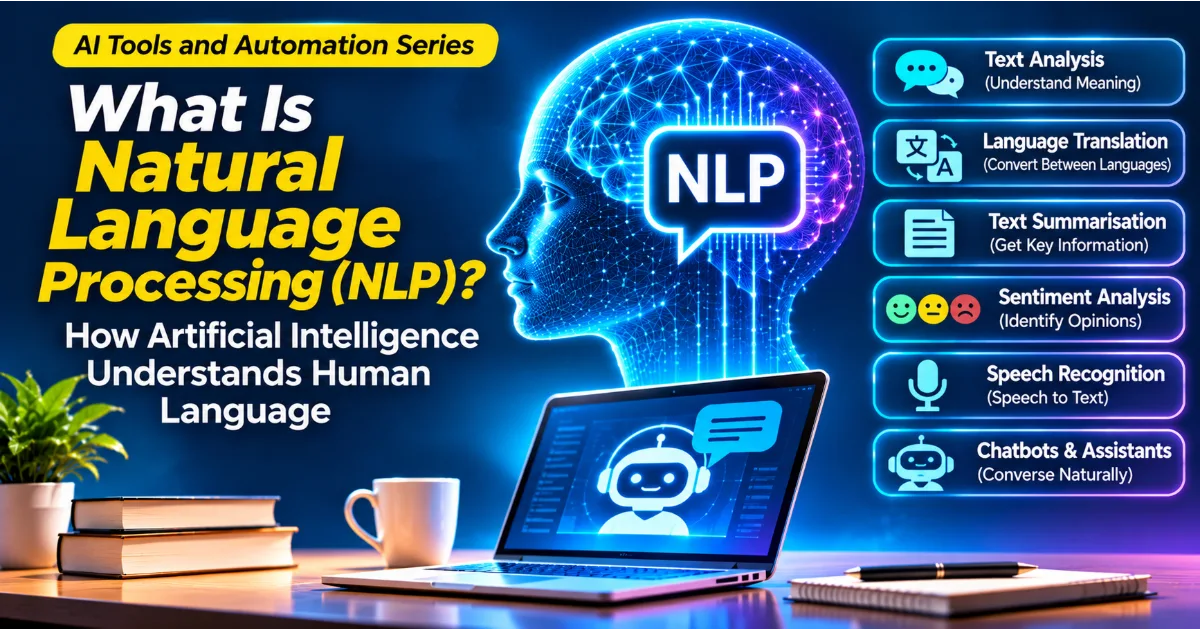
This is where Natural Language Processing, commonly known as NLP, becomes important. NLP is a field of Artificial Intelligence that enables computers to process, analyse, interpret, and generate human language. It combines techniques from computer science, linguistics, statistics, and machine learning to help machines work with text and speech.
NLP powers many technologies people use every day. When a smartphone converts spoken words into text, an email application filters unwanted messages, a search engine understands a query, or an AI assistant responds to a question, natural language processing may be involved.
The development of machine learning and deep learning has significantly expanded NLP capabilities. Modern systems can translate languages, summarise lengthy documents, identify customer sentiment, answer questions, generate content, and participate in conversations.
Continue Reading
Understanding NLP is useful for students, software developers, business owners, researchers, educators, and professionals interested in Artificial Intelligence. This guide explains what natural language processing means, how it works, its major techniques, real-world applications, benefits, limitations, and future possibilities.
What Is Natural Language Processing?
Natural Language Processing is a branch of Artificial Intelligence that focuses on enabling computers to understand, interpret, analyse, and generate human language.
Human languages such as English, Hindi, Bengali, Spanish, French, Japanese, and Mandarin contain complex structures. Words can have multiple meanings, sentences can express indirect messages, and the same statement can communicate different ideas depending on context.
NLP attempts to help computers work with these complexities.
For example, consider the question, "What is the weather like today?" An NLP-powered system can identify that the user is asking for weather information. It can recognise the subject of the question, determine the intended request, and pass the relevant information to a weather service or another system.
Similarly, when a customer writes, "My order has not arrived yet," an NLP application can identify that the message concerns a delayed delivery. A customer support system may then classify the message and direct it to the appropriate department.
NLP is not limited to understanding written language. It also works with spoken language, often in combination with speech recognition and speech generation technologies.
Its primary objective is to make communication between people and computers more natural and effective.
Why Is Natural Language Processing Important?
People communicate through language, but computers traditionally operate using structured instructions and numerical representations. This difference creates a communication gap between humans and machines.
Without NLP, users would often need to interact with software through carefully designed buttons, commands, menus, and predefined input formats. Such interfaces are useful, but they do not always provide the flexibility of ordinary conversation.
NLP makes it possible to interact with digital systems using everyday language.
Imagine a customer visiting an online shopping platform. Instead of navigating several menus, the customer might type, "Show me comfortable running shoes under a certain budget." An NLP-enabled search system can interpret the request, identify the product category, understand the price constraint, and help retrieve relevant results.
Businesses also receive large volumes of unstructured information in the form of emails, customer reviews, support conversations, reports, and social media posts. NLP can help analyse this information at scale.
For educational platforms, NLP can support language learning, question answering, content discovery, and automated feedback. In healthcare administration, it can assist with processing documents and organising information, subject to appropriate privacy and professional safeguards.
NLP is important because it helps convert human language into information that digital systems can process and use.
How Does Natural Language Processing Work?
Natural language processing involves several stages. The exact workflow depends on the task, the language, the model, and the application. A translation system, for example, works differently from a sentiment analysis system. However, many NLP applications use a combination of the following processes.
1. Collecting Text or Speech Data
The first stage involves obtaining the language information that the system needs to process.
For a text-based application, the input may be a customer review, email, article, question, document, or social media comment.
For a voice-based application, the input may be a recording of someone speaking.
The information must be collected and handled according to the application's purpose, applicable permissions, and privacy requirements.
For example, a business developing a customer feedback analysis system may use authorised customer reviews to understand how people feel about its products.
2. Text Preprocessing
Raw text often contains information that needs to be cleaned or organised before analysis.
Text preprocessing may involve removing unnecessary formatting, handling punctuation, standardising text, identifying unusual characters, and separating text into smaller units.
For example, a customer review might contain inconsistent capitalisation, repeated spaces, and unnecessary formatting. Preprocessing can make the information easier for a model to analyse.
However, preprocessing must be designed carefully. Removing punctuation or certain words may change the meaning of a sentence. A system analysing customer sentiment, for instance, must not accidentally remove the word "not" because it can completely reverse the meaning of a statement.
3. Tokenisation
Tokenisation is the process of dividing text into smaller units called tokens.
Depending on the model and method, tokens may represent complete words, parts of words, punctuation marks, or other text units.
Consider the sentence:
"Artificial Intelligence is changing technology."
A simple word-based tokenisation approach may divide it into:
"Artificial", "Intelligence", "is", "changing", and "technology".
Modern language models often use subword tokenisation. This allows them to represent words through smaller units, which can be useful when handling unfamiliar words, technical vocabulary, and different languages.
Tokenisation is important because machine learning models need a structured representation of language before they can perform mathematical operations on it.
4. Normalisation
Text normalisation attempts to make different forms of text more consistent.
For example, an application may standardise certain variations in spelling, capitalisation, or formatting.
A search application might treat different forms of a word as related so that users can find relevant information even when they use slightly different wording.
The normalisation process depends on the task. Excessive normalisation can remove meaningful distinctions, particularly in languages where spelling, accents, or word forms carry important information.
5. Linguistic and Contextual Analysis
After preparing the input, an NLP system may analyse its structure and meaning.
This can involve identifying grammatical relationships, recognising important terms, determining the role of words, and examining how different parts of a sentence relate to one another.
For example, consider the sentence, "The company hired a new engineer."
A language processing system may identify "company" as the subject, "hired" as the action, and "engineer" as the object of that action.
Modern deep learning models often learn many language relationships through training rather than relying entirely on manually programmed linguistic rules.
6. Converting Language into Numerical Representations
Computers and machine learning algorithms work with numerical information. Therefore, language must be represented in a form that models can process.
Earlier NLP systems often used methods based on word counts, word frequencies, or manually designed features.
Modern NLP commonly uses embeddings, which represent words, tokens, or larger pieces of text as numerical vectors.
These representations can help models learn relationships between language elements.
For example, words that are used in similar contexts may develop related numerical representations. This allows a model to identify certain similarities even when two sentences do not use exactly the same vocabulary.
7. Applying an NLP Model
The prepared numerical representation is processed by an appropriate algorithm or model.
Depending on the application, the model may classify the text, identify entities, translate a sentence, generate a summary, answer a question, or produce a response.
A sentiment analysis model, for example, may classify a review as positive, negative, or neutral.
A language generation model may use the context of a question to produce a relevant response.
8. Producing and Evaluating the Output
The final stage involves presenting the result to the user or passing it to another application.
The output may be a translated sentence, a category, a summary, a generated answer, or a structured record.
Developers must evaluate whether the output is accurate and useful. The evaluation method depends on the task and may involve human review, automated performance measures, or both.
For applications that influence important decisions, additional testing and human oversight are essential.
Major Techniques Used in Natural Language Processing
NLP includes several techniques that help computers process different aspects of human language. Understanding these techniques provides a clearer picture of how language-based applications work.
1. Tokenisation
Tokenisation divides text into smaller units that a computer can process.
It may divide a sentence into words, subwords, or other tokens. This is a fundamental step in many NLP workflows.
For example, a chatbot receives the message, "Can you help me find a job?" The system first converts the input into tokens that can be processed by its language model.
The way tokenisation works can affect how a model handles spelling variations, rare words, punctuation, and multilingual content.
2. Stop Word Removal
Stop words are common words that some traditional NLP applications remove because they may contribute relatively little to a particular analysis.
Words such as "the", "is", "and", and "a" are often treated as stop words in certain text-processing tasks.
For example, a basic keyword analysis system may focus on the important terms in a sentence rather than counting every common word.
However, stop word removal is not appropriate for every application. In sentiment analysis and language understanding, words such as "not" and "never" can be essential to meaning.
Modern language models generally use more sophisticated approaches than simply removing common words.
3. Stemming
Stemming reduces words to a simplified root-like form by removing certain endings.
For example, the words "playing", "played", and "plays" may be reduced to a common stem.
Stemming can help traditional search and text analysis systems identify related word forms.
However, stemming does not always produce a valid dictionary word. Its purpose is to create a simplified representation rather than a linguistically perfect result.
4. Lemmatization
Lemmatization identifies the base dictionary form of a word.
For example, "better" may be mapped to "good" in an appropriate linguistic context, while "running" may be mapped to "run".
Unlike basic stemming, lemmatization uses linguistic information to identify a more meaningful base form.
It can be useful in applications that need to understand different grammatical forms of the same word.
5. Part-of-Speech Tagging
Part-of-speech tagging identifies the grammatical role of each word in a sentence.
Words may function as nouns, verbs, adjectives, adverbs, pronouns, prepositions, and other grammatical categories.
Consider the sentence, "The student writes clearly."
A part-of-speech tagging system may identify "student" as a noun, "writes" as a verb, and "clearly" as an adverb.
This information can help other NLP processes understand sentence structure.
6. Named Entity Recognition
Named Entity Recognition, commonly called NER, identifies important entities in text.
These entities may include people's names, organisations, locations, dates, monetary values, and other categories.
For example, consider the sentence:
"Anjali joined a technology company in Bengaluru in October."
An NER system may identify "Anjali" as a person, "Bengaluru" as a location, and "October" as a date-related expression.
Businesses can use this technique to extract structured information from documents, news articles, reports, and customer communications.
7. Sentiment Analysis
Sentiment analysis attempts to identify the opinion, attitude, or emotional tone expressed in text.
A simple system may classify a review as positive, negative, or neutral.
For example:
"The product is excellent and easy to use."
This may be classified as positive.
"The delivery was late and the packaging was damaged."
This may be classified as negative.
Sentiment analysis is useful for businesses that want to understand customer feedback across large numbers of reviews and messages.
However, sarcasm, humour, cultural expressions, and mixed opinions can make sentiment analysis difficult. A sentence such as "Great, another delay!" may contain positive vocabulary while expressing dissatisfaction.
8. Text Classification
Text classification assigns text to predefined categories.
An email filtering system may classify messages as spam or legitimate. A support platform may classify incoming requests as billing, technical support, account access, or delivery-related issues.
News applications may categorise articles according to topics such as business, sports, technology, politics, and entertainment.
Text classification can help organisations organise large collections of information and automate repetitive sorting tasks.
9. Machine Translation
Machine translation converts text from one language into another.
For example, a translation system may convert an English sentence into Hindi, Spanish, or Japanese.
Modern neural machine translation systems use deep learning to understand relationships between words and sentences and generate translations in the target language.
Translation quality depends on the languages involved, the context, the subject matter, and the quality of the underlying model.
Technical documents, legal materials, and culturally sensitive communication may still require professional review.
10. Text Summarisation
Text summarisation produces a shorter version of a longer piece of text while attempting to preserve its important information.
There are two major approaches.
Extractive summarisation selects important sentences or passages from the original material.
Abstractive summarisation generates a new summary using language that may differ from the original wording.
For example, an NLP system may summarise a lengthy business report into a shorter overview containing its main findings and recommendations.
Summarisation can save time, but generated summaries must be checked for missing context or inaccurate statements.
11. Question Answering
Question answering systems attempt to identify or generate answers to questions expressed in natural language.
A user might ask, "What are the main benefits of machine learning?" A question answering system analyses the request and uses available information to produce an answer.
Some systems retrieve relevant passages from documents. Others use language models to generate responses based on their training and supplied context.
The reliability of the answer depends on the quality of the available information and the system's ability to interpret the question correctly.
12. Speech Recognition
Speech recognition converts spoken language into text.
A voice assistant may use speech recognition to identify what a person has said before passing the recognised words to an NLP system.
For example, a user might say, "Set a reminder for tomorrow morning." The speech recognition system converts the audio into text, and the language processing system identifies the intended action and relevant time information.
Speech recognition and NLP often work together, although they solve different problems.
What Is the Difference Between NLP and Machine Learning?
Natural Language Processing and Machine Learning are related, but they are not the same.
Machine Learning is a branch of Artificial Intelligence that enables systems to learn patterns from data.
Natural Language Processing is a field focused on working with human language.
Machine learning provides many of the methods used to build modern NLP systems.
For example, a machine learning model can be trained using thousands of customer reviews to classify their sentiment. The machine learning approach enables the system to learn patterns, while the NLP application focuses on analysing language.
Not every NLP system must use the same machine learning method. Earlier systems often relied on manually designed linguistic rules, dictionaries, and statistical techniques. Modern applications frequently use machine learning and deep learning because they can handle more complex language patterns.
The relationship can be understood as a combination of a problem area and the methods used to solve problems within it.
What Is the Difference Between NLP and Deep Learning?
Deep Learning is a specialised area of machine learning that uses neural networks with multiple processing layers.
NLP is concerned with processing and understanding human language. Deep learning is one of the major approaches used to develop modern NLP applications.
Earlier NLP systems often relied on manually created language rules, statistical methods, and traditional machine learning algorithms.
Deep learning introduced models that can learn complex language representations from large datasets.
For example, a traditional text classification system may depend on manually selected features and word frequencies. A deep learning model can learn more complex relationships between words and their surrounding context.
Deep learning has been especially important in the development of neural machine translation, speech recognition, modern chatbots, and large language models.
However, deep learning is not automatically the best choice for every language task. Smaller applications may work effectively with simpler methods, particularly when data and computing resources are limited.
What Are Large Language Models and How Are They Connected to NLP?
Large Language Models, commonly called LLMs, are advanced machine learning models trained on large collections of text and other language-related information.
They are designed to process and generate language. Many modern LLMs use transformer-based neural network architectures.
An LLM learns statistical patterns and relationships within its training data. It can use the context of a prompt to generate text, answer questions, summarise information, explain concepts, and perform other language-related tasks.
For example, a user may ask an LLM to explain a programming concept in simple language. The model processes the prompt and generates a response based on patterns learned during training and the context available in the conversation.
LLMs have expanded the capabilities of NLP because they can perform a wide range of tasks through natural language instructions.
However, they do not guarantee factual accuracy. They can misunderstand questions, generate incorrect information, or produce statements that sound convincing but are unsupported.
The connection is straightforward: NLP is the broader field, while large language models are one important category of technology used for advanced language processing and generation.
What Are Transformers in NLP?
Transformers are a type of neural network architecture that has become central to modern NLP.
Earlier sequence-processing models often handled information step by step. Transformers introduced an attention mechanism that allows models to examine relationships between different parts of an input more effectively.
One important concept is self-attention.
Self-attention helps a model determine which other words or tokens are relevant when processing a particular token.
Consider the sentence, "The animal did not cross the road because it was frightened."
To interpret the word "it", a language model needs to understand which earlier word it refers to. Contextual relationships help the model process such sentences.
Transformers can process information in parallel during important stages of training, which has helped make large-scale language model development more practical.
Transformer-based architectures are used in translation, summarisation, text generation, question answering, and many other NLP tasks.
Real-World Applications of Natural Language Processing
NLP is used across industries to improve communication, analyse information, and automate language-related activities.
1. Customer Support and Chatbots
Businesses receive thousands of customer questions through websites, email, messaging platforms, and support portals.
NLP-powered chatbots can interpret common questions and provide relevant responses.
For example, a customer may ask, "How can I reset my password?" The system can recognise that the request concerns account access and provide the appropriate instructions.
More advanced systems can classify support requests, identify customer intent, retrieve relevant information, and direct complex cases to human representatives.
Chatbots can reduce repetitive work, but human support remains important for complicated, sensitive, or unusual situations.
2. Search Engines
Search engines use language processing techniques to interpret queries and identify relevant content.
A user might search for "best ways to improve website speed" rather than entering a specific technical phrase.
Modern search systems attempt to understand the meaning and intent behind the query rather than relying only on exact keyword matching.
NLP can help identify related concepts, understand query context, and improve the relevance of search results.
3. Email Filtering
Email applications use NLP and machine learning techniques to identify spam, phishing-related language, promotional messages, and other categories of email.
A filtering system may analyse message content, sender information, links, formatting, and patterns associated with previously identified unwanted messages.
This helps users organise their inboxes and reduce exposure to certain suspicious communications.
4. Language Translation
Translation services use NLP to convert written content between languages.
Students can translate learning materials, businesses can communicate with international customers, and travellers can understand basic information in unfamiliar languages.
Modern translation systems can process entire sentences and consider context rather than translating every word independently.
However, specialised documents may require human translation and review.
5. Social Media Monitoring
Organisations receive customer opinions through social media platforms, discussion forums, and online reviews.
NLP can analyse large volumes of public or authorised text to identify frequently discussed topics, common complaints, product feedback, and general sentiment.
A company may discover that customers frequently mention delivery delays or difficulties using a particular feature.
This information can help teams prioritise improvements.
6. Healthcare Documentation
NLP can assist with organising and analysing healthcare-related text, including certain administrative documents, clinical notes, and research materials.
For example, a document-processing system may identify relevant dates, medication names, or medical terms within a record.
Such applications require strict privacy safeguards, appropriate validation, and qualified professional oversight. NLP systems should not independently replace clinical judgement.
7. Education and E-Learning
Educational platforms can use NLP to support language learning, answer student questions, provide writing feedback, and organise educational content.
A language learning application may analyse a student's sentence and identify grammatical errors.
An educational chatbot may explain a concept or suggest additional reading material.
Teachers and subject experts should remain involved in evaluating the quality and suitability of generated educational content.
8. Recruitment and Human Resources
NLP can help process large collections of job descriptions, applications, and recruitment-related documents.
A system may extract skills, qualifications, experience, and other information from resumes to support administrative workflows.
It can also help organisations identify recurring skills mentioned in job advertisements.
However, automated recruitment systems can introduce bias and unfair outcomes if they are poorly designed or trained on unsuitable historical data. Human review, transparency, and fairness testing are essential.
9. Banking and Financial Services
Financial organisations may use NLP to process customer messages, analyse financial documents, and identify information within reports.
A customer support system can classify a complaint related to a failed transaction and direct it to the appropriate team.
Financial researchers may also use language analysis to examine large collections of business announcements and reports.
Decisions involving customers, credit, or financial risk require appropriate controls and human accountability.
10. Legal Document Processing
Law firms and legal departments work with contracts, case documents, policies, and other extensive collections of text.
NLP can help identify important clauses, extract dates, locate references, and organise documents for further review.
These tools can reduce some repetitive document-handling tasks, but legal interpretation and advice must remain with qualified professionals.
11. News and Content Analysis
News organisations and research teams can use NLP to classify articles, identify topics, extract named entities, and summarise information.
A media monitoring system may identify articles mentioning a particular organisation, industry, or public development.
This can help researchers and editorial teams organise large amounts of information.
12. Voice Assistants
Voice assistants combine speech recognition, NLP, and other technologies to interpret spoken requests and perform actions.
A person might say, "What meetings do I have this afternoon?" The system needs to recognise the speech, interpret the request, identify the relevant time period, and retrieve calendar information if authorised.
This demonstrates how NLP can become part of a larger intelligent application.
How Businesses Can Use NLP for Automation
NLP has significant potential for businesses because many routine operations involve reading, writing, sorting, and responding to language.
A company may receive customer emails throughout the day. Employees must read each message, understand its purpose, identify its urgency, and send it to the right department.
An NLP-powered workflow can assist with this process.
First, the system receives an incoming email. It then analyses the content and identifies the likely category, such as billing, technical support, delivery, or account access.
Next, the system may extract relevant information, such as an order number or product name. It can assign a priority based on predefined business rules and route the message to the appropriate team.
A similar approach can be used for internal documents, feedback analysis, meeting summaries, and information retrieval.
NLP can also support marketing activities. Businesses may analyse customer feedback to identify common interests and concerns. They can use these findings to improve product descriptions, organise frequently asked questions, and create more relevant customer communication.
The most effective business applications do not simply automate everything. They identify repetitive tasks where language processing can save time while preserving human involvement in situations that require judgement.
Popular NLP Tools and Libraries
Developers and researchers use different tools to build natural language processing applications. The appropriate choice depends on the task, programming language, available data, and project requirements.
Natural Language Toolkit
Natural Language Toolkit, commonly known as NLTK, is a Python library used for working with human language data.
It provides tools for tokenisation, stemming, tagging, text processing, and linguistic analysis.
It is often used in education and experimentation because it helps beginners understand traditional NLP techniques.
spaCy
spaCy is a Python library designed for practical NLP applications.
It provides capabilities such as tokenisation, part-of-speech tagging, named entity recognition, and dependency parsing.
It is commonly used in production-oriented language processing workflows.
Hugging Face Transformers
The Transformers library provides access to many pretrained machine learning models.
Developers can use it for text classification, translation, summarisation, question answering, and text generation.
It supports several popular deep learning frameworks and provides tools for working with transformer-based models.
PyTorch
PyTorch is a machine learning framework used for developing and training neural networks.
Researchers and developers use it to build custom NLP models and experiment with deep learning architectures.
TensorFlow
TensorFlow is another widely used machine learning framework.
It provides tools for developing and deploying machine learning applications, including certain NLP systems.
Scikit-Learn
Scikit-learn provides traditional machine learning algorithms and tools for data preparation, classification, clustering, and model evaluation.
It can be useful for building basic text classification systems and learning how machine learning workflows operate.
Challenges and Limitations of Natural Language Processing
Despite significant progress, NLP still faces important technical and practical challenges.
1. Language Ambiguity
The same word can have different meanings depending on context.
For example, the word "bank" can refer to a financial institution or the land beside a river.
An NLP system must examine surrounding information to determine the intended meaning.
2. Sarcasm and Humour
People frequently use sarcasm, irony, jokes, and indirect expressions.
A sentence such as "Wonderful, my computer crashed again" contains a positive word but communicates frustration.
A system that relies only on individual words may misunderstand the speaker's actual intention.
3. Cultural and Regional Differences
Language varies across regions, communities, and cultures.
People may use local expressions, abbreviations, dialects, and informal vocabulary that are unfamiliar to a model.
A system trained mainly on one variety of a language may perform poorly when used with another.
4. Multilingual Complexity
Different languages have different grammatical structures, writing systems, word formation rules, and linguistic conventions.
A model that performs well in English may not achieve the same results in a less represented language.
This is particularly important for languages with limited high-quality digital training data.
5. Context Understanding
A sentence may depend on information mentioned much earlier in a conversation.
Understanding references, implied meanings, and long discussions remains challenging for language processing systems.
Even advanced models can lose important context or misinterpret a user's intention.
6. Bias in Training Data
Language models learn patterns from their training data.
If that information contains stereotypes, unfair representations, or historical biases, the model may reproduce them in its output.
Developers must evaluate systems carefully and consider how their outputs affect different groups.
7. Privacy and Data Protection
NLP applications may process emails, personal messages, business documents, and other sensitive information.
Organisations must establish appropriate data access controls, retention policies, security measures, and privacy protections.
Sensitive information should not be collected or processed without an appropriate purpose and legal basis.
8. Hallucinations and Incorrect Information
Generative language models can produce statements that appear convincing but are incorrect or unsupported.
This problem is particularly important when systems generate summaries, explanations, research assistance, or answers involving important decisions.
Outputs should be verified against reliable information when accuracy matters.
9. Computational Requirements
Large NLP models can require substantial computing resources for training and operation.
Although smaller models and efficient techniques are improving accessibility, deploying advanced language systems at scale can still involve infrastructure and maintenance costs.
10. Evaluation Difficulties
It can be difficult to measure whether an NLP system truly understands a sentence.
A translation may preserve the general meaning while changing its wording. A summary may be grammatically correct but omit an important detail.
Therefore, evaluation often requires multiple measures and human judgement rather than relying on a single numerical score.
How to Start Learning Natural Language Processing
NLP can be learned gradually. Beginners do not need to understand every advanced language model before building their first project.
Step 1: Understand Artificial Intelligence and Machine Learning
Begin with the fundamentals of Artificial Intelligence, Machine Learning, and Deep Learning.
Understand how algorithms learn from data, how models are trained, and why the quality of training information matters.
These concepts provide the foundation for understanding modern NLP systems.
Step 2: Learn Python
Python is widely used for NLP development.
Start with variables, data types, conditional statements, loops, functions, lists, dictionaries, and file handling.
You should also learn how to install libraries and work with external datasets.
Step 3: Learn Basic Linguistics
You do not need to become a linguist, but understanding basic language concepts is helpful.
Learn about nouns, verbs, adjectives, sentence structure, grammar, word forms, and the relationship between words and context.
These concepts make traditional NLP techniques easier to understand.
Step 4: Explore Text Processing
Practise reading text files, cleaning data, splitting sentences, tokenising words, and identifying common patterns.
Experiment with simple examples using NLTK or spaCy.
Step 5: Understand Machine Learning for Text
Learn how text can be converted into numerical features.
Explore approaches such as Bag of Words and Term Frequency-Inverse Document Frequency, commonly called TF-IDF.
Build a basic text classification model using Scikit-Learn.
Step 6: Explore Deep Learning and Transformers
After understanding traditional NLP methods, explore neural networks and transformer-based models.
Learn how embeddings, attention mechanisms, and pretrained models contribute to modern language processing.
You can experiment with pretrained models before attempting to train large models from scratch.
Step 7: Build Practical Projects
Practical projects help develop the skills needed to solve real problems.
Start with a spam classifier, sentiment analysis tool, keyword extractor, or simple document summariser.
As your understanding improves, experiment with translation, question answering, and conversational applications.
Step 8: Evaluate Your Results
Do not judge an NLP application only by whether it produces an output.
Check whether the output is accurate, relevant, understandable, and suitable for the intended user.
Examine incorrect predictions and consider how data quality, model selection, or preprocessing may be improved.
Beginner-Friendly NLP Project Ideas
A few small projects can help you understand how NLP works in practical situations.
Project 1: Spam Email Classifier
Create a system that identifies whether an email is spam or legitimate.
Use a labelled dataset containing examples from both categories. Clean the text, convert it into numerical features, and train a classification algorithm.
Evaluate the model using appropriate measures such as precision, recall, and F1 score.
Project 2: Customer Sentiment Analysis
Build a model that classifies customer reviews as positive, negative, or neutral.
You can use product reviews or another suitable labelled dataset.
The project will help you understand text preprocessing, feature extraction, classification, and model evaluation.
Project 3: News Category Classifier
Develop an application that assigns news articles to categories such as business, sports, technology, or entertainment.
This project demonstrates how NLP can help organise large collections of documents.
Project 4: Named Entity Extractor
Create a tool that identifies people, organisations, locations, and dates in a paragraph.
Use an existing NLP library to process the text and display the extracted information.
This is a practical introduction to structured information extraction.
Project 5: Basic Text Summariser
Build an application that produces a shorter version of a lengthy article.
Begin with extractive summarisation, where the system selects important sentences from the original text.
After understanding the basic approach, explore pretrained abstractive summarisation models.
The Future of Natural Language Processing
NLP is evolving as researchers develop more capable language models, improve multilingual performance, and explore new ways for computers to work with human communication.
One important direction is multilingual AI. More systems are being developed to support languages and dialects that have historically received less attention in digital technology.
This can improve access to information and digital services for people who do not primarily communicate in widely represented languages.
Another important development is multimodal AI. These systems can process combinations of text, images, audio, and video. Instead of working only with written sentences, they can use information from multiple forms of communication.
Conversational AI is also becoming more capable. Modern assistants can interpret longer instructions, work with supplied documents, and support complex information tasks. However, their responses still need appropriate evaluation and oversight.
NLP is also likely to play a larger role in business automation. Organisations may use language models to help process documents, classify requests, summarise meetings, and support customer service workflows.
Another area of development is more efficient language processing. Smaller models may allow certain NLP applications to operate locally on computers and mobile devices, potentially reducing dependence on remote infrastructure for suitable tasks.
Responsible AI will remain essential. Future NLP systems must address privacy, bias, reliability, security, transparency, and the risk of generating misleading information.
The future of NLP will not depend only on models becoming larger or more powerful. It will also depend on making language technologies more accessible, reliable, efficient, and useful across different communities and industries.
Conclusion: Natural Language Processing Is Making Human-Computer Communication More Natural
Natural Language Processing is an important field of Artificial Intelligence that enables computers to work with human language.
It supports applications such as chatbots, search engines, language translation, sentiment analysis, speech recognition, document processing, and generative AI.
NLP combines techniques from linguistics, computer science, statistics, machine learning, and deep learning. Its capabilities have expanded significantly through neural networks and transformer-based models.
However, understanding human language remains difficult. Ambiguity, sarcasm, cultural differences, limited training data, bias, privacy concerns, and incorrect outputs continue to create challenges.
Building useful NLP applications requires more than choosing a model. Developers must understand the problem, prepare suitable data, select appropriate techniques, evaluate performance, and monitor how the application behaves in real situations.
For beginners, learning Python, exploring text-processing libraries, studying basic machine learning, and building small projects provide a practical starting point.
NLP is helping computers move beyond rigid commands and interact with people through the language they already use. As this technology develops, it will become increasingly important in education, business, research, communication, and everyday digital experiences.
Understanding Natural Language Processing is therefore an important step towards understanding how modern Artificial Intelligence communicates, assists, and works with people.
Continue the Discussion
Have you used a chatbot, voice assistant, translation application, or AI writing tool recently? Which NLP application do you find most useful in your daily life?
Do you think computers will eventually understand human language as naturally as people do, or will context, emotions, humour, and cultural differences remain major challenges?
Share your thoughts and experiences. Your responses can help identify the practical AI and language technologies worth exploring in future articles.
#NaturalLanguageProcessing #NLP #ArtificialIntelligence #MachineLearning #AITools