Artificial Intelligence has become an important part of modern technology, influencing how people communicate, work, study, shop, travel, and access information. Behind many of the most impressive developments in AI are technologies that allow computers to recognise complex patterns, understand different forms of information, and generate content. One of the most important technologies responsible for these developments is Deep Learning.
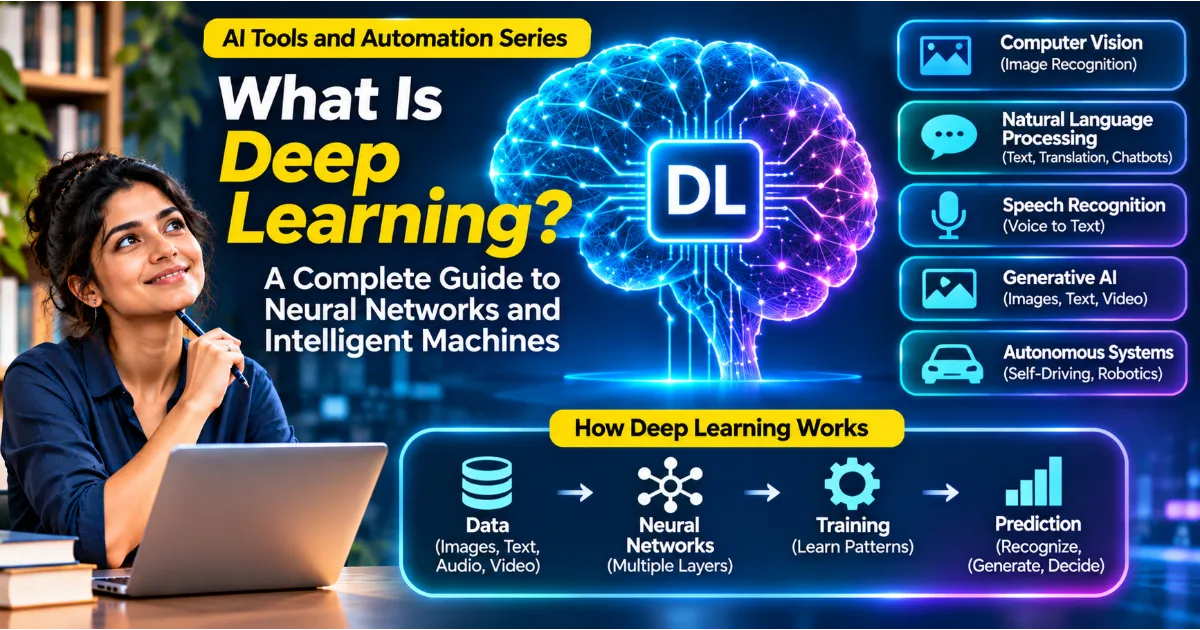
Deep Learning is a specialised branch of Machine Learning that uses artificial neural networks with multiple layers to learn patterns from large amounts of data. It has made significant contributions to image recognition, speech processing, natural language understanding, autonomous systems, medical research, and generative AI.
When a smartphone recognises a person's face, a voice assistant understands spoken instructions, an application translates languages, or an AI tool generates an image from a written description, deep learning may be part of the technology behind the experience.
Although the term sounds highly technical, its basic idea is straightforward. Instead of requiring developers to manually define every feature a computer should recognise, deep learning systems can learn useful representations from examples. They process information through multiple computational layers, gradually identifying patterns that help them perform a particular task.
Understanding deep learning is useful for software developers, business owners, students, researchers, digital professionals, and anyone interested in the future of Artificial Intelligence. It explains how modern AI applications process complex information and why certain technologies have become so powerful.
Continue Reading
This article explores what deep learning means, how it works, its relationship with Artificial Intelligence and Machine Learning, the structure of neural networks, major architectures, practical applications, advantages, limitations, and the skills required to begin learning it.
What Is Deep Learning?
Deep Learning is a subset of Machine Learning that uses artificial neural networks containing multiple layers of computational units to learn patterns and representations from data.
Traditional machine learning algorithms often depend on developers selecting or creating useful features from the available data. Deep learning models can learn many of these features automatically during training.
For example, consider an application designed to recognise animals in photographs. A traditional machine learning workflow may require developers to identify useful visual characteristics, such as shapes, textures, edges, and colour patterns, before training a classification model.
A deep learning system can process many labelled images and learn visual representations through its neural network layers. Earlier layers may learn simple patterns such as edges and textures, while later layers can combine those patterns to recognise more complex structures.
The model eventually learns patterns that help it distinguish between different categories of animals.
This ability to learn increasingly complex representations makes deep learning particularly useful for working with unstructured information such as images, audio, video, and natural language.
The word "deep" refers to the presence of multiple processing layers in a neural network. It does not mean that the system necessarily possesses deep understanding or human-like intelligence. It describes the architecture used to process information.
How Is Deep Learning Related to Artificial Intelligence?
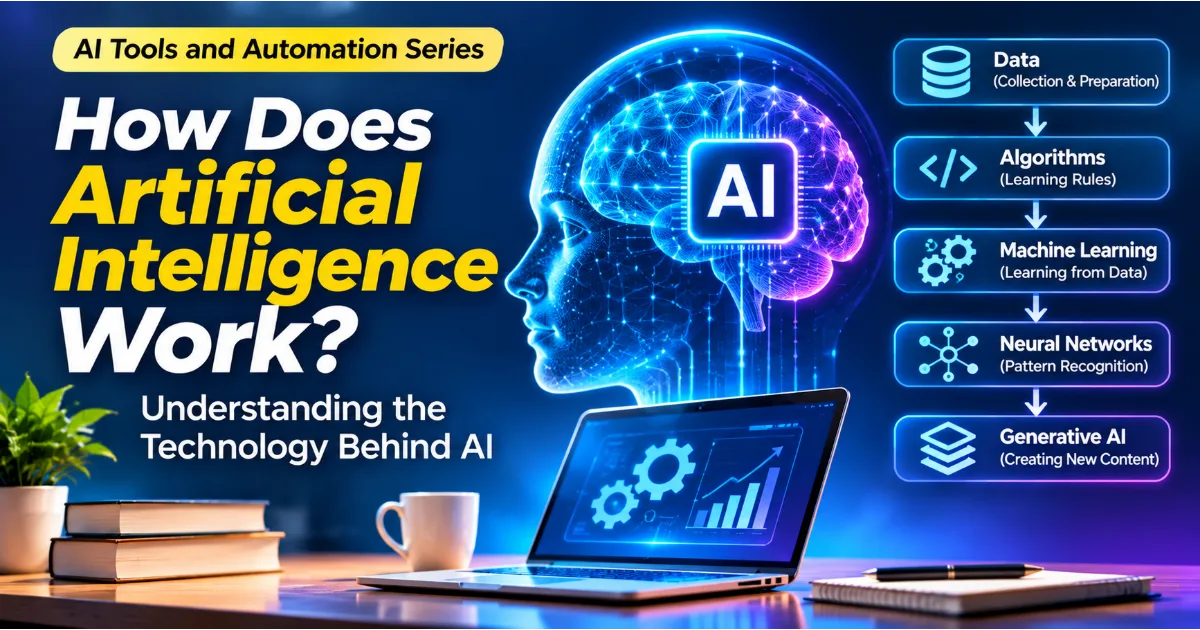
Artificial Intelligence, Machine Learning, and Deep Learning are closely connected, but they represent different levels of a broader technological field.
Artificial Intelligence is the broad discipline concerned with creating systems capable of performing tasks associated with intelligent behaviour. These tasks may include problem-solving, language processing, perception, reasoning, and decision support.
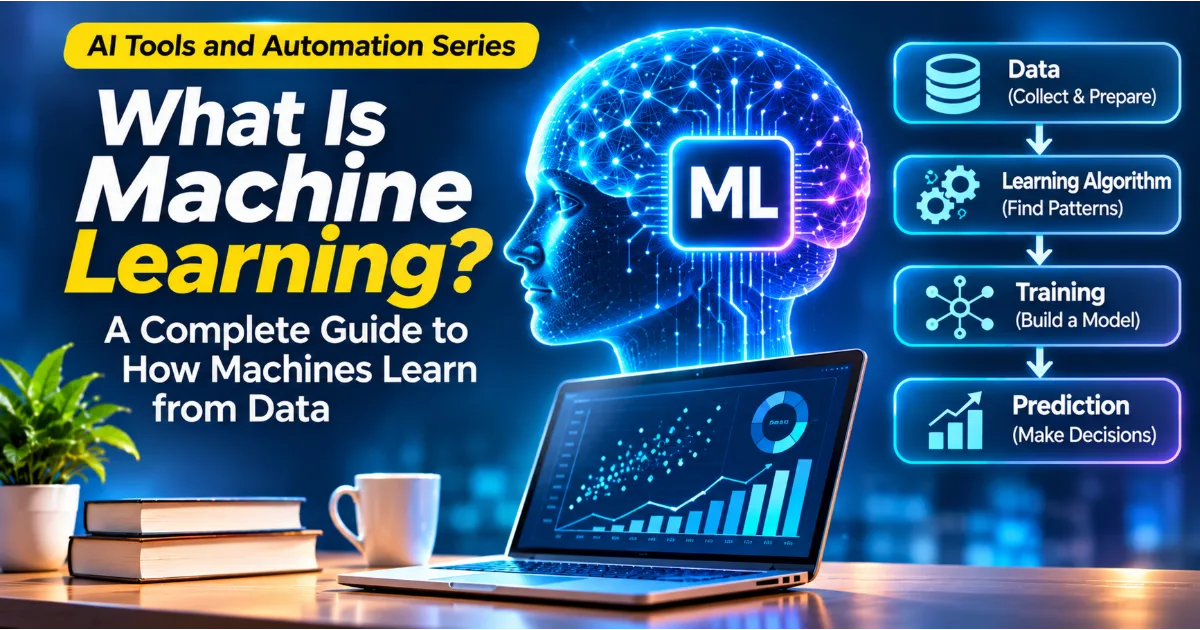
Machine Learning is a branch of Artificial Intelligence that allows systems to learn patterns from data rather than depending entirely on manually written instructions.
Deep Learning is a specialised area within Machine Learning that uses neural networks with multiple layers.
This relationship can be understood through an example involving a voice assistant.
The overall voice assistant is an AI application. It may use machine learning to identify patterns in speech and determine the meaning of a request. Deep learning may power the speech recognition and language processing components that allow the system to understand spoken words.
These technologies work together to create an intelligent application.
It is important to understand that not every AI system uses deep learning. Rule-based systems, search algorithms, decision trees, and other traditional methods can also be used to develop AI applications.
Deep learning is powerful, but it is one approach within the wider field of Artificial Intelligence.
Why Is Deep Learning Important?
Many real-world problems involve information that is difficult to describe using a small collection of manually written rules.
Recognising objects in photographs, understanding natural speech, translating languages, identifying patterns in medical images, and generating realistic content are examples of complex tasks.
A photograph may contain thousands or millions of individual pixel values. A spoken sentence contains variations in pronunciation, speed, background noise, and accent. A written paragraph may include context, ambiguity, grammar, and relationships between words.
Traditional programming approaches can struggle to handle every possible variation in such information.
Deep learning provides a way to learn useful patterns from large datasets. Instead of requiring developers to define every feature, neural networks adjust their internal parameters during training to improve their predictions.
The availability of large datasets, powerful graphics processing units, specialised hardware, and improved training techniques has made deep learning increasingly practical.
It is now an important technology behind many modern AI applications.
What Is an Artificial Neural Network?
An artificial neural network is a computational model inspired in a simplified way by the structure of biological neural networks.
The human brain contains interconnected biological neurons that communicate through complex electrical and chemical processes. Artificial neural networks do not reproduce the full structure or functioning of the human brain. They use mathematical operations to process information through connected computational units.
A typical artificial neural network contains an input layer, one or more hidden layers, and an output layer.
Each layer contains units often called neurons. These units receive numerical information, apply mathematical operations, and pass their outputs to other units.
The connections between neurons have numerical values called weights. These weights influence how strongly information contributes to the output.
During training, the network adjusts its weights and other parameters to improve its performance.
The Input Layer
The input layer receives information that the model will process.
For an image recognition system, the input may consist of numerical pixel values representing an image.
For a speech recognition system, the input may be a numerical representation of an audio signal.
For a text processing system, the input may be tokens converted into numerical representations.
The input layer provides the information required by the network.
Hidden Layers
Hidden layers process information received from the previous layer.
Each layer applies mathematical operations to its inputs and passes the resulting information forward.
A network with several hidden layers can learn increasingly complex representations.
For example, an image recognition network may learn simple visual patterns in early layers and combine them into more complex shapes and object-related features in later layers.
The exact representations learned by a network depend on its architecture, training data, objective, and optimisation process.
The Output Layer
The output layer produces the result of the model's computation.
For an image classification task, the output may represent the predicted probabilities of different image categories.
For a numerical prediction task, the output may be a value such as an estimated house price.
For a language model, the output may represent scores associated with possible next tokens.
The output layer is designed according to the task the network is intended to perform.
How Does Deep Learning Work?
Deep learning models learn by adjusting their internal parameters during training. Although the mathematical details can become complex, the basic process can be understood through a sequence of steps.
1. Collect Training Data
The first step is obtaining data relevant to the task.
A deep learning model designed to recognise cats and dogs requires a suitable collection of animal photographs.
A speech recognition model needs audio recordings and appropriate training targets.
A language model may be trained using large collections of text or other forms of data, depending on its intended capabilities.
The quality, diversity, and suitability of the training data strongly influence the model's performance.
2. Convert Information into Numerical Form
Neural networks perform mathematical operations, so information must be represented numerically.
Images can be represented as arrays of pixel values. Audio can be converted into numerical signals or other representations. Text can be divided into tokens and converted into numerical vectors.
This transformation allows the neural network to process different types of information.
3. Initialise the Network
Before training begins, the model contains parameters such as weights and biases.
These parameters are usually initialised using suitable methods. At this stage, the model has not yet learned the patterns required for its intended task.
Its initial predictions may be inaccurate.
4. Perform Forward Propagation
Forward propagation is the process of passing input information through the neural network to generate an output.
Each layer performs mathematical operations on the information received from the previous layer.
The output of one layer becomes the input to the next layer.
After processing the information through the network, the model produces a prediction.
For example, an image classification model may produce a probability distribution indicating how likely an image is to belong to different animal categories.
5. Calculate the Loss
The model's prediction is compared with the expected result when suitable training targets are available.
A loss function measures the difference between the model's prediction and the expected output.
A larger loss generally indicates that the prediction is less accurate according to the selected objective.
Different tasks require different loss functions. Classification, numerical prediction, and language modelling may use different mathematical approaches.
6. Perform Backpropagation
Backpropagation is a method used to calculate how changes in the model's parameters would affect the loss.
It uses the chain rule of calculus to determine gradients for the network's parameters.
These gradients provide information about how the parameters should change to reduce the loss.
Backpropagation is an essential part of training many neural networks.
7. Update the Parameters
An optimisation algorithm uses the calculated gradients to adjust the model's weights and other parameters.
Gradient descent and its variations are commonly used for this purpose.
The model repeats the process across many training examples and iterations. Over time, it can learn patterns that improve its predictions.
8. Evaluate the Trained Model
After training, the model is evaluated using data that was not used to fit its parameters.
This helps developers estimate how well it performs on new information.
Evaluation should include more than a single accuracy measurement. Developers may examine different error types, performance across relevant groups, robustness, computational costs, and other factors.
9. Deploy and Monitor the Model
Once the model meets the required standards, it can be integrated into an application or business process.
However, deployment is not the end of the development process.
Developers must monitor performance, identify unexpected behaviour, evaluate changing data conditions, and update the model when necessary.
A model that performs well during testing may behave differently in a changing real-world environment.
What Are Activation Functions?
An activation function is a mathematical function applied within a neural network to transform the output of a computational unit.
Activation functions help neural networks learn complex relationships that cannot be represented effectively through simple linear operations alone.
Without suitable nonlinear activation functions, stacking multiple linear layers would still produce a transformation that is mathematically equivalent to a single linear transformation.
Activation functions therefore play an important role in enabling deep networks to represent more complicated patterns.
ReLU
Rectified Linear Unit, commonly called ReLU, is one of the most widely used activation functions.
It returns zero for negative input values and returns the input value for positive values.
ReLU is popular because it is computationally simple and works effectively in many neural network architectures.
Sigmoid
The sigmoid function transforms input values into outputs between zero and one.
It has historically been used in binary classification and neural network output layers.
Its usefulness depends on the architecture and training requirements because gradients can become very small for extreme input values.
Tanh
The hyperbolic tangent function produces outputs between negative one and positive one.
It has been used in different neural network architectures, including certain recurrent network designs.
Softmax
Softmax converts a collection of numerical scores into a probability distribution across categories.
It is commonly used in classification systems where the model must choose among multiple possible classes.
For example, an image classification model may use softmax to produce probabilities for categories such as cat, dog, bird, and horse.
Major Types of Deep Learning Neural Networks
Different neural network architectures are designed to handle different types of information and tasks.
Some architectures are particularly effective for images. Others are designed for sequential information, language, or generative applications.
Understanding the major architectures provides insight into how deep learning is used across industries.
1. Feedforward Neural Networks
Feedforward neural networks are among the basic forms of artificial neural networks.
Information moves from the input layer through hidden layers to the output layer. The network does not contain the type of recurrent connections used in recurrent neural networks.
These models can be used for classification and numerical prediction.
For example, a business may build a feedforward neural network to estimate customer purchasing probability based on information such as previous purchases, browsing activity, and customer characteristics.
Feedforward networks provide a useful foundation for understanding how information flows through neural networks.
2. Convolutional Neural Networks
Convolutional Neural Networks, commonly known as CNNs, are neural network architectures particularly associated with image processing.
They use convolutional operations to identify local patterns within input data.
For example, an image contains visual features such as edges, corners, textures, shapes, and object parts. A CNN can learn filters that respond to these patterns.
Early layers may detect simple visual characteristics. Deeper layers can combine these features to identify more complex visual structures.
How CNNs Work
A convolutional layer applies filters to sections of an image. These filters help identify patterns at different locations.
The resulting feature maps represent where particular patterns appear in the image.
Some CNN architectures also use pooling operations or other methods to reduce spatial dimensions and computational requirements.
After several processing layers, the network can combine the learned features to produce a classification or another required output.
Applications of CNNs
CNNs have been used in facial recognition, object detection, medical image analysis, quality inspection, satellite image processing, and agricultural monitoring.
A manufacturing company may use a CNN-based system to examine product photographs and identify visible defects.
A research team may use image processing models to analyse patterns in medical images, subject to appropriate clinical validation and professional oversight.
CNNs have played a major role in the development of modern computer vision.
3. Recurrent Neural Networks
Recurrent Neural Networks, or RNNs, are designed to process sequential information.
Unlike basic feedforward networks, RNNs include connections that allow information from earlier steps to influence later processing.
This makes them useful for tasks in which order and context matter.
Examples include time-series forecasting, sequence modelling, and certain language processing applications.
A language model based on an RNN may process a sentence one word or token at a time, using information from previous positions to help interpret the next part of the sequence.
Limitations of Traditional RNNs
Traditional RNNs can struggle to learn relationships across long sequences because of problems involving vanishing and exploding gradients.
These problems can make it difficult for the network to retain useful information over long periods during training.
Specialised architectures were developed to address some of these limitations.
4. Long Short-Term Memory Networks
Long Short-Term Memory networks, commonly called LSTMs, are a specialised form of recurrent neural network.
They use internal mechanisms called gates to control how information is stored, updated, and removed.
This design helps LSTMs learn certain long-term relationships more effectively than traditional RNNs.
LSTMs have been used in speech recognition, language modelling, time-series forecasting, and other sequence-related tasks.
For example, an energy forecasting system may use historical consumption patterns to estimate future demand.
Although transformers have become dominant in many modern language applications, LSTMs remain important for understanding the development of sequence modelling.
5. Gated Recurrent Units
Gated Recurrent Units, or GRUs, are another type of recurrent neural network architecture.
They use gating mechanisms to control the flow of information through the network.
GRUs have a simpler structure than LSTMs in several respects and can perform well on different sequence learning tasks.
They have been used in speech processing, time-series analysis, and language-related applications.
The choice between an LSTM, GRU, transformer, or another architecture depends on the specific problem and practical requirements.
6. Transformers
Transformers are neural network architectures that have become central to modern natural language processing and generative AI.
They use an attention mechanism to model relationships between different parts of an input sequence.
Traditional recurrent models process sequences step by step. Transformer architectures can process many tokens in parallel during important parts of training, making them highly suitable for large-scale language modelling.
What Is Attention?
Attention allows a model to determine which parts of the available information are particularly relevant when processing a particular token or representation.
For example, consider a sentence containing a reference to a person introduced earlier in the paragraph. Understanding that reference may require connecting information from different positions in the text.
Attention mechanisms help models represent relationships between tokens, including relationships that may be separated by many other words.
Self-Attention
Self-attention allows elements within the same sequence to consider information from other elements in that sequence.
It helps a transformer build contextual representations of the input.
Multiple attention heads can learn different types of relationships, allowing the network to process information from several perspectives.
Applications of Transformers
Transformers are widely used in large language models, machine translation, document analysis, code generation, conversational AI, and multimodal systems.
Their development has significantly influenced modern generative AI.
7. Autoencoders
Autoencoders are neural networks designed to learn compressed representations of input data.
A typical autoencoder contains an encoder and a decoder.
The encoder transforms the input into a more compact representation. The decoder attempts to reconstruct the original information from that representation.
The model is trained to reduce the difference between the original input and the reconstructed output.
Autoencoders can be used for dimensionality reduction, feature learning, data reconstruction, and certain anomaly detection applications.
For example, a manufacturing system may learn the typical patterns found in normal product images. Unusual reconstruction errors may help identify products that deserve further inspection.
However, anomaly detection requires careful evaluation because unusual patterns are not always defects, and genuine defects may not always produce large reconstruction errors.
8. Generative Adversarial Networks
Generative Adversarial Networks, commonly called GANs, are a type of generative model introduced as a framework involving two neural networks.
A GAN contains a generator and a discriminator.
The generator attempts to create realistic synthetic data. The discriminator attempts to distinguish generated examples from real examples.
During training, both networks improve through this competitive process.
The generator learns to produce outputs that are increasingly difficult for the discriminator to distinguish from real data.
GANs have been used for image generation, image enhancement, synthetic data research, and other generative tasks.
Although newer generative approaches have become important in many applications, GANs remain a significant part of deep learning history.
9. Diffusion Models
Diffusion models are another important family of generative AI systems.
They are widely associated with modern image generation.
A common diffusion approach gradually adds noise to training data and learns how to reverse the process. During generation, the model starts with a noisy representation and repeatedly transforms it towards a structured output.
The process allows the model to generate new images based on learned patterns and, in suitable systems, conditioning information such as a text prompt.
Diffusion models have helped advance text-to-image generation, image editing, and certain audio and video generation research.
Deep Learning and Natural Language Processing
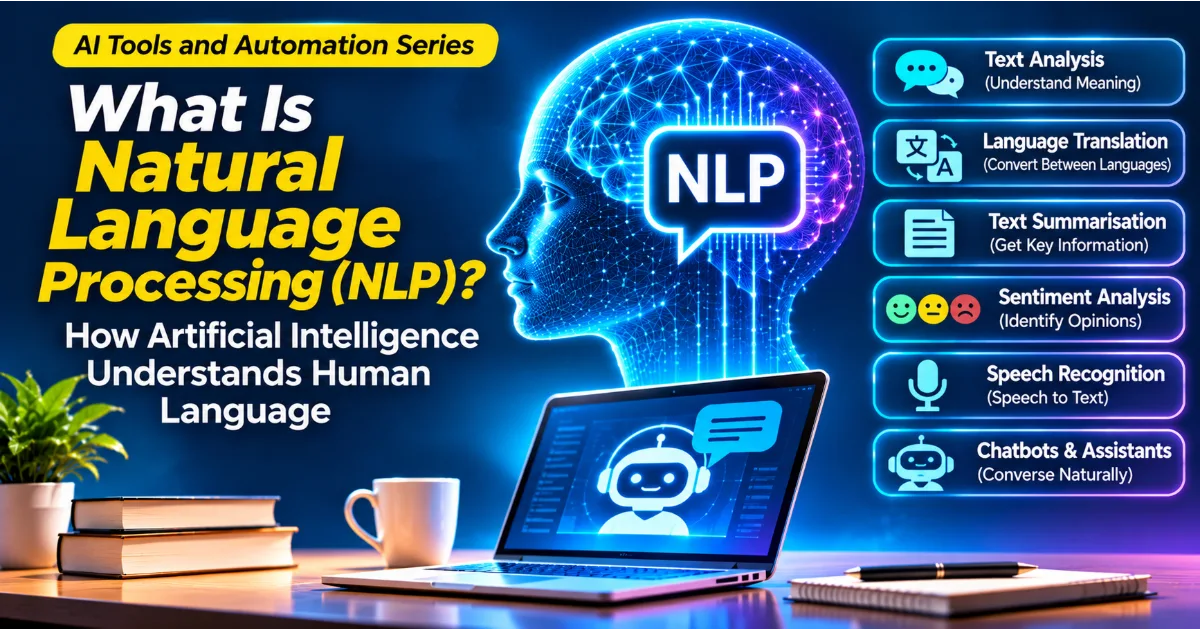
Natural Language Processing, or NLP, is the area of AI concerned with enabling computers to process and work with human language.
Deep learning has significantly improved many NLP applications.
Earlier NLP systems often relied heavily on manually designed linguistic rules and features. Deep learning models can learn language representations from large collections of text.
Applications include machine translation, sentiment analysis, text classification, question answering, summarisation, and conversational AI.
Modern transformer-based language models can process context and generate responses based on patterns learned during training.
However, fluent language generation does not guarantee factual accuracy. A model may produce a convincing response containing incorrect or unsupported information.
Users and developers must evaluate generated content carefully, particularly in professional, educational, legal, and technical settings.
Deep Learning and Computer Vision
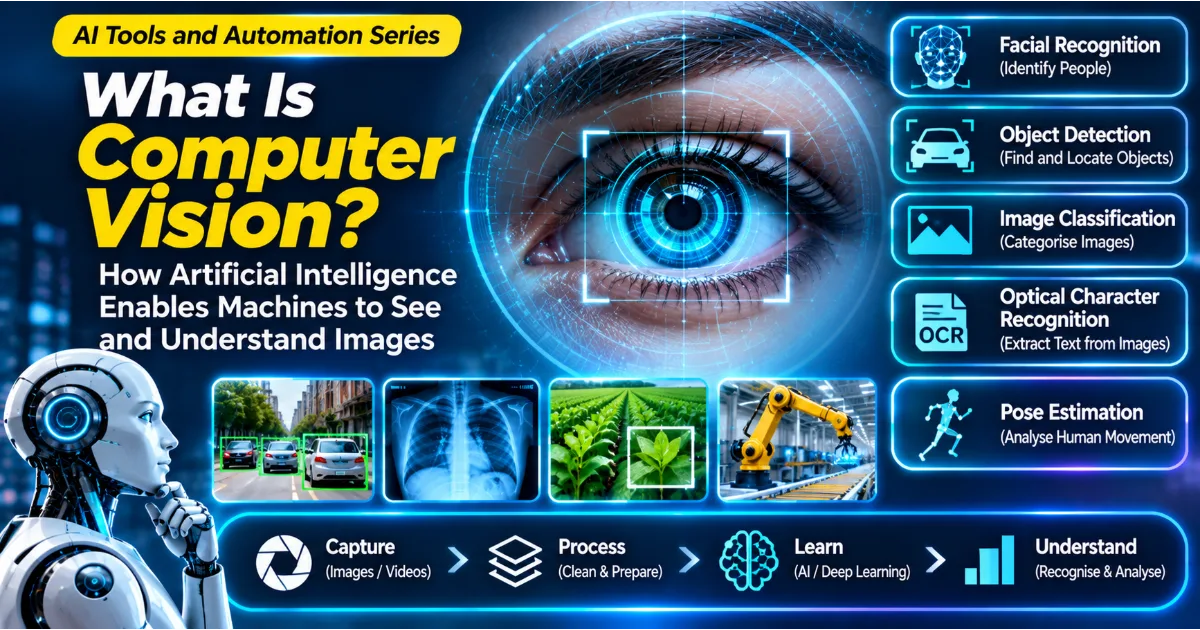
Computer Vision is the field of AI concerned with enabling computers to interpret visual information.
Deep learning has played a major role in advancing computer vision systems.
These systems can identify objects, classify images, detect visual defects, track movement, and analyse video.
An object detection system may identify several objects within a single image and estimate their locations.
A facial recognition system may compare facial representations to support identity verification, subject to privacy and legal requirements.
A retail application may analyse product photographs to help organise inventory.
A computer vision system can also process satellite imagery to study land use, agricultural conditions, or environmental changes.
These applications demonstrate how deep learning can transform visual information into useful computational outputs.
Deep Learning and Speech Recognition
Speech recognition involves converting spoken language into text or another structured representation.
Deep learning models can analyse audio signals and learn relationships between sound patterns and language.
Modern speech recognition systems can support voice assistants, automatic transcription, caption generation, meeting summaries, and accessibility applications.
Speech processing must account for different accents, pronunciation, background noise, speaking speeds, and recording quality.
A model trained on limited speech patterns may perform poorly when it encounters unfamiliar accents or environmental conditions.
Deep learning has improved speech recognition, but reliable performance across different languages and speakers remains an important challenge.
Real-World Applications of Deep Learning
Deep learning is used in a growing number of industries. Its applications vary depending on the available data, technical requirements, and operational environment.
Healthcare and Medical Research
Deep learning models can analyse medical images and identify visual patterns that may be relevant to research or clinical workflows.
They are being studied and used in areas such as radiology, pathology, medical image segmentation, and certain forms of risk prediction.
A model may highlight regions in an image that deserve attention from a qualified professional.
Deep learning can also support research involving complex biological and medical datasets.
However, healthcare applications require careful validation, data protection, regulatory compliance, and professional oversight. A model's output should not be treated as a substitute for medical expertise.
Banking and Financial Services
Financial institutions use deep learning in certain applications involving fraud detection, transaction analysis, risk modelling, and customer service.
A model may analyse patterns across large collections of transactions to identify behaviour that differs from expected activity.
Deep learning can also support document processing and automated analysis of certain financial information.
Financial institutions must consider explainability, fairness, security, and regulatory requirements when deploying these systems.
Automotive Industry
Deep learning is used in computer vision and perception systems that support advanced driver assistance and autonomous driving research.
Vehicles may use cameras and other sensors to identify road markings, vehicles, pedestrians, traffic signals, and obstacles.
The system must interpret changing road conditions and operate reliably in complex environments.
These technologies require extensive testing because mistakes can have serious safety consequences.
Manufacturing
Manufacturers use deep learning for image-based quality inspection, equipment monitoring, and process optimisation.
A visual inspection system may analyse product images and identify scratches, missing components, or other visible defects.
Sensor-based models may also identify patterns associated with equipment performance.
Deep learning can help improve inspection efficiency, but it must be tested against real production conditions and different types of defects.
Retail and E-Commerce
Online retailers use deep learning for product recommendations, visual search, customer behaviour analysis, and certain demand forecasting applications.
Visual search allows customers to upload an image and find products with similar visual characteristics.
Recommendation systems can use customer interactions and product information to suggest relevant items.
Retailers must also consider privacy, fairness, and the potential effects of automated recommendations on customer experience.
Agriculture
Deep learning can help analyse crop photographs, identify visual signs of plant disease, monitor field conditions, and process satellite imagery.
A farmer may use a camera-equipped device to capture images of plants. A computer vision model can analyse the images and identify patterns associated with potential crop problems.
Such systems can support agricultural decisions, although field verification and local agricultural expertise remain important.
Cybersecurity
Deep learning is used in certain cybersecurity applications involving malware analysis, network monitoring, and detection of unusual activity.
A model may analyse patterns in network traffic or file behaviour and identify signals that deserve investigation.
However, cybersecurity threats constantly evolve. Deep learning systems must be combined with other security practices, including access controls, patch management, monitoring, threat intelligence, and incident response.
Education
Educational applications can use deep learning to support speech processing, language translation, automated feedback, and personalised learning tools.
For example, a language learning platform may analyse spoken responses and provide feedback about pronunciation.
An educational assistant may process a written question and generate an explanation.
These systems should support teachers and learners rather than replace the human relationships and professional judgement involved in education.
Entertainment and Media
Deep learning supports image generation, video analysis, recommendation systems, speech synthesis, and other media technologies.
Streaming platforms may use recommendation models to suggest films and programmes.
Creative tools may generate images or assist with audio production.
These applications also raise concerns about copyright, consent, authenticity, and the responsible use of synthetic media.
What Is the Difference Between Machine Learning and Deep Learning?
Machine Learning includes a wide range of algorithms that learn patterns from data. Deep Learning is a specialised subset that uses multilayer neural networks.
Traditional machine learning often requires developers to perform feature engineering, selecting or creating useful variables before training.
Deep learning can learn many useful features automatically, particularly when working with complex unstructured information.
Traditional machine learning models may work effectively with smaller datasets and require fewer computing resources, depending on the algorithm and problem.
Deep learning models often require more data and computational power, although modern techniques and pretrained models can reduce the resources required for particular applications.
Traditional algorithms may be easier to interpret. Deep learning models can be more difficult to explain because their learned representations are distributed across many parameters and layers.
Neither approach is always better. The correct choice depends on the problem, available data, performance requirements, cost, and need for explainability.
What Is the Difference Between Deep Learning and Generative AI?
Deep Learning is a technical approach that uses multilayer neural networks to learn representations and perform tasks.
Generative AI refers to systems designed to create new content, such as text, images, audio, video, or code.
Many modern generative AI systems use deep learning architectures. Large language models use transformer-based neural networks, while several image generation systems use diffusion models or other deep learning methods.
However, not every deep learning model is generative.
A deep learning model that classifies photographs into categories is performing a predictive task rather than generating new content.
The distinction is important because Deep Learning describes how a model is built, while Generative AI describes a capability or type of application.
Advantages of Deep Learning
Deep learning offers several important advantages when applied to suitable problems.
One major advantage is automatic feature learning. Neural networks can discover useful representations from raw or minimally processed information, reducing the need for some forms of manual feature engineering.
Another advantage is the ability to process complex data. Deep learning is particularly effective in many image, audio, video, and language tasks.
Deep learning models can also scale with larger datasets and computing resources, although the relationship between scale and performance depends on the architecture, training process, and quality of data.
They can support automation by processing large amounts of information and producing predictions or generated content with limited manual intervention.
Deep learning also supports transfer learning. A model trained on one large dataset can sometimes be adapted to a related task, reducing the amount of training data and computing resources required.
These advantages have made deep learning an important foundation for modern AI development.
Limitations and Challenges of Deep Learning
Despite its capabilities, deep learning has significant limitations.
Large Data Requirements
Many deep learning models require substantial amounts of data to learn reliable patterns.
Obtaining suitable training data can be difficult, expensive, or time-consuming. Some domains have limited examples, particularly when data requires expert annotation.
High Computing Requirements
Training large neural networks can require powerful processors, specialised accelerators, and significant electricity.
The cost of training and operating models can be a major consideration for businesses and researchers.
Limited Explainability
Deep learning models can contain millions or billions of parameters. Understanding precisely why a model produced a particular output can be difficult.
This creates challenges in areas where decisions need to be explained or independently audited.
Bias in Training Data
Deep learning models can reproduce biases present in their training data.
If certain groups, languages, environments, or conditions are poorly represented, the model may perform less reliably for them.
Overfitting
A deep learning model may learn the training data too specifically and fail to generalise to new examples.
Developers use suitable validation methods, regularisation, data augmentation, and other techniques to reduce this risk.
Security Vulnerabilities
Machine learning systems can be affected by adversarial inputs, data poisoning, model theft, and other security threats.
Developers must consider how a model could be manipulated or misused.
Changing Conditions
A model trained under one set of conditions may perform poorly when the real-world environment changes.
Monitoring and maintenance are therefore important parts of responsible deployment.
Environmental and Operational Costs
Large-scale training and inference can require significant computing resources.
Organisations should consider energy consumption, infrastructure costs, and the actual value created by the model before deploying expensive systems.
What Is Transfer Learning?
Transfer learning is a technique in which knowledge learned by a model on one task is reused to help with another related task.
Training a deep learning model from the beginning can require substantial data and computing resources.
Transfer learning offers an alternative. Developers can start with a model that has already learned useful representations from a large dataset and adapt it to a specific application.
For example, an image recognition model trained on a broad collection of photographs may already recognise general visual features such as edges, textures, and shapes.
A developer can adapt that model to identify a smaller set of specialised objects using additional task-specific examples.
Transfer learning is widely used in computer vision and natural language processing.
It can reduce training requirements, but developers must ensure that the original model is suitable for the new task and that the adapted model is evaluated properly.
What Is Fine-Tuning?
Fine-tuning is the process of further training an existing model on a more specific dataset or task.
A pretrained language model may already understand many general language patterns. Fine-tuning can adapt its behaviour to a particular domain, such as technical support, legal document classification, or product information processing.
A pretrained image model may be fine-tuned to recognise specific types of manufacturing defects.
Fine-tuning can improve performance for specialised tasks, but it requires suitable data and careful evaluation.
It is not a guarantee that the model will become more accurate. Poor-quality training examples or unsuitable training settings can reduce performance.
What Skills Are Required to Learn Deep Learning?
Deep learning combines programming, mathematics, statistics, data analysis, and practical experimentation.
Beginners do not need to master every advanced topic before starting. A gradual learning path makes the subject more manageable.
Learn Python Programming
Python is widely used in deep learning because of its extensive libraries and development ecosystem.
Start with variables, data types, conditions, loops, functions, lists, dictionaries, and basic file handling.
After learning the fundamentals, practise working with datasets and numerical operations.
Understand Basic Mathematics
Mathematics provides the foundation for understanding neural networks.
Important topics include linear algebra, matrices, vectors, functions, derivatives, probability, and statistics.
You do not need to become a mathematician to begin experimenting, but understanding these concepts will make it easier to understand how neural networks learn.
Learn Machine Learning Fundamentals
Before studying complex neural network architectures, understand supervised learning, unsupervised learning, training data, validation, testing, overfitting, underfitting, and model evaluation.
These concepts are essential for understanding deep learning workflows.
Explore NumPy and Data Processing
NumPy is a Python library used for numerical computing.
Pandas can help organise and analyse structured datasets.
Matplotlib can be used to create visualisations that help identify patterns and evaluate data.
These tools provide a foundation for working with machine learning projects.
Learn a Deep Learning Framework
PyTorch and TensorFlow are widely used frameworks for developing and training neural networks.
They provide tools for defining network architectures, performing mathematical operations, calculating gradients, and training models.
Beginners can start by building a small neural network that classifies a simple dataset.
Explore Computer Vision and NLP
After learning the fundamentals, choose an area that interests you.
Computer vision projects may involve image classification or object detection.
Natural language processing projects may involve text classification, sentiment analysis, or language modelling.
Working on focused projects helps develop practical understanding.
Build a Portfolio
A portfolio of practical projects can demonstrate your ability to apply deep learning concepts.
You might build an image classification application, a handwritten digit recogniser, a basic sentiment analysis model, or a speech transcription prototype.
Document the problem, dataset, model, evaluation results, limitations, and lessons learned.
A strong portfolio should explain not only what the model achieved but also how its performance was tested.
A Beginner-Friendly Deep Learning Project
A handwritten digit recognition application is a useful introductory project.
The objective is to train a neural network that can recognise handwritten digits from zero to nine.
The project begins with a labelled image dataset containing examples of handwritten digits.
Each image is converted into numerical pixel values. The model receives these values as inputs and learns to identify patterns associated with different digits.
A simple neural network or convolutional neural network can be trained using the labelled examples.
After training, the model is evaluated using images that were not included in the training data.
Developers examine the model's predictions and identify which digits are most frequently confused.
For example, certain handwritten forms of the numbers three, five, and eight may look similar. The model may struggle when the handwriting is unclear or unusually shaped.
The project demonstrates data preparation, neural network training, evaluation, and prediction.
It is a manageable way for beginners to understand how deep learning works in practice.
The Future of Deep Learning
Deep learning continues to evolve as researchers develop more efficient architectures, improved training methods, and new applications.
One important direction is model efficiency. Researchers are exploring methods that allow powerful models to operate with fewer parameters, lower memory requirements, and reduced computing costs.
Another area is multimodal learning. Models are increasingly being developed to process combinations of text, images, audio, video, and other forms of information.
Deep learning is also becoming more closely connected with robotics. Robots can use visual perception, sensor information, and learned policies to interact with physical environments.
Scientific research is another important area. Deep learning models can help researchers analyse complex biological, chemical, and physical datasets.
Explainability and safety will also become increasingly important. As deep learning systems influence more consequential decisions, developers and organisations will need better methods for evaluating their reliability and communicating their limitations.
There is also growing interest in running AI models directly on personal devices and specialised hardware. This can improve responsiveness and may reduce the need to transfer certain types of information to remote servers, although privacy depends on the complete system design.
The future of deep learning will not be determined only by making models larger. It will also depend on efficiency, reliability, accessibility, safety, and the ability to solve practical problems.
Conclusion: Deep Learning Is Powering a New Generation of AI
Deep Learning is one of the most important technologies behind modern Artificial Intelligence. It uses multilayer neural networks to learn patterns and representations from data, making it particularly useful for complex tasks involving images, audio, video, language, and other forms of information.
Its major architectures include feedforward neural networks, convolutional neural networks, recurrent neural networks, LSTMs, GRUs, transformers, autoencoders, GANs, and diffusion models. Each architecture has different characteristics and is suitable for particular applications.
Deep learning has contributed to progress in healthcare research, financial services, manufacturing, transportation, education, cybersecurity, agriculture, and entertainment. It also provides the technical foundation for many modern generative AI systems.
However, deep learning is not without challenges. It can require large datasets, powerful computing resources, careful evaluation, and ongoing maintenance. Models may produce inaccurate results, inherit bias, and be difficult to explain.
Understanding deep learning requires more than knowing the names of neural network architectures. It involves learning how data is prepared, how models are trained, how performance is measured, and how systems are deployed responsibly.
For beginners, Python, mathematics, machine learning fundamentals, and practical projects provide a strong starting point.
Deep learning is helping computers process complex information in increasingly capable ways. Understanding how it works gives us a clearer view of the technology shaping the next generation of Artificial Intelligence.
Continue the Discussion
Which deep learning application interests you the most: image recognition, speech recognition, language models, autonomous systems, or AI-generated images?
Have you ever used an AI application that recognises images, understands speech, or generates content? Share your experience and tell us which technology you would like to explore in greater detail.
#DeepLearning #ArtificialIntelligence #NeuralNetworks #MachineLearning #AITools