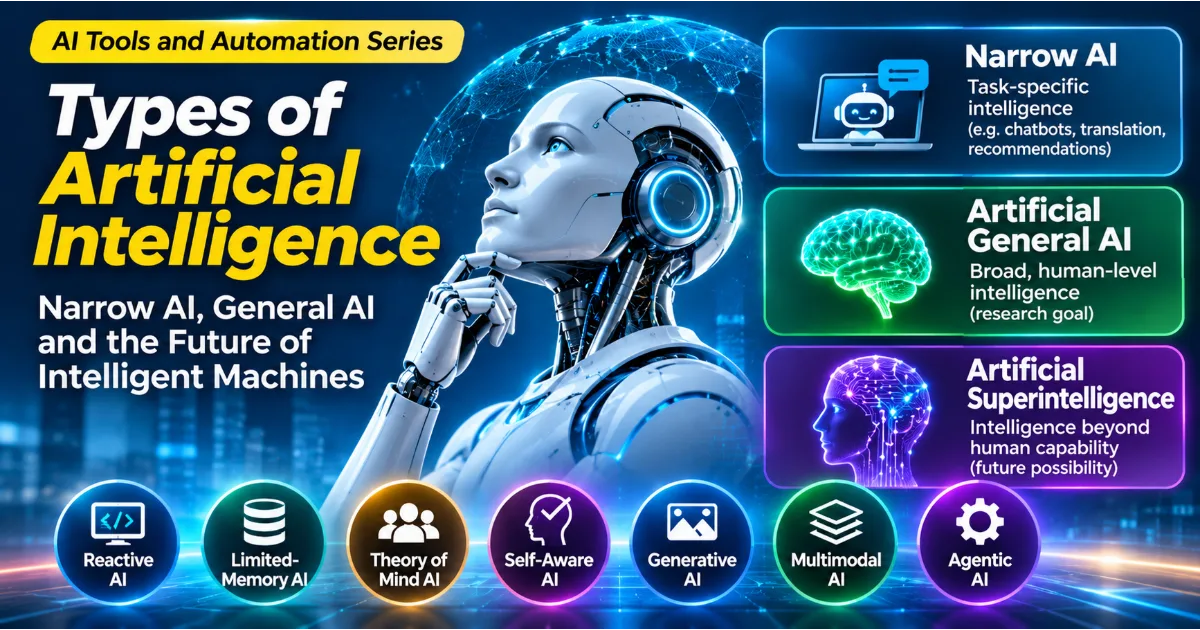
Artificial Intelligence has become part of everyday life. People use AI-powered applications to write emails, translate languages, generate images, receive recommendations, analyse information, navigate unfamiliar roads, and automate repetitive tasks. Businesses use it to understand customers, improve operations, detect unusual activities, and make better decisions. Although these applications may appear very different, they share an underlying idea: using computer systems to perform tasks that traditionally require some form of human intelligence.
Many people use artificial intelligence without understanding what happens behind the screen. When someone asks an AI assistant a question, how does it understand the request? When a streaming platform recommends a movie, how does it decide what the viewer might enjoy? When an image generator creates a picture from a written description, how does it turn words into visual content? These questions lead to an important topic: how artificial intelligence actually works.
Understanding the working principles of AI does not require advanced mathematics or programming knowledge. The basic concepts can be explained through familiar examples, from how children learn to recognise objects to how a computer improves its predictions after analysing thousands of examples.
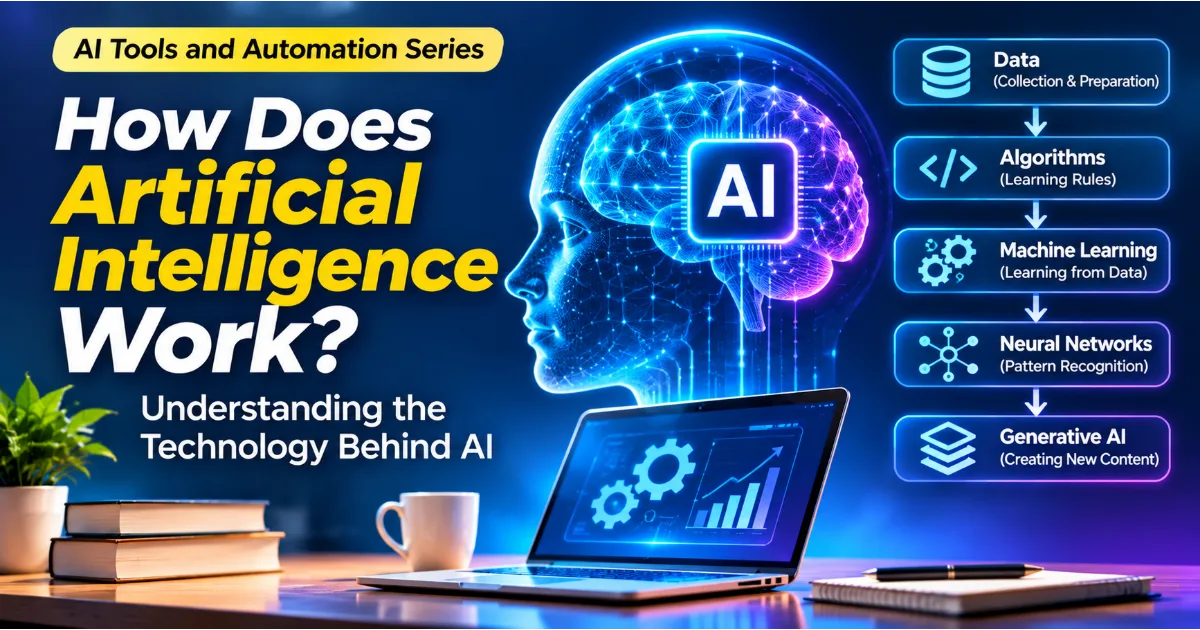
This article explores the complete process behind artificial intelligence, including data collection, algorithms, machine learning, neural networks, model training, prediction, generative AI, and continuous improvement. It also explains the limitations of AI and why human judgement remains essential when using intelligent systems.
Continue Reading
What Happens When You Use Artificial Intelligence?
Imagine opening an AI assistant and typing a question: "Explain how solar energy works in simple language." Within seconds, the system produces an answer that explains sunlight, solar panels, electricity generation, and energy storage.
The response may look like a normal conversation, but several computational processes take place behind the scenes. The system receives the text, processes the information, identifies patterns and relationships, and generates a response based on what it has learned during training.
A simplified AI workflow can be understood through five major stages.
Input: The system receives information from a user or another source. This information could be text, an image, audio, video, numerical data, or sensor readings.
Processing: The system converts the input into a format it can analyse. It identifies relevant features, patterns, relationships, or signals.
Model execution: The trained AI model processes the information using mathematical operations and learned parameters.
Output: The system produces a result, such as a prediction, recommendation, classification, generated response, or action.
Evaluation and improvement: Depending on the application, the result may be evaluated using feedback, testing, or newly available data. Developers can use this information to improve future versions of the system.
These stages describe a simplified process. Real-world AI systems may contain many additional components, including databases, safety filters, retrieval systems, application interfaces, and monitoring tools.
1. Data: The Foundation of Artificial Intelligence
Data is one of the most important ingredients in artificial intelligence. An AI system needs information to identify patterns, understand relationships, make predictions, or generate content.
Consider how a child learns to recognise a dog. The child may see dogs of different sizes, colours, and breeds. Over time, the child begins to recognise common characteristics such as four legs, a tail, fur, and a particular shape. Eventually, the child can identify a dog they have never seen before.
An AI image recognition system can learn a similar task by analysing many labelled images. It examines visual patterns and learns which combinations of features are associated with particular categories.
Data used in AI applications can come from many sources. It may include written documents, photographs, recorded conversations, videos, business transactions, product information, weather observations, medical images, customer interactions, and information collected by sensors.
The type of data depends on the problem being solved. A system designed to recognise spoken language requires audio data. A fraud detection system may use transaction records. A recommendation engine may analyse viewing history, ratings, and user interactions.
Different Types of Data Used in AI
Structured data is organised into a predefined format, usually in rows and columns. Examples include customer databases, financial transactions, inventory records, and sales reports. Structured data is commonly used in business analytics, forecasting, and fraud detection.
Unstructured data does not follow a fixed tabular structure. Documents, emails, photographs, audio recordings, and videos are examples. Many modern AI systems are designed to process large amounts of unstructured information.
Semi-structured data contains some organisational elements without following a strict table format. JSON documents, XML files, and certain application logs are common examples.
The quality of data matters as much as its quantity. If an AI system learns from incomplete, inaccurate, outdated, or biased information, its outputs may also become unreliable. A large dataset does not automatically guarantee an intelligent or trustworthy system.
Why Data Quality Matters
Imagine a company developing an AI system to shortlist job applicants. If its training data contains historical hiring decisions that unfairly favoured certain groups, the system may learn and reproduce those patterns.
Similarly, a forecasting system trained on incorrect sales records may produce misleading predictions. A language model trained on unreliable material may generate inaccurate information.
Good AI development therefore involves collecting relevant information, checking its quality, removing unnecessary duplication, managing missing values, and considering privacy and legal requirements.
Data preparation is not merely a technical step. It is an important part of building responsible AI systems.
2. Algorithms: The Instructions Behind AI
An algorithm is a set of instructions or mathematical procedures used to solve a problem. Algorithms are not exclusive to artificial intelligence. They are used throughout computing, from sorting numbers to searching databases.
Artificial intelligence uses algorithms to identify patterns, learn relationships, make predictions, and generate outputs.
Consider a simple example. A person wants to determine whether an email is spam. An algorithm can examine characteristics such as suspicious words, unusual links, sender information, and message patterns. It then uses these characteristics to estimate whether the message is likely to be spam.
Different algorithms solve different types of problems. Some are designed to classify information into categories. Others estimate numerical values, identify groups, detect unusual behaviour, or generate new content.
Common Categories of AI Algorithms
Classification algorithms assign information to predefined categories. An email filter that labels messages as spam or legitimate is one example.
Regression algorithms estimate numerical values. A property price prediction system may use information such as location, area, property age, and recent sales to estimate a price.
Clustering algorithms group similar items without requiring predefined categories. A retailer might use clustering to identify customer segments based on purchasing behaviour.
Decision trees make decisions through a sequence of questions or conditions. For example, a simple loan assessment model might consider income, existing debt, repayment history, and other relevant factors.
Neural network algorithms use interconnected mathematical units to learn complex patterns. They are widely used in image recognition, language processing, speech recognition, and generative AI.
The choice of algorithm depends on the problem, the available data, the expected output, and the level of accuracy required.
3. Machine Learning: How AI Learns from Data
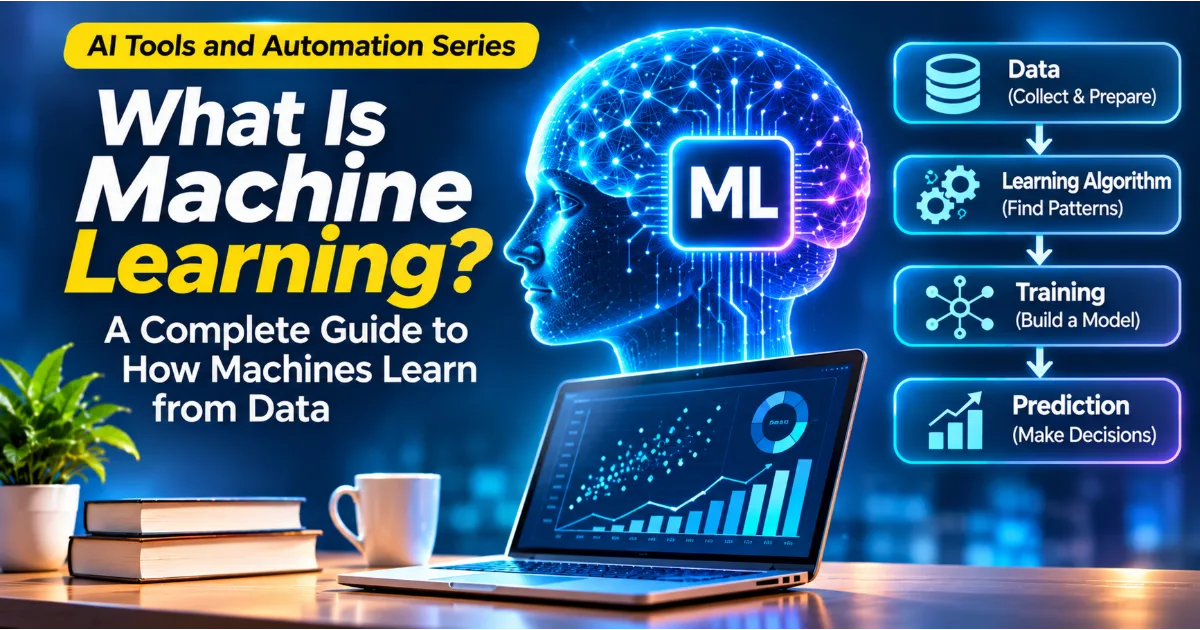
Machine learning is a major branch of artificial intelligence. It allows computer systems to learn patterns from data and use those patterns to make predictions or decisions without requiring developers to write a separate instruction for every possible situation.
Traditional programming generally follows a direct approach. A developer writes rules, provides input, and the computer produces an output according to those rules.
Machine learning takes a different approach. Developers provide data and a learning method. The algorithm identifies patterns in the data and builds a model that can be used to process new information.
For example, imagine developing a system that predicts house prices. Instead of manually writing a rule for every possible combination of property size, location, and age, developers can provide historical property data. A machine learning algorithm analyses the examples and learns relationships between property characteristics and prices.
After training, the model can estimate the price of a property using information it has not previously encountered.
How a Machine Learning Model Learns
The process generally begins with a clearly defined problem. Developers decide what the system should predict or classify.
Next, they collect relevant data. For a house price prediction model, this could include property size, location, number of rooms, age, and historical sale prices.
The data is prepared and divided into suitable portions for training, validation, and testing. The training data is used to teach the model. Validation data helps developers compare model configurations and identify problems during development. Test data provides an evaluation using examples that were not used to train the model.
The learning algorithm examines the training examples and adjusts internal parameters to reduce prediction errors. After training, developers evaluate the model to determine how well it performs on new information.
If the results are unsatisfactory, they may improve the data, change the algorithm, adjust model settings, or redesign parts of the system.
A Simple Example of Machine Learning
Suppose an online store wants to predict whether a customer is likely to purchase a product.
The system may analyse historical information such as the products viewed, time spent on product pages, previous purchases, search activity, and shopping cart behaviour.
It learns patterns associated with previous purchases and uses them to estimate the likelihood of a future purchase.
The prediction is not a guarantee. A customer may purchase something unexpected or leave the website without buying anything. Machine learning produces estimates based on patterns, not certainty about the future.
4. The Three Main Types of Machine Learning
Machine learning is commonly divided into three major approaches: supervised learning, unsupervised learning, and reinforcement learning. Each approach is useful for different situations.
Supervised Learning
Supervised learning uses labelled training data. This means that the examples include both the input information and the expected answer.
Imagine teaching a computer to recognise cats and dogs. Developers provide thousands of images along with labels identifying each image as a cat or a dog. The algorithm studies the visual patterns associated with each category and builds a model.
After training, the system can examine a new image and estimate whether it contains a cat or a dog.
Supervised learning is widely used in spam detection, credit risk assessment, image classification, sales forecasting, medical image analysis, and customer churn prediction.
Its effectiveness depends heavily on the quality and relevance of the labelled examples.
Unsupervised Learning
Unsupervised learning works with data that does not have predefined labels. Instead of being told what the correct answer should be, the system searches for patterns, similarities, or hidden structures.
Consider a supermarket that has information about thousands of customers but does not know how to divide them into useful groups. An unsupervised learning algorithm can analyse purchasing behaviour and identify clusters of customers with similar habits.
One group might frequently purchase household essentials, another might buy premium products, and another might make seasonal purchases.
These groups can help businesses understand customer behaviour and design more relevant marketing strategies.
Unsupervised learning is useful for customer segmentation, anomaly detection, pattern discovery, and exploratory data analysis.
Reinforcement Learning
Reinforcement learning involves an agent learning through interaction with an environment. The agent takes actions, receives feedback in the form of rewards or penalties, and adjusts its behaviour to improve its results.
A familiar example is a computer learning to play a game. Initially, it may make poor decisions. As it plays more games, it receives feedback about the consequences of its actions. Over time, it can learn strategies that produce better outcomes.
Reinforcement learning has applications in robotics, game-playing systems, resource allocation, and certain optimisation problems.
It is particularly useful when a system must make a sequence of decisions and the consequences of one action may affect later outcomes.
5. Neural Networks: Learning Complex Patterns
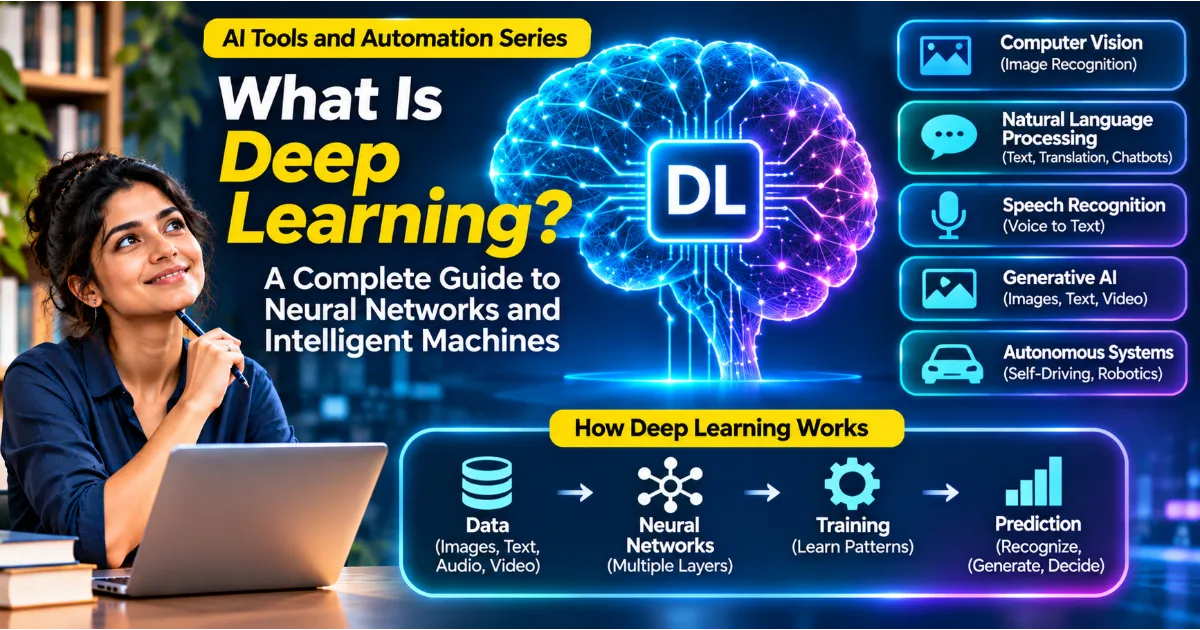
Neural networks are computational models inspired in a broad way by the interconnected structure of biological nervous systems. They consist of connected mathematical units, often called neurons, organised into layers.
A typical neural network contains an input layer, one or more hidden layers, and an output layer.
The input layer receives information. Hidden layers process it through mathematical operations. The output layer produces a result, such as a classification, prediction, or numerical estimate.
Each connection has a weight that influences how much one unit contributes to another. During training, the network adjusts these weights to improve its performance.
For example, an image recognition model may learn to identify a vehicle by examining different visual patterns. Earlier layers may respond to simple features such as edges and shapes, while deeper layers can learn more complex combinations that help distinguish cars, buses, and motorcycles.
This layered learning process allows neural networks to solve problems that are difficult to handle using simple manually written rules.
What Is Deep Learning?
Deep learning is a specialised area of machine learning that uses neural networks with multiple processing layers.
The word "deep" refers to the presence of multiple layers in the network. These layers enable the model to learn increasingly complex representations of information.
Deep learning is particularly important in modern AI applications involving images, speech, natural language, video, and large-scale pattern recognition.
For example, a speech recognition system can process audio signals and identify patterns associated with spoken words. A computer vision system can analyse photographs and identify objects, people, or activities.
Deep learning often requires substantial computing resources and large amounts of training data, although the exact requirements depend on the task and model design.
6. Training an AI Model
Training is the process through which an AI model learns from examples. It is one of the most important stages in developing a machine learning system.
During training, the model makes predictions based on its current parameters. These predictions are compared with the expected results when labelled data is available. The difference between the prediction and the expected result is measured using a loss function.
The training algorithm then adjusts the model's parameters to reduce the loss. This process is repeated across many examples and training iterations.
A simplified example helps explain this process.
Imagine a model that predicts whether a customer will purchase a product. During training, it receives information about previous customers and their purchasing decisions. It makes an initial prediction, compares that prediction with the actual outcome, measures the error, and adjusts its parameters.
After processing many examples, the model may become better at identifying patterns associated with purchasing behaviour.
What Is a Loss Function?
A loss function measures how far a model's prediction is from the expected answer. Different problems use different loss functions.
For example, a classification model may use a loss function designed to evaluate the difference between predicted class probabilities and the actual labels. A numerical forecasting model may use a function that measures the size of prediction errors.
Reducing training loss is important, but it does not automatically mean the model will perform well in real-world situations. A model can become too closely fitted to its training examples and fail to generalise to new data.
What Is Overfitting?
Overfitting occurs when a model learns the training examples too specifically, including patterns that do not represent the wider problem.
Imagine a student who memorises the answers to a set of practice questions but does not understand the underlying subject. The student may perform well on familiar questions but struggle when the examination presents different examples.
An overfitted AI model behaves in a similar way. It may perform very well on training data but poorly on new information.
Developers use techniques such as validation, regularisation, suitable data selection, and careful model evaluation to reduce this risk.
What Is Underfitting?
Underfitting occurs when a model is too simple or insufficiently trained to capture important patterns in the data.
A student who has studied only a small part of a subject may struggle with both practice questions and unfamiliar problems. Similarly, an underfitted model may perform poorly even on the training data.
The objective of model development is to find an appropriate balance between learning useful patterns and generalising to new situations.
7. What Happens After Training?
A trained model is not automatically ready for every real-world application. It must be evaluated, integrated into an application, monitored, and maintained.
Testing helps developers understand whether the model performs adequately under expected conditions. They may evaluate accuracy, precision, recall, error rates, response speed, and other measures depending on the application.
Once the model meets the required standards, it can be deployed. Deployment means making the model available for use through an application, website, software service, or internal business system.
For example, a retailer may deploy a recommendation model on its website. When a customer views a product, the system processes relevant information and returns a list of recommended items.
However, the work does not end at deployment. Customer behaviour, market conditions, and the information being processed can change. A model that performed well during development may become less effective over time.
Monitoring helps identify changes in model performance, data quality, and operational behaviour. Developers may retrain or update the model when appropriate.
8. How Generative AI Works
Generative AI is a category of artificial intelligence designed to create new content based on patterns learned during training.
Unlike a traditional classification system that identifies whether an image contains a cat or a dog, a generative model can create an entirely new image based on a description.
Generative AI can produce written text, computer code, images, audio, video, and other forms of content.
Examples include writing assistants, image generators, music generation tools, coding assistants, and conversational AI applications.
How Text Generation Works
Many modern text generation systems use large language models. These models are trained on large collections of text and learn statistical relationships between words, phrases, and broader language patterns.
When a user enters a prompt, the system processes the text and generates a response by predicting suitable next tokens. A token may represent a complete word, part of a word, or another text unit.
The model generates content one token at a time, using the context available in the conversation and the patterns learned during training.
For example, if a user asks, "Write a professional email requesting a meeting," the model processes the instruction and generates text that fits the requested format and context.
The result can appear remarkably natural because the model has learned complex relationships in language. However, it does not necessarily understand the world in the same way a human does. It can generate plausible-sounding statements that are inaccurate.
What Is a Large Language Model?
A large language model, commonly called an LLM, is a machine learning model trained to process and generate human language.
LLMs can perform tasks such as answering questions, summarising documents, translating text, drafting emails, explaining technical concepts, and assisting with programming.
They are trained using large collections of language data and often use transformer-based neural network architectures.
The term "large" generally refers to the scale of the model, including the number of learned parameters and the resources used in training. Size alone does not determine quality. Training data, architecture, evaluation, and application design also matter.
How AI Image Generation Works
AI image generation systems learn relationships between visual information and other forms of input, such as text descriptions.
A user might enter a prompt requesting a photograph of a mountain village during winter. The model processes the description and generates an image that reflects learned associations between words, objects, colours, textures, and visual composition.
Many modern image generation systems use diffusion-based techniques. In simplified terms, these models learn how to transform noisy visual information into a coherent image through a sequence of denoising steps.
The generated result is not necessarily a copy of one specific training image. It is produced by the model using learned patterns and its generation process.
9. What Are Transformers in Artificial Intelligence?
Transformers are a neural network architecture that became particularly important in natural language processing and modern generative AI.
One of their central mechanisms is called attention. Attention allows a model to evaluate relationships between different parts of the input when processing information.
Consider the sentence: "The student placed the book on the table because it was heavy."
To interpret the sentence, a language system needs to understand how different words relate to one another. Attention mechanisms help models identify relevant relationships across the input rather than processing every word as an isolated item.
Transformers can process sequences efficiently and learn complex contextual relationships. This architecture has played a major role in the development of large language models and several other AI applications.
Transformers are not the only architecture used in artificial intelligence. Other architectures remain useful for particular problems, including convolutional neural networks for certain image tasks and recurrent neural networks for some sequence-processing applications.
10. How AI Understands Different Types of Inputs
AI systems can process much more than written text. Different systems are designed to work with different kinds of information.
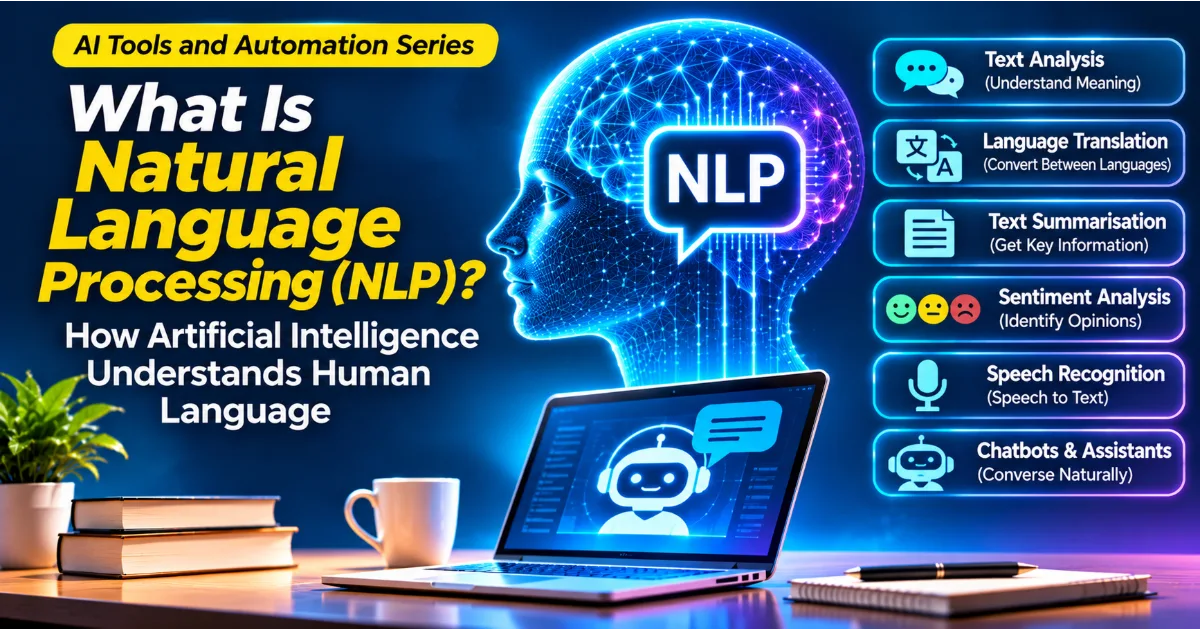
Natural language processing focuses on the interaction between computers and human language. It supports tasks such as translation, sentiment analysis, summarisation, and text classification.
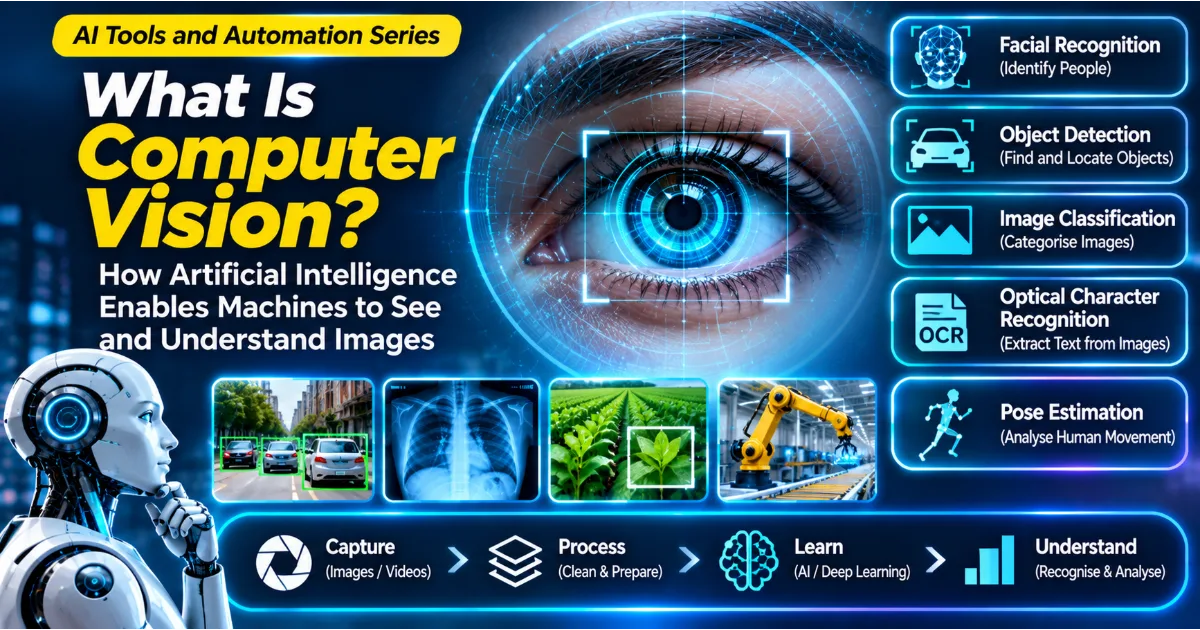
Computer vision allows systems to analyse images and videos. It can be used for object detection, image classification, quality inspection, and medical image analysis.
Speech recognition converts spoken language into text or structured information. It is used in voice assistants, transcription services, and automated customer support.
Audio processing can also support speaker recognition, sound classification, and music analysis.
Multimodal AI combines multiple types of input and output. A multimodal system may process text and images together, understand a spoken question about a photograph, or generate content using more than one media type.
These capabilities allow AI applications to interact with people in increasingly flexible ways.
11. How AI Makes Recommendations
Recommendation systems are among the most familiar applications of artificial intelligence.
When a streaming platform suggests a film, an online store recommends a product, or a music application creates a personalised playlist, a recommendation system is often involved.
One approach is collaborative filtering. It uses patterns in the behaviour of multiple users to identify items that people with similar preferences may enjoy.
For example, if two users frequently watch similar films, the system may recommend a film watched by one user to the other.
Another approach is content-based filtering. It examines characteristics of the items themselves. A movie recommendation system might consider genre, actors, language, themes, and other attributes.
Some systems combine multiple approaches to generate more relevant recommendations.
Recommendation systems can improve user experience, but they also have limitations. They may repeatedly suggest similar content, reduce exposure to unfamiliar ideas, or reflect incomplete information about a person's interests.
12. How AI Is Used in Everyday Life
Artificial intelligence is no longer limited to research laboratories or large technology companies. It is integrated into many products and services that people use every day.
Smartphones use AI for facial recognition, photography enhancements, voice recognition, predictive text, and intelligent assistance. Navigation applications use machine learning and other computational techniques to estimate traffic conditions and suggest routes.
Email applications use automated systems to filter spam, identify suspicious messages, and organise incoming communication. Online stores use recommendation systems to suggest products based on browsing and purchasing behaviour.
Banks use AI-assisted systems to identify unusual transactions and support fraud detection. Healthcare organisations use AI tools for certain medical imaging, administrative, and analytical tasks, with appropriate professional oversight.
Businesses use AI to analyse customer feedback, prepare reports, forecast demand, and automate repetitive processes.
These examples show that AI is not one single product. It is a collection of technologies that can be integrated into different applications.
13. Artificial Intelligence and Automation: What Is the Difference?
Artificial intelligence and automation are related, but they are not identical.
Automation refers to using technology to perform tasks with limited or no repeated human intervention. Traditional automation usually follows predefined rules.
For example, an automated email system can send a confirmation message whenever a customer completes an online purchase. The system follows a predefined condition: when an order is placed, send the confirmation.
Artificial intelligence adds capabilities such as pattern recognition, prediction, classification, and content generation.
Imagine a customer support system. Traditional automation may send a fixed response whenever a customer selects a particular menu option. An AI-powered system may analyse the customer's written question, identify the likely issue, and generate a relevant response.
When AI is combined with automation, organisations can build workflows that respond to information rather than simply following fixed instructions.
For example, an AI system may classify incoming invoices, extract relevant details, and send the information to an accounting workflow for review. The automation then routes the invoice to the appropriate person or system.
However, not every automated task needs AI. If a process is predictable and follows clear rules, traditional automation may be cheaper, easier to test, and more reliable.
14. Why AI Sometimes Makes Mistakes
Artificial intelligence can produce impressive results, but it is not perfect. Its outputs depend on training data, model design, input quality, and the conditions under which it is used.
One important limitation is bias. If the information used to train a model contains unfair or unrepresentative patterns, the model may reproduce those patterns.
Another limitation is incomplete information. A model may be asked to answer a question about a recent event even though its training information does not include that event. Without access to reliable current sources, it may produce an outdated or incorrect response.
Generative AI can also experience hallucinations. This term describes situations in which a system produces information that sounds convincing but is false, unsupported, or fabricated.
For example, an AI assistant may provide an incorrect statistic, invent a research paper, or explain a technical concept inaccurately.
AI systems can also struggle with ambiguity, unusual situations, complex reasoning, and context that requires specialised human experience.
The best approach is to treat AI outputs as information that may need verification, particularly when decisions involve finance, law, healthcare, employment, security, or other important matters.
15. Can AI Learn Continuously?
It is common to hear that AI learns from every interaction. However, this is not necessarily how deployed AI systems operate.
A model that has already been trained does not automatically change its underlying parameters every time a user asks a question.
Some systems use the current conversation as context to generate a relevant response. This can make the system appear to learn during the interaction, but it does not necessarily mean that the underlying model has been retrained.
Developers may collect feedback, evaluate performance, and use suitable new data to train updated versions. Some specialised systems also use online learning or other approaches that allow models to adapt during operation.
The process depends on the system's architecture, policies, privacy controls, and deployment design.
Understanding this distinction is important because users should not assume that every correction or conversation permanently changes an AI model.
16. What Is the Role of Human Intelligence?
Artificial intelligence can process large amounts of information quickly, identify patterns, and automate many tasks. However, human intelligence remains essential.
People define the problems that AI systems are intended to solve. They select objectives, evaluate results, establish boundaries, and decide how the technology should be used.
For example, an AI tool may analyse customer feedback and identify common complaints. However, a business leader must decide which issues should be addressed first, how resources should be allocated, and what changes are appropriate.
Similarly, an AI assistant may help draft a legal document, but qualified legal professionals must verify its accuracy and suitability before relying on it.
Human judgement is particularly important when decisions involve empathy, accountability, ethics, social context, and consequences for other people.
The most effective use of AI often comes from combining computational capabilities with human experience and critical thinking.
17. A Practical Example: Building an AI-Powered Customer Support System
Consider an online business that receives hundreds of customer messages every day. Customers ask about orders, payments, refunds, delivery schedules, account access, and product information.
Handling every message manually can consume significant time and resources.
An AI-powered customer support system can help manage this workload.
First, the business collects relevant information, including product documentation, frequently asked questions, support policies, and approved customer service responses.
Next, developers create or configure an AI system that can process customer messages and identify their likely intent.
When a customer asks, "Where is my order?", the system identifies that the request concerns order tracking. It may then connect to an authorised order management system to retrieve the relevant information.
If the customer asks about a refund, the system can retrieve the applicable refund policy and explain the next steps.
More complex or sensitive requests can be transferred to a human support representative.
The workflow combines several technologies: natural language processing, information retrieval, AI-generated responses, business databases, and automation.
It also requires appropriate safeguards. The system should protect customer information, avoid exposing data to unauthorised users, and escalate cases when it cannot provide a reliable answer.
This example demonstrates that practical AI applications often involve more than a single model. They combine models, software, databases, workflows, and human supervision.
18. How Beginners Can Start Learning How AI Works
You do not need to become a data scientist to understand artificial intelligence. Beginners can start by exploring the basic concepts and observing how different AI applications work.
Start with the difference between artificial intelligence, machine learning, deep learning, and generative AI. Understanding these terms provides a useful foundation.
Next, experiment with AI tools. Ask a writing assistant to explain a difficult topic, summarise a document, or create an outline. Try an image generation tool with a detailed description. Observe how changing the instructions affects the output.
Learn basic data concepts, including structured data, unstructured data, training data, testing data, and data quality.
If you are interested in the technical side, begin learning Python. It is widely used in data science and machine learning because of its extensive libraries and developer ecosystem.
You can then explore libraries such as scikit-learn for traditional machine learning and PyTorch or TensorFlow for deep learning.
Beginners should also learn how to evaluate AI results. Compare generated answers with trusted information, identify unsupported claims, and understand where human review is necessary.
Practical experimentation combined with foundational knowledge is an effective way to develop AI literacy.
19. The Future of Artificial Intelligence
Artificial intelligence continues to develop across several areas. Models are becoming more capable of processing different types of information, including text, images, audio, and video.
AI agents are another important area of development. These systems are designed to work towards goals by planning steps, using tools, retrieving information, and interacting with software under defined permissions.
Businesses are exploring AI-powered workflows for customer service, research, software development, operations, marketing, and data analysis.
Smaller and more specialised models are also important. Not every application needs a massive general-purpose model. A compact model designed for a specific task may be more efficient, cost-effective, and easier to deploy.
At the same time, responsible AI development is becoming increasingly important. Privacy, transparency, security, fairness, copyright, and accountability must be considered when designing and deploying intelligent systems.
The future of AI will not depend only on making models more powerful. It will also depend on making them more reliable, useful, accessible, secure, and appropriate for real-world applications.
Conclusion: Understanding the Technology Behind AI
Artificial intelligence works by using data, algorithms, and computational models to identify patterns, make predictions, process information, and generate outputs. Machine learning allows systems to learn from examples, while deep learning uses multilayered neural networks to solve complex tasks. Generative AI builds on these capabilities to create text, images, audio, code, and other forms of content.
Behind a simple AI interaction, there may be several stages involving input processing, model execution, information retrieval, prediction, and output generation. The exact process depends on the application.
Understanding these foundations helps people use AI more effectively. It also makes it easier to recognise the technology's limitations and avoid treating every AI-generated result as automatically correct.
Artificial intelligence is a powerful technology, but its value depends on how thoughtfully people apply it. Learning how it works is the first step towards using it responsibly in education, business, careers, and everyday life.
Continue the Discussion
Artificial intelligence may seem complicated at first, but understanding its basic working principles makes the technology easier to explore.
Have you ever wondered how an AI assistant generates answers, how a recommendation engine selects content, or how an image generator creates pictures from words? Which part of artificial intelligence would you like to understand in greater detail?
Share your thoughts, questions, and experiences. Your questions can help shape the next discussions in this series.
#ArtificialIntelligence #MachineLearning #DeepLearning #GenerativeAI #AITools