Understanding AI, how it works, where we use it, and why it is becoming an essential part of modern life.
Artificial Intelligence is one of the most discussed technologies in the world today. It is changing how people work, learn, communicate, create, conduct business, and solve problems. From AI chatbots that answer questions to intelligent systems that analyse large amounts of information, artificial intelligence is becoming increasingly visible in everyday life.
But what exactly is artificial intelligence? How does it work? Can machines really think like humans? Why can an AI assistant write an article, generate an image, explain a programming concept, or help someone analyse business data? Is AI something only technology professionals need to understand, or is it becoming relevant to everyone?
These are important questions, especially for people who are beginning their journey into AI tools and automation.
In our previous post, we asked how you are doing and how AI is going in your life. We wanted to understand your experiences, interests, challenges, and expectations. Now, before exploring individual AI tools and automation platforms, it is important to understand the technology behind them.
Continue Reading
This article will introduce artificial intelligence in simple language, explain its major concepts, explore practical applications, and discuss how individuals and businesses can begin using it responsibly.
1. What Is Artificial Intelligence?
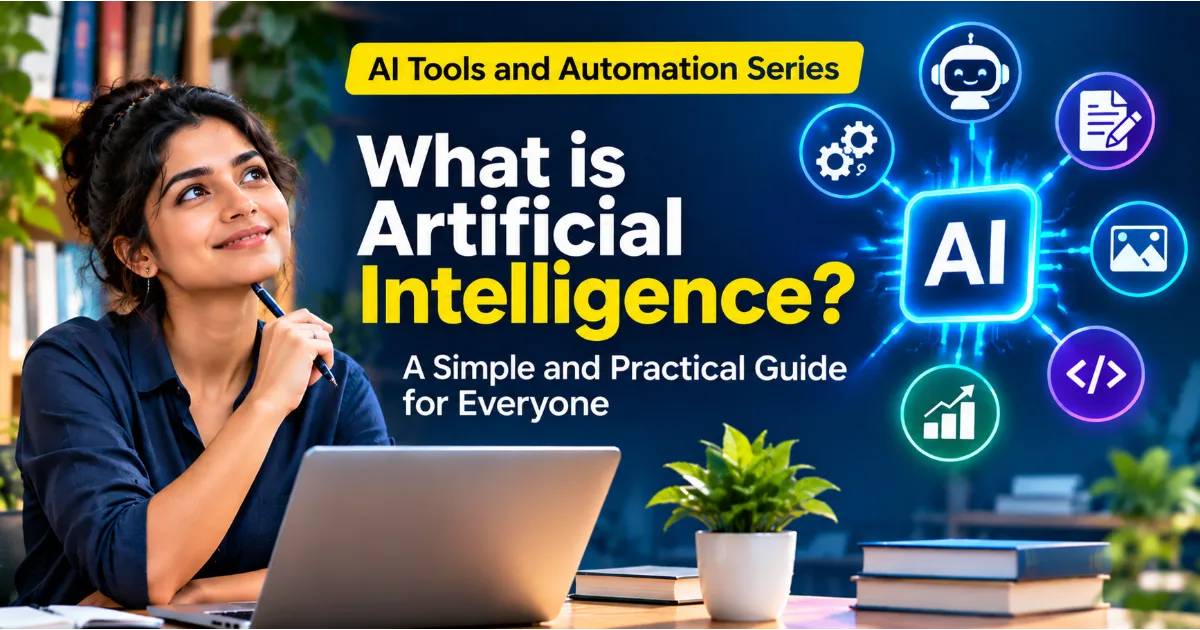
Artificial Intelligence, commonly known as AI, is a branch of computer science focused on developing systems that can perform tasks that normally require human intelligence. These tasks may include understanding language, recognising images, identifying patterns, making predictions, solving problems, processing information, and generating content.
Traditionally, computers have followed instructions written by human programmers. A conventional computer program performs operations according to predefined rules. For example, a calculator receives numbers and performs mathematical operations according to the instructions built into it.
Artificial intelligence introduces additional capabilities. Instead of relying exclusively on manually written rules for every possible situation, certain AI systems can learn patterns from data, use those patterns to make predictions, and improve their performance through training.
Consider an email application that identifies unwanted messages. A traditional system might block emails containing specific words or coming from known addresses. An AI-powered spam detection system can analyse patterns in messages, sender behaviour, links, formatting, and other characteristics to estimate whether an incoming email is likely to be spam.
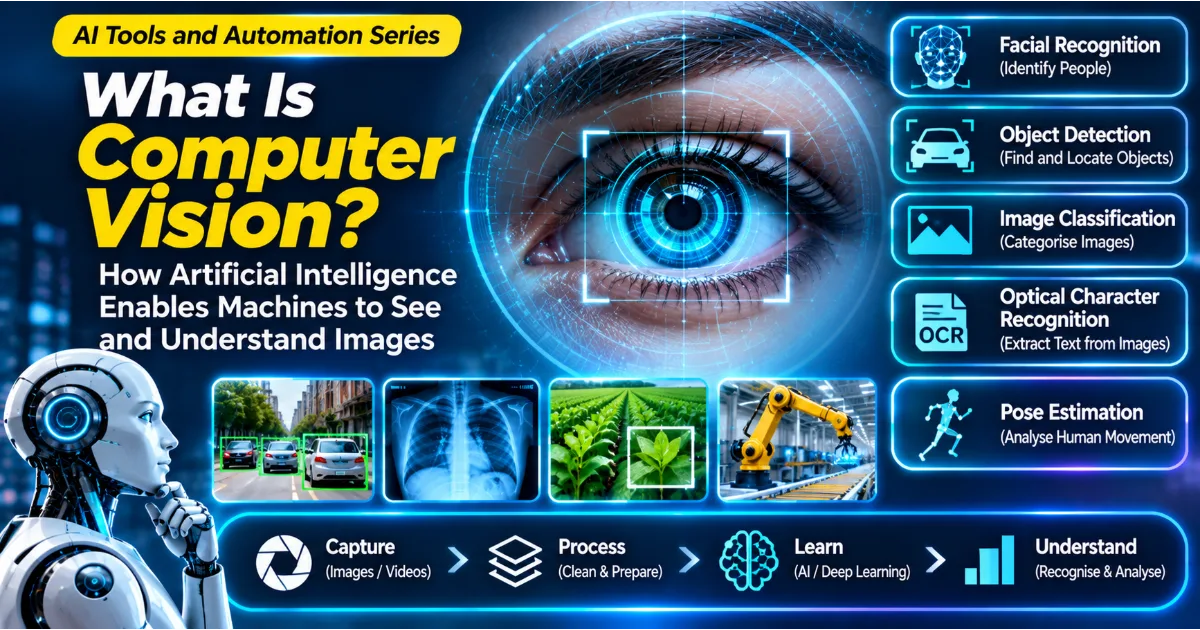
Similarly, an image recognition system can analyse photographs and identify objects, animals, people, or other visual elements. A language model can process written instructions and generate responses that resemble natural human communication.
Artificial intelligence does not mean that a computer has automatically developed human consciousness, emotions, or independent understanding. It means that the system has been designed to perform particular intelligent tasks using computational methods.
The important distinction is that AI systems can produce useful results through learned patterns and computational processes without necessarily understanding the world in the same way humans do.
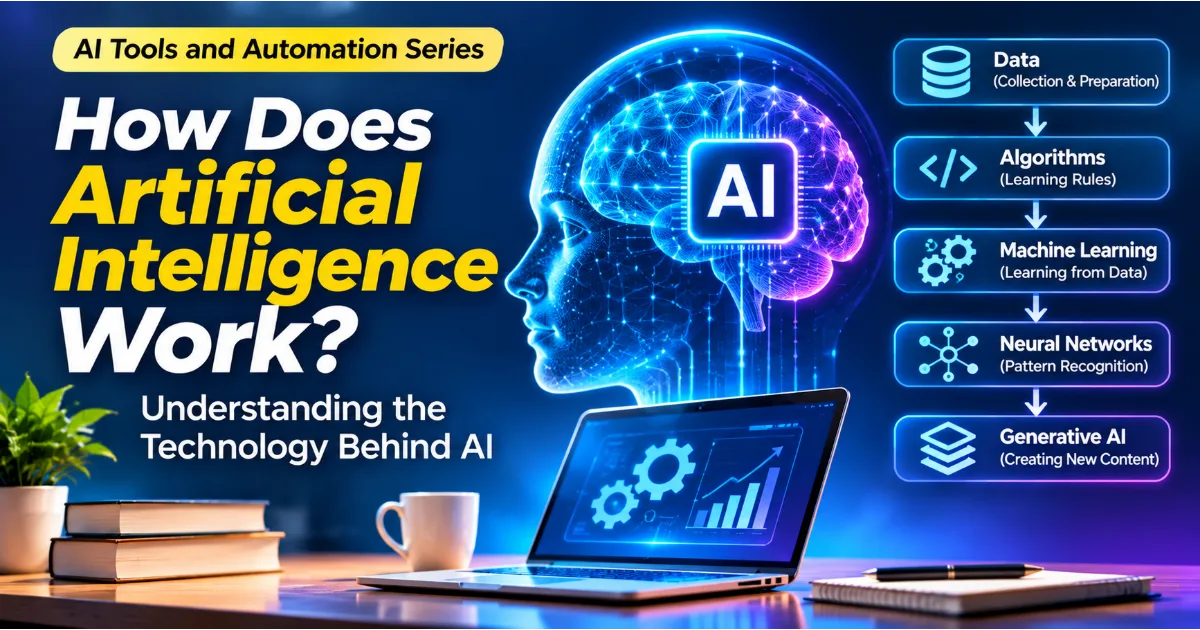
2. How Does Artificial Intelligence Work?
Artificial intelligence works through a combination of data, algorithms, mathematical models, computing infrastructure, and training processes. The exact mechanism depends on the type of AI system being developed, but many modern AI applications follow a similar general process.
First, a system receives information. This information may include text, images, audio recordings, videos, numerical records, or other types of data. The data is then processed so that the system can identify relevant patterns and relationships.
During training, an AI model uses computational methods to learn from examples. Depending on the approach, the model adjusts its internal parameters to improve its ability to perform a particular task. Once training is complete, the model can receive new information and produce predictions, classifications, recommendations, or generated content.
For example, imagine developing an AI system that identifies different types of flowers. The system can be trained using thousands of labelled flower photographs. Each photograph provides examples of visual characteristics such as colour, shape, petal arrangement, and structure. During training, the model learns patterns that help distinguish one flower category from another.
When a new photograph is provided, the trained model analyses its visual characteristics and predicts the most likely category.
The same broad principle applies to many AI applications, although language generation, speech recognition, robotics, and predictive analytics involve different technical approaches.
An important point to remember is that AI performance depends on many factors, including the quality of training data, model design, computing resources, task complexity, and evaluation methods. An AI system is not automatically accurate simply because it uses advanced technology.
3. Understanding the Difference Between AI, Machine Learning, and Deep Learning
People often use Artificial Intelligence, Machine Learning, and Deep Learning as if they mean exactly the same thing. Although they are closely connected, they represent different concepts.
Artificial Intelligence is the broader field. It includes methods and technologies that enable computers to perform tasks associated with intelligent behaviour. Some AI systems use predefined rules, while others learn from data.
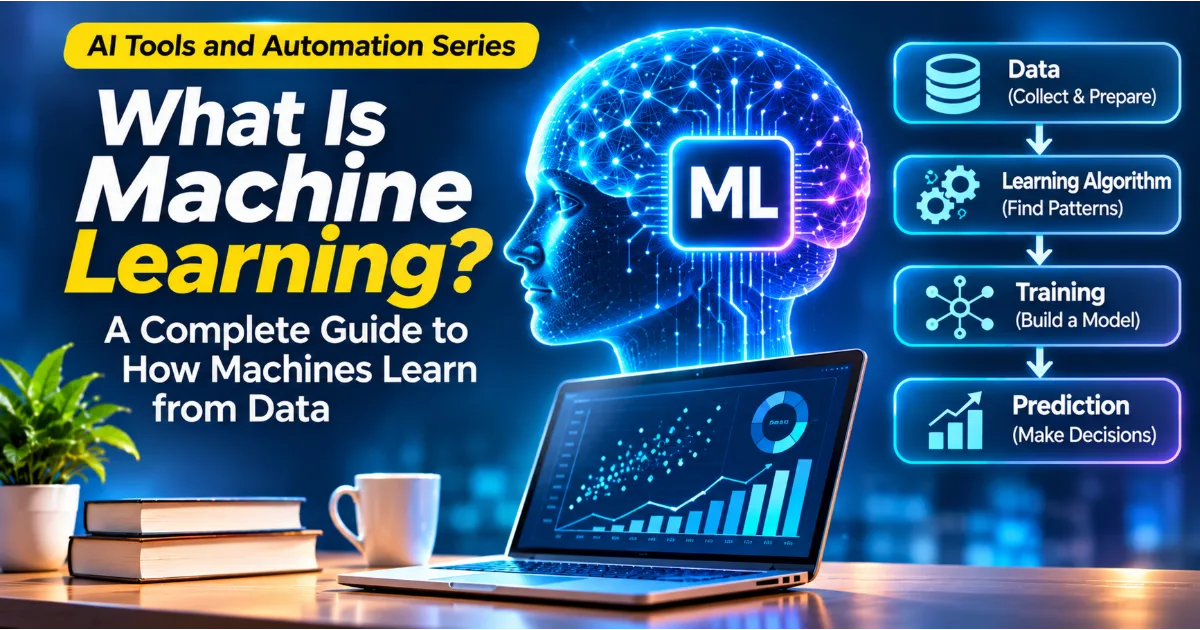
Machine Learning is a subfield of artificial intelligence. It focuses on developing algorithms that learn patterns from data and use those patterns to make predictions or decisions without requiring programmers to manually specify every individual rule.
For example, a machine learning system can analyse historical customer transactions and identify patterns associated with customers who may stop using a particular service. A business can use these predictions to investigate customer dissatisfaction and improve retention strategies.
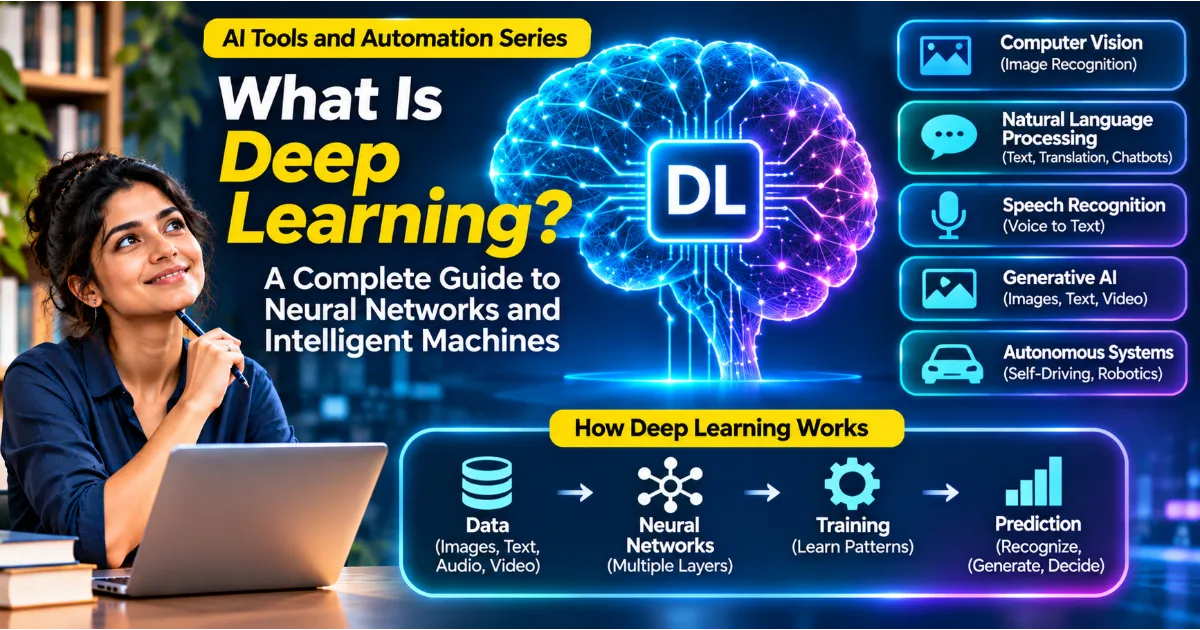
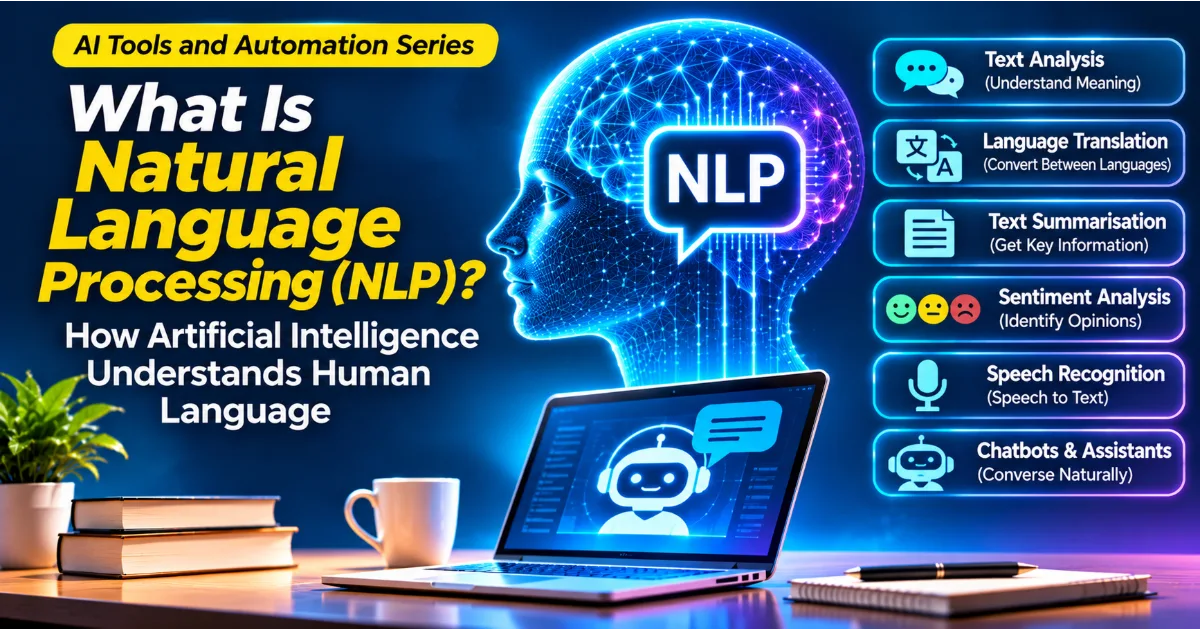
Deep Learning is a specialised area of machine learning that uses artificial neural networks with multiple processing layers. These networks can learn complex patterns from large amounts of data and are particularly important in modern image recognition, speech processing, natural language processing, and generative AI.
A useful way to understand the relationship is to think of AI as the larger subject, Machine Learning as one important approach within AI, and Deep Learning as a specialised approach within Machine Learning.
Understanding these differences will help you make sense of the technologies behind the tools we will explore throughout this series.
4. What Are the Different Types of Artificial Intelligence?
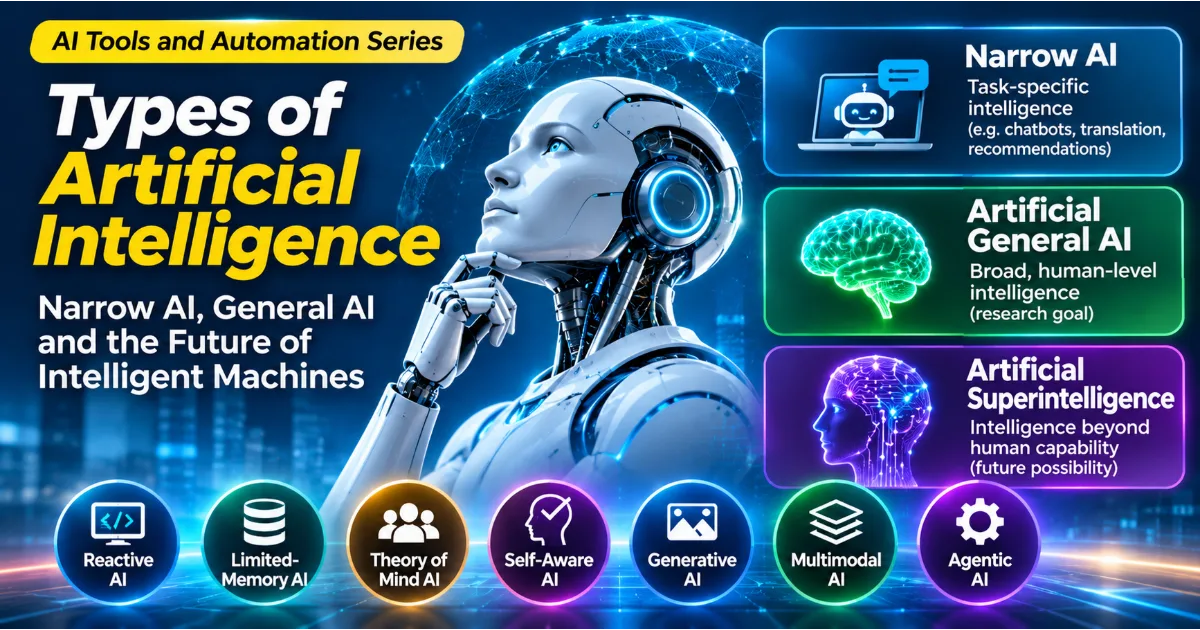
Artificial intelligence can be classified in several ways. One common conceptual classification describes AI according to its capabilities.
Narrow AI, also known as Artificial Narrow Intelligence, refers to systems designed to perform specific tasks or a limited range of related tasks. Most AI applications currently available belong to this category. A chatbot, image recognition system, translation service, recommendation engine, or voice assistant may be highly capable within its intended area without possessing general human intelligence.
Artificial General Intelligence, often called AGI, refers to a hypothetical form of AI that could understand, learn, and perform a broad range of intellectual tasks at a level comparable to human capabilities. AGI remains a research and development goal rather than an established capability of today's widely available AI systems.
Artificial Superintelligence is a hypothetical concept involving an AI system that would surpass human intellectual capabilities across a wide range of areas. It is frequently discussed in debates about the long-term future of AI, but it should not be confused with the capabilities of current commercial AI products.
Another way to classify AI is according to how systems operate. Some systems rely on predefined rules, while others use machine learning, deep learning, reinforcement learning, or generative models.
These classifications help us understand that artificial intelligence is not one single product or technology. It is a broad field containing many different approaches, each designed for particular problems and applications.
5. What Is Generative AI and Why Is Everyone Talking About It?
Generative AI is one of the most significant developments in the modern AI ecosystem. It refers to AI systems capable of generating new content based on patterns learned during training.
Traditional AI applications are often designed to classify information, detect patterns, make predictions, or recommend actions. Generative AI goes further by producing new outputs such as written content, images, audio, video, computer code, and other forms of digital material.
For example, a user can describe an idea in ordinary language and ask a generative AI tool to prepare a blog outline. Another user can provide a visual description and request an illustration. A software developer can describe a programming requirement and ask an AI coding assistant to generate an initial code implementation.
This capability has made AI accessible to people who do not necessarily have advanced technical knowledge.
Generative AI is powered by different types of models. Large Language Models, commonly called LLMs, are particularly important for text-based applications. They are trained using large collections of data and learn statistical relationships between words, phrases, and other language elements.
When a user submits a prompt, the model processes the input and generates a response based on its learned patterns and the information available within its context.
Image-generation systems work differently. They use models trained to associate visual patterns with descriptions and can generate images from text instructions or other inputs.
Generative AI has applications in education, business, programming, marketing, research, entertainment, and creative industries. However, generated content is not automatically correct or original in every meaningful sense. Users must review the results, verify important information, and consider copyright, privacy, and ethical requirements.
6. What Are AI Models and Why Do They Matter?
An AI model is a computational system trained to recognise patterns and perform a particular task or range of tasks. It is the underlying technology that powers many AI applications.
When someone uses an AI chatbot, the visible interface is only one part of the experience. Behind that interface is a model that processes the user's instructions and produces responses.
Different models have different capabilities. Some are designed for language generation, while others specialise in image processing, speech recognition, video understanding, forecasting, or scientific applications.
A model's performance depends on its architecture, training data, available context, computing resources, and evaluation methods. Some models are designed to respond quickly and efficiently, while others are optimised for complex reasoning or specialised tasks.
You may also encounter terms such as foundation models, multimodal models, open-weight models, and specialised models.
A foundation model is trained on broad datasets and can serve as the basis for multiple applications. A multimodal model can work with more than one type of information, such as text, images, or audio. An open-weight model makes its trained model weights available under particular licensing conditions, allowing developers to use or adapt it subject to those conditions.
Understanding AI models is useful because choosing an AI tool is not simply about selecting the most popular application. It is also about understanding what technology powers the application and whether that technology is suitable for your requirements.
7. Everyday Examples of Artificial Intelligence
One reason artificial intelligence has become so important is that people interact with it in many ways, sometimes without recognising that AI is involved.
Search engines use sophisticated systems to understand queries and rank relevant information. Streaming platforms analyse viewing behaviour and recommend films, programmes, or music that users may find interesting. Online shopping platforms use recommendation systems to suggest products based on browsing activity, purchase history, and other signals.
Navigation applications can use predictive models and real-time information to estimate traffic conditions and suggest routes. Email applications use AI-based systems to identify spam and detect suspicious activity. Smartphones use AI for speech recognition, camera enhancement, translation, and other features.
Customer service systems may use conversational AI to answer frequently asked questions and direct customers to relevant information. Banks and payment companies use machine learning to identify unusual transaction patterns and support fraud detection.
These examples demonstrate that AI is not limited to futuristic robots or sophisticated research laboratories. It is already integrated into many digital services people use every day.
The important lesson is that understanding AI can help users make better decisions about the technology they interact with and the information they receive.
8. How Artificial Intelligence Is Transforming Education
Education is one of the areas where artificial intelligence can create meaningful opportunities. Students have different learning speeds, interests, strengths, and difficulties. AI-powered educational applications can help provide additional explanations and learning support.
A student struggling with a mathematics concept can ask an AI assistant to explain the topic using simpler examples. Someone learning a new language can practise vocabulary, request grammar explanations, and receive feedback on written exercises. A student preparing for competitive examinations can use AI to organise a revision schedule, generate practice questions, and identify topics that require further attention.
Teachers can also use AI to prepare lesson outlines, create educational exercises, organise teaching materials, and explore alternative ways to explain difficult concepts.
However, there is a significant difference between using AI to support learning and using it to avoid learning. If students simply copy generated answers without understanding them, they may miss the opportunity to develop important skills.
AI-generated explanations can also contain errors. Students should compare important information with textbooks, reliable educational resources, and guidance from qualified teachers.
The best approach is to use AI as a learning companion. It can help explain concepts, encourage curiosity, and provide additional practice, while genuine understanding must still come from active learning and critical thinking.
9. How AI Is Changing the Workplace
Artificial intelligence is increasingly influencing professional activities across industries. Organisations are exploring AI to improve productivity, reduce repetitive work, analyse information, and support decision-making.
In human resources, AI-assisted systems may help organise applications, identify relevant skills, and support recruitment administration. In finance, machine learning can assist with forecasting, anomaly detection, and financial data analysis. In marketing, generative AI can support brainstorming, campaign planning, content drafting, and customer research.
Software development is another area experiencing significant change. AI coding assistants can suggest code, explain programming concepts, generate test cases, and help developers investigate errors. These tools can reduce certain repetitive activities, although developers remain responsible for reviewing code quality, security, and functionality.
In customer support, conversational AI can handle routine enquiries, retrieve information, and help direct customers to appropriate support channels. Human representatives can then concentrate on situations requiring judgement, empathy, or specialised assistance.
However, AI adoption also raises important questions about employment, professional skills, accountability, and workplace policies. Some tasks may become automated, while other responsibilities may change or require new capabilities.
The future workplace will likely reward people who understand their professional domain and can use emerging technologies effectively. Technical knowledge, communication, creativity, adaptability, and critical thinking will continue to matter.
10. How Businesses Can Use Artificial Intelligence
Businesses of different sizes can explore AI applications depending on their operational needs, budgets, available data, and technical capabilities.
A small business can begin with relatively simple applications. AI writing assistants can help prepare product descriptions, email drafts, marketing ideas, and customer communication. Data analysis tools can help identify patterns in sales information. AI-powered customer support can assist with routine questions, subject to appropriate review and escalation procedures.
Larger organisations may explore more advanced implementations, including predictive analytics, document processing, intelligent search, demand forecasting, quality inspection, and AI-supported business intelligence.
Consider an online retail business that receives hundreds of customer enquiries every day. A carefully configured AI-assisted support system could classify incoming enquiries, identify relevant product information, and prepare draft responses. Routine questions may be handled through approved automated workflows, while complicated issues can be directed to human support representatives.
A manufacturing organisation might use computer vision to inspect products for visible defects. A logistics company could use predictive analytics to estimate demand and improve resource planning.
AI can also help organisations analyse unstructured information such as documents, customer feedback, and internal knowledge resources.
Nevertheless, businesses should not adopt AI simply because it is popular. They should identify a specific problem, establish measurable objectives, evaluate suitable tools, protect sensitive data, and monitor results.
A successful AI project is one that creates genuine business value rather than simply adding another technology subscription.
11. What Is the Difference Between Artificial Intelligence and Automation?
Artificial intelligence and automation are closely related, but they solve different types of problems.
Automation involves using technology to execute tasks or workflows with limited manual intervention. Traditional automation generally follows predefined instructions. For example, an organisation might configure a workflow that automatically sends an email when a customer completes a registration form.
Artificial intelligence enables systems to analyse information, identify patterns, interpret inputs, generate content, and support certain decisions.
When AI and automation are combined, workflows can become more flexible and capable of handling information that is not always presented in a fixed format.
Imagine a company receiving customer enquiries through email. A traditional automation system can detect a new email and forward it to a designated team. An AI-powered component could additionally analyse the message, identify its subject, classify the enquiry, and prepare a suggested response.
The automation platform can then use the classification to route the enquiry to the appropriate department.
Another example involves invoice processing. A traditional workflow might move uploaded documents into a storage folder. An AI-enabled workflow could extract invoice numbers, dates, supplier names, and totals before sending the information to an accounting system for verification.
This combination is particularly useful when organisations need to process large amounts of information across multiple applications.
Throughout this series, we will explore both technologies separately and understand how they work together in practical situations.
12. What Are the Advantages of Artificial Intelligence?
Artificial intelligence offers several potential advantages when it is implemented appropriately.
One major advantage is the ability to process large amounts of information. AI systems can analyse datasets and identify patterns that may be difficult for people to detect manually. This can support research, forecasting, fraud detection, and business analysis.
Another advantage is productivity support. AI assistants can help users draft documents, organise information, generate ideas, and complete certain repetitive activities more efficiently.
AI can also improve accessibility. Speech recognition, text-to-speech applications, translation systems, and image descriptions can help people interact with digital information in different ways.
Personalisation is another important application. Educational platforms can recommend learning materials, shopping platforms can suggest relevant products, and digital services can adapt certain experiences according to user preferences.
AI can also support innovation by helping researchers explore complex problems, developers experiment with software solutions, and creative professionals test new ideas.
However, these advantages are not guaranteed. Results depend on the quality of the system, the task, implementation decisions, and human supervision.
13. What Are the Risks and Limitations of AI?
Artificial intelligence is powerful, but it has important limitations that users should understand.
One major concern is inaccurate information. Generative AI systems can produce responses that sound convincing but contain incorrect facts, fabricated references, or misleading explanations. This is sometimes called hallucination.
Bias is another challenge. AI systems learn from data, and if training information contains historical inequalities or incomplete representation, the resulting system may reproduce or amplify those patterns.
Privacy is equally important. Users should avoid entering sensitive personal information, passwords, confidential business records, or private customer details into AI services unless the service has been appropriately reviewed and authorised for that purpose.
Security risks also require attention. AI applications can be misused to produce phishing messages, deceptive media, or misleading content. Organisations need suitable security policies, access controls, and monitoring procedures.
Copyright and intellectual property questions can arise when AI-generated material is used commercially. Users should understand the applicable laws, platform terms, and licensing requirements before publishing or distributing generated material.
Another concern is overdependence. If people rely entirely on AI-generated answers without developing their own understanding, they may weaken their ability to evaluate information independently.
Responsible AI adoption requires human judgement, transparency, verification, and accountability. The objective should be to use AI intelligently, not blindly.
14. Popular AI Tools You Should Know About
The AI ecosystem includes tools for writing, research, programming, design, productivity, communication, and automation. Understanding the categories can help beginners identify where to start.
For general-purpose AI assistance, platforms such as ChatGPT, Google Gemini, and Claude offer conversational capabilities that can support writing, research, reasoning, and everyday problem-solving.
For programming, GitHub Copilot and other AI coding assistants can help developers generate code suggestions, understand existing projects, and investigate programming errors.
For visual creation, Adobe Firefly and Canva offer AI-supported creative capabilities.
For workflow automation, Zapier, Make, and n8n help connect applications and build automated processes.
These are examples rather than a complete list. Each platform has different capabilities, pricing structures, usage restrictions, and privacy policies. The best tool depends on the task you want to accomplish.
In upcoming posts, we will explore different categories individually, understand their practical applications, and discuss how to choose tools based on real requirements rather than popularity alone.
15. How Can Beginners Start Learning Artificial Intelligence?
You do not need to be a programmer, mathematician, or technology expert to begin learning artificial intelligence. A basic understanding of digital tools, curiosity, and willingness to experiment are sufficient starting points for many everyday AI applications.
Begin by understanding what AI can and cannot do. Learn the difference between traditional software, machine learning, generative AI, and automation. These basic concepts will make it easier to understand the tools you encounter.
Next, choose one general-purpose AI assistant and experiment with practical tasks. Ask it to explain a difficult concept, prepare a study plan, organise your ideas, or help draft a professional email. Observe the results and practise improving your instructions.
Once you are comfortable, explore specialised tools based on your interests. Students can investigate educational applications, content creators can experiment with creative tools, professionals can explore productivity solutions, and developers can learn about AI-assisted programming.
The next step is to understand prompting. A prompt is the instruction or information provided to an AI system. Clear prompts usually explain the task, provide relevant context, identify the expected format, and specify important constraints.
For example, instead of asking an AI assistant to simply write something about marketing, you could explain the type of business, target audience, marketing objective, desired tone, and expected output. This additional context helps the system produce a more relevant response.
You should also develop the habit of checking important information. Compare answers with reliable sources, test generated code, review calculations, and ask qualified professionals when the situation requires specialised expertise.
Finally, learn through small projects. Create a simple research workflow, organise your study notes, prepare a content calendar, or automate a repetitive administrative task. Practical experience will help you understand where AI creates value and where human intervention remains necessary.
16. The Future of Artificial Intelligence
Artificial intelligence is likely to become increasingly integrated into digital products, professional workflows, scientific research, and everyday services.
One important development is the growth of multimodal AI. These systems can work with different forms of information, including text, images, audio, and video. This creates opportunities for more natural interactions and applications that can process different types of information together.
Another developing area is AI agents. These systems are designed to work towards specified objectives by combining reasoning capabilities, tools, and actions. Depending on their design and permissions, they may be able to research information, interact with applications, organise tasks, and execute parts of a workflow. Their reliability, security, and need for human oversight remain important considerations.
Robotics is another area where AI may have significant applications. Intelligent systems can help robots interpret their surroundings, recognise objects, and perform tasks in manufacturing, logistics, healthcare, and other environments.
Scientific research is also exploring AI applications in areas such as drug discovery, climate modelling, materials science, and biological research. These technologies may help researchers analyse complex datasets and investigate possibilities more efficiently.
However, the future of AI will not be determined by technical capability alone. Regulations, data governance, public trust, safety standards, infrastructure, economic conditions, and human choices will all influence how these systems are developed and adopted.
For individuals, the most useful preparation is continuous learning. Understanding AI fundamentals, developing practical digital skills, and learning how to evaluate technology will help people adapt as the ecosystem evolves.
17. Why Understanding AI Matters for Everyone
Artificial intelligence is no longer a subject that belongs exclusively to technology specialists. Its influence is spreading across education, healthcare, finance, business, entertainment, communication, and public services.
A student who understands AI can use it more effectively for learning while recognising the importance of original thinking. A professional can identify opportunities to improve workflows and develop relevant skills. A business owner can evaluate automation opportunities and make informed technology investments. A developer can understand how AI models and APIs can be integrated into applications.
Even people who do not intend to use AI professionally can benefit from understanding how it affects information, privacy, digital services, and decision-making.
AI literacy is becoming an important part of digital literacy. It involves understanding what AI systems do, recognising their limitations, checking information, protecting personal data, and making responsible decisions about their use.
You do not need to follow every AI announcement or experiment with every new application. You need to understand enough to identify useful opportunities and make informed choices.
That is the foundation we want to build through this series.
Conclusion: Your AI Learning Journey Starts Here
Artificial Intelligence is a broad and rapidly developing field that is changing how people interact with technology. From machine learning and deep learning to generative AI, intelligent assistants, predictive analytics, and workflow automation, there are many concepts and applications worth exploring.
But learning AI does not have to be complicated. Start with the fundamentals, experiment with practical tools, ask questions, verify information, and gradually develop your understanding.
The objective of this series is not simply to introduce popular AI applications. We want to help you understand the technology behind them, discover useful tools, explore practical applications, and learn how to combine AI with automation to solve real problems.
Whether you are a student, working professional, entrepreneur, developer, content creator, or someone simply curious about technology, there is something valuable to learn.
The most important thing is to remain curious and approach AI with both an open mind and a critical perspective.
Now we want to hear from you.
Have you understood the difference between Artificial Intelligence, Machine Learning, Deep Learning, and Generative AI? Which concept would you like us to explain in greater detail? Are you more interested in AI tools, practical applications, or automation?
Share your questions and experiences in the comments. Your participation will help shape the direction of this learning series.
Let's explore AI together, one concept and one practical application at a time.
#ArtificialIntelligence #LearnAI #AITools #GenerativeAI #AIAutomation