Artificial Intelligence is often discussed as though it were a single technology. In reality, AI includes many different approaches, systems, and capabilities. Some AI applications perform one clearly defined task, such as recognising faces, translating languages, or recommending products. Others can work with text, images, audio, and code, allowing people to use them for a wide variety of activities. Researchers are also exploring more advanced forms of intelligence that could eventually perform a much broader range of tasks.
Understanding the different types of Artificial Intelligence helps us distinguish between technologies that already exist and possibilities that are still being researched. It also helps explain why a simple spam filter, a voice assistant, an advanced language model, and a hypothetical human-level intelligent machine should not all be considered equivalent.
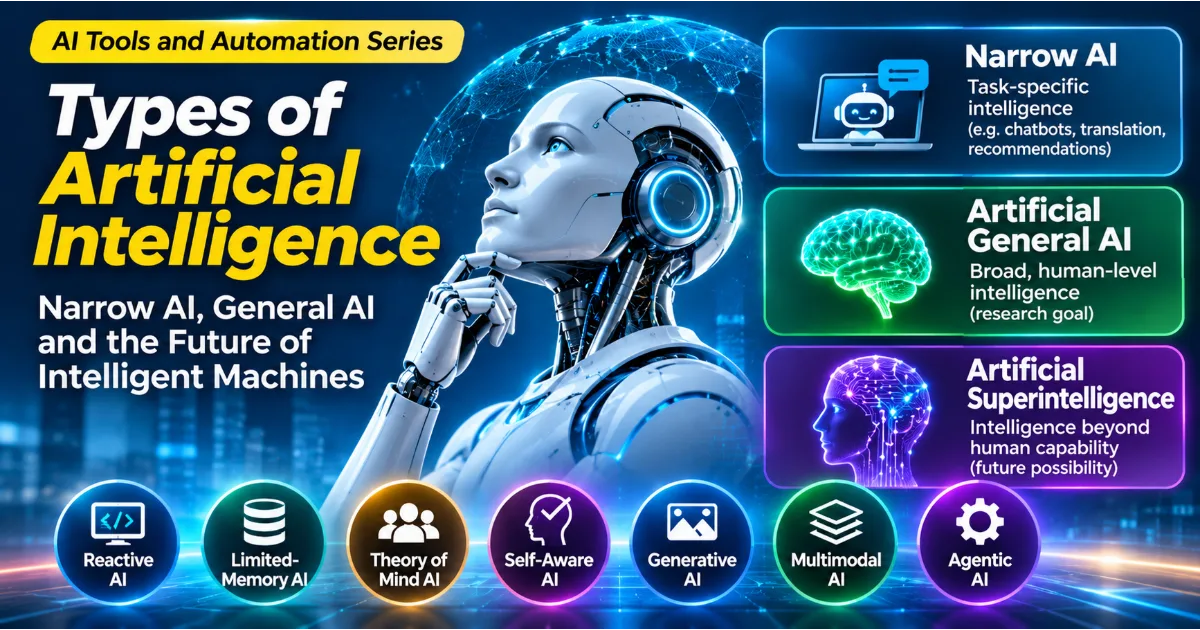
Artificial Intelligence can be classified in several ways. One common approach focuses on the capability of an AI system, distinguishing between Narrow AI, Artificial General Intelligence, and Artificial Superintelligence. Another approach classifies systems according to how they operate, including reactive machines, limited-memory systems, and theoretical models involving deeper understanding of their environment.
These classifications are useful for understanding the development of AI, but they should not be confused with one another. A system can be generative, multimodal, and based on deep learning while still being classified as Narrow AI because its capabilities do not amount to general human-level intelligence.
This article explores the major types of Artificial Intelligence, explains their differences, examines practical examples, and discusses what their development could mean for individuals, businesses, education, and society.
Continue Reading
What Does It Mean to Classify Artificial Intelligence?
Classification means organising AI systems into groups according to their characteristics, capabilities, or methods of operation. Since artificial intelligence covers a wide range of technologies, there is no single classification that explains every aspect of an AI system.
For example, an image recognition application can be classified as Narrow AI because it performs a specialised task. It may also be described as a machine learning system because it learns patterns from data. If it uses multiple neural network layers, it can additionally be described as a deep learning application.
These descriptions are not contradictory. They explain different aspects of the same technology.
A useful way to understand AI classification is to consider three questions. First, how broad are the system's capabilities? Second, how does the system process information and respond to its environment? Third, what technical methods does it use to perform its tasks?
The first question leads to the distinction between Narrow AI, General AI, and Superintelligence. The second is associated with classifications such as reactive machines and limited-memory systems. The third includes machine learning, deep learning, neural networks, natural language processing, and other technical approaches.
Understanding these categories provides a clearer picture of where current AI technology stands and where researchers hope it may go.
1. Narrow Artificial Intelligence: AI Designed for Specific Tasks
Narrow Artificial Intelligence, also called Artificial Narrow Intelligence or ANI, refers to AI systems designed to perform specific tasks or a defined range of related tasks.
Almost all AI applications currently used in everyday life fall into this category. These systems can perform impressive activities, sometimes faster and more accurately than humans in particular situations, but their capabilities remain limited by their design, training, tools, and operating environment.
Consider a facial recognition system used to unlock a smartphone. It can analyse facial features and determine whether the person attempting to unlock the device matches an authorised user. However, that capability does not mean the system can independently understand human emotions, write a business strategy, teach mathematics, or manage a company.
The system is specialised for a particular task.
Similarly, an AI recommendation engine can analyse viewing habits and suggest films. It does not automatically possess the broader reasoning abilities required to understand every aspect of human preferences or make unrelated decisions.
Examples of Narrow AI in Everyday Life
Email spam filters are common examples of Narrow AI. They analyse message characteristics and identify emails that are likely to be unwanted or suspicious. These systems can learn from previously labelled messages and adapt their classification patterns.
Navigation applications use intelligent algorithms and predictive models to estimate travel times, identify traffic conditions, and recommend routes. Their capabilities are useful for transportation-related tasks, but they do not represent general intelligence.
Voice assistants process spoken instructions and perform supported actions. They may set alarms, answer questions, control connected devices, or retrieve information. Their capabilities depend on the services, models, and tools available to them.
Online shopping platforms use recommendation systems to suggest products based on browsing behaviour, previous purchases, and similarities between customer preferences.
AI-powered translation systems convert text or speech between languages. Modern systems can produce natural translations, but they may still struggle with cultural references, specialised terminology, humour, and ambiguous expressions.
Computer vision applications identify objects, analyse photographs, detect manufacturing defects, and support medical image analysis. These systems can be highly capable within their intended domains.
Advantages of Narrow AI
Narrow AI offers several important benefits. It can automate repetitive tasks, analyse large amounts of information, reduce processing time, and support decisions in specialised environments.
Businesses can use Narrow AI to improve customer service, identify suspicious transactions, forecast demand, and organise information. Educational platforms can use it to recommend learning materials. Healthcare organisations can use specialised AI tools to assist with certain analytical and administrative activities.
Narrow AI is also easier to evaluate within a clearly defined task than a hypothetical system with unrestricted general capabilities. Developers can establish specific performance requirements and test whether the system meets them.
Limitations of Narrow AI
The biggest limitation of Narrow AI is its lack of general capability. A system designed for one task cannot automatically perform unrelated tasks simply because it performs its original task very well.
Its performance may also decline when it encounters information that differs significantly from its training data or operating conditions.
For example, an image recognition model trained primarily on photographs taken in bright daylight may struggle with images captured in unusual lighting. A forecasting model trained on historical market patterns may produce unreliable estimates when economic conditions change dramatically.
Narrow AI can also inherit biases from its training data and make mistakes when information is incomplete.
Despite these limitations, Narrow AI is already transforming industries and will remain an important part of the technology landscape.
2. Artificial General Intelligence: The Goal of Broad Machine Intelligence
Artificial General Intelligence, commonly known as AGI, refers to a hypothetical or not-yet-established level of AI capability in which a system could learn, understand, and perform a broad range of intellectual tasks at a level comparable to human intelligence.
Unlike Narrow AI, which is developed for specific tasks, AGI would be expected to adapt its knowledge and abilities across different situations.
Imagine a person learning to manage a small business. The task may require understanding customers, managing finances, communicating with employees, analysing sales, negotiating with suppliers, and solving unexpected problems.
Human beings can combine knowledge from different experiences to handle these responsibilities. An AGI system would ideally demonstrate a similarly broad ability to learn and apply knowledge across many domains.
What Would Make AGI Different?
The defining characteristic of AGI would not simply be the ability to answer questions or generate content. It would involve a much broader and more flexible form of capability.
An AGI system would need to learn unfamiliar tasks, transfer knowledge between domains, reason through complex situations, adapt to changing conditions, and handle problems that were not specifically anticipated during development.
For example, suppose an AI system has learned to design websites. A broadly intelligent system might also be able to understand the business requirements behind a website, analyse the intended audience, develop a marketing strategy, evaluate customer feedback, and adapt its approach when the business changes direction.
These activities involve multiple areas of knowledge and different forms of reasoning.
Is Artificial General Intelligence Already Available?
There is no universally accepted demonstration that an AI system has achieved Artificial General Intelligence.
Modern AI models can perform a wide variety of tasks. They can write, summarise, translate, generate images, assist with programming, analyse documents, and interact with software tools. Some systems can also complete complex workflows when given suitable instructions and permissions.
However, impressive performance across multiple tasks does not automatically establish general intelligence.
Researchers and developers continue to debate how AGI should be defined, measured, and evaluated. A system may perform well on many benchmarks while still having important limitations in reliability, adaptability, reasoning, memory, or independent operation.
The distinction between highly capable Narrow AI and AGI remains an important subject in AI research.
Potential Applications of AGI
If AGI becomes technically achievable and can be developed safely, it could influence many areas of society.
In education, a broadly capable AI system might adapt explanations to individual learners, identify gaps in understanding, and support learning across multiple subjects.
In scientific research, it could help researchers explore hypotheses, analyse evidence, design experiments, and connect findings from different disciplines.
In business, it might support complex planning, operational analysis, product development, and coordination across departments.
In healthcare, it could potentially assist with a broad range of information-intensive tasks, although medical decisions would still require appropriate professional accountability and oversight.
These possibilities are speculative. Their practical value would depend on actual technical capabilities, reliability, governance, cost, safety, and the willingness of institutions to adopt such systems.
3. Artificial Superintelligence: Intelligence Beyond Human Capability
Artificial Superintelligence, often abbreviated as ASI, refers to a hypothetical form of artificial intelligence that would significantly exceed human intellectual capabilities across a broad range of important domains.
It is a theoretical concept rather than an established technology.
An ASI system would not simply be better than a human at one specialised task. It would be expected to outperform humans across many areas, potentially including scientific discovery, strategic planning, problem-solving, learning, and technological development.
The concept raises important questions about the future relationship between humans and intelligent machines.
How Would Superintelligence Differ from AGI?
AGI is generally discussed in terms of broad capabilities comparable to human intelligence. Superintelligence goes further by imagining capabilities that substantially exceed those of the most capable human individuals.
For example, an AGI system might be able to conduct scientific research at a broadly human level. A hypothetical ASI system might identify scientific relationships that human researchers could not easily recognise and explore possible solutions at extraordinary speed.
Similarly, an AGI system might manage a complex business operation with capabilities comparable to an experienced human professional. An ASI system could theoretically develop strategies and analyse interconnected systems at levels beyond ordinary human performance.
These comparisons describe hypothetical possibilities, not demonstrated capabilities.
Why Do Researchers Discuss Superintelligence?
Researchers discuss superintelligence because increasingly capable AI systems may create opportunities as well as risks.
Potential benefits could include accelerated scientific discovery, improved resource planning, better modelling of complex problems, and assistance with challenges that require extensive analysis.
However, a system with capabilities far beyond human oversight could also create serious difficulties if its objectives, behaviour, or access to resources were not properly controlled.
A central concern is alignment. AI alignment refers to the challenge of ensuring that an AI system's behaviour remains consistent with human intentions, values, and safety requirements.
A system can be highly capable without necessarily interpreting human goals in the way people expect. This makes safety, accountability, transparency, and appropriate control important topics in advanced AI research.
4. Reactive Machines: AI That Responds to Current Information
Another way of classifying AI systems focuses on how they use information when making decisions.
Reactive machines are often described as the simplest category in a traditional conceptual classification of AI. They respond to the information currently available to them without using stored memories of previous experiences in the way more advanced learning systems might.
A classic example is a chess-playing computer that evaluates the current board position and selects a move based on its programmed evaluation methods and search procedures.
The system analyses the available position and determines a suitable action. Its decision-making process does not depend on remembering a personal history of previous games in the human sense.
Characteristics of Reactive Machines
Reactive systems are designed to respond to specific inputs and conditions. They may be highly effective within their intended environment, especially when the problem can be represented through well-defined rules and states.
They do not necessarily require a complex memory of past interactions to perform their task.
Their limited scope can make them useful in situations where the current state contains enough information to determine an appropriate response.
Limitations of Reactive Machines
Reactive machines cannot use remembered experiences in the same way as systems that maintain and use historical information.
They may also struggle when a problem requires learning from previous interactions, adapting to long-term changes, or maintaining context across multiple stages.
This classification is primarily useful for understanding the conceptual development of AI. It should not be assumed that every modern system fits neatly into only one category.
5. Limited-Memory AI: Systems That Use Historical Information
Limited-memory AI refers to systems that use information from previous observations or interactions to improve their current decisions.
Many modern AI applications rely on this general capability.
Consider a self-driving vehicle. It must process information from cameras, radar, sensors, and other sources. Its decisions may depend on the recent movement of nearby vehicles, the position of pedestrians, road conditions, and traffic signals.
The system uses recent observations to estimate what may happen next and select an appropriate response.
Similarly, a recommendation system can use a customer's previous viewing activity to suggest relevant content. A fraud detection model can analyse historical transaction patterns when assessing whether a new transaction appears unusual.
How Limited Memory Helps AI
Historical information provides context. Without it, a system may have to make every decision using only the current input.
For example, if a navigation system only examined a road at one moment, it would have limited information about traffic movement. By analysing recent traffic observations, it can estimate whether congestion is increasing or decreasing.
A customer support system that retains relevant conversation context can avoid asking the same questions repeatedly and provide more coherent assistance.
Memory and historical information can therefore improve the usefulness of AI systems.
Limitations and Privacy Considerations
Using historical information introduces important responsibilities. Systems must handle personal and business data carefully and follow applicable privacy and security requirements.
Stored information may become outdated, inaccurate, or irrelevant. A model may also make poor decisions if its historical data does not represent current conditions.
Developers need to consider what information should be retained, how long it should be stored, who can access it, and how it should be protected.
Limited memory is useful, but more stored information does not automatically produce better intelligence.
6. Theory of Mind AI: A Research Concept
Theory of Mind is a concept from psychology and cognitive science. It refers to the ability to recognise that other people may have beliefs, intentions, emotions, knowledge, and perspectives that differ from one's own.
In discussions about AI, Theory of Mind AI refers to a hypothetical or research-oriented category of systems that could interpret the mental states and intentions of other people.
For example, imagine a conversation in which someone says, "I thought the meeting was tomorrow." Understanding the sentence may require recognising that the speaker had a particular belief about the meeting schedule and has now discovered that the belief may have been incorrect.
A system with a sophisticated ability to model human perspectives could potentially respond more appropriately to such situations.
Why Would This Capability Matter?
Human communication involves more than interpreting words. People use tone, context, facial expressions, shared experiences, and social expectations to understand one another.
A customer may say that a product is "interesting" while expressing disappointment through tone and context. A human support representative may recognise that the customer is not necessarily satisfied.
AI systems that become better at interpreting context and emotional signals could support more natural interactions.
However, detecting emotional patterns is not the same as genuinely experiencing emotions or understanding another person's mind in the human sense.
Current Limitations
Modern AI systems can identify certain emotional cues, analyse conversational context, and generate responses that appear empathetic.
These capabilities should not be confused with proof of human-like consciousness or a complete understanding of mental states.
Interpreting emotions is difficult even for humans. The same expression or sentence can have different meanings depending on culture, personality, circumstances, and individual communication style.
Theory of Mind AI therefore remains a useful conceptual direction for discussing future capabilities rather than an established category of fully developed intelligent machines.
7. Self-Aware AI: A Hypothetical Category
Self-aware AI is often described as a theoretical category of artificial intelligence that would possess awareness of its own existence and internal state.
The concept is frequently discussed in science fiction, philosophy, and debates about future AI development.
A self-aware machine would theoretically have more than the ability to process information or describe its own operations. It would involve some form of subjective self-awareness.
This distinction is important because modern AI systems can produce sentences such as "I am an AI assistant" or describe their own limitations. Such statements are generated through computational processes and do not demonstrate that a system has subjective consciousness.
Is Self-Aware AI Possible?
There is no established scientific demonstration that current AI systems possess consciousness or subjective self-awareness.
Researchers and philosophers disagree about how consciousness should be defined and whether it could emerge from artificial computational systems.
Some discussions focus on information processing, internal representations, and cognitive architectures. Others emphasise the difficulty of measuring subjective experience objectively.
For now, self-aware AI should be treated as a theoretical concept rather than an existing technology.
8. Generative AI: Systems That Create New Content
Generative AI has become one of the most visible areas of artificial intelligence.
These systems are designed to generate new content based on patterns learned during training. They can create written explanations, marketing drafts, images, audio, videos, software code, and other forms of digital content.
Generative AI does not represent a separate level of intelligence comparable to AGI or ASI. It describes a type of capability that can exist within Narrow AI systems.
For example, a text generation model may produce a detailed report, but it does not automatically possess general intelligence simply because it can write about many subjects.
Text Generation
Text generation systems use learned language patterns to produce responses to prompts.
They can assist with writing emails, preparing summaries, explaining concepts, developing outlines, and generating creative ideas.
Their usefulness depends on the quality of the instructions, available context, model capabilities, and the user's ability to evaluate the output.
Image Generation
Image generation systems create visual content from text descriptions, reference images, or other inputs.
A designer might describe a futuristic city at sunset and use an image generation system to produce a visual interpretation of that description.
These tools can support brainstorming, concept development, educational illustrations, and marketing content.
Audio and Video Generation
Generative AI can also produce speech, music, sound effects, and video content.
Businesses may use synthetic voice systems for certain narration tasks, while video generation tools can help develop visual concepts and draft scenes.
Generated audio and video also create challenges involving consent, authenticity, impersonation, copyright, and misinformation.
Why Generative AI Matters
Generative AI can reduce the time needed to create an initial draft, explore ideas, and produce certain forms of content.
It can help people who do not have specialised design or programming skills participate in creative and technical activities.
However, generated content still requires review. A polished result may contain incorrect information, misleading visuals, or material that does not meet the intended requirements.
Generative AI is most effective when used as an assistant rather than an unquestioned source of truth.
9. Discriminative AI: Systems That Recognise and Classify Information
Discriminative AI focuses on identifying differences, classifying inputs, or predicting outputs from available information.
For example, an image classification system may determine whether a photograph contains a cat, dog, or bird.
An email classification system may distinguish between legitimate messages and spam.
A fraud detection model may estimate whether a financial transaction is suspicious based on learned patterns.
Discriminative models are commonly used in classification and prediction tasks.
Generative AI Versus Discriminative AI
The difference can be understood through a simple example involving photographs of animals.
A discriminative model may examine an image and predict whether it contains a cat or a dog.
A generative model may learn patterns from many animal images and create a new image based on a prompt describing a cat.
The first system focuses on recognising or distinguishing information. The second focuses on generating new content.
Both approaches are useful, and some modern applications combine generative and discriminative methods.
10. Multimodal AI: Working Across Different Types of Information
Multimodal AI refers to systems that can process or generate more than one type of information.
Traditional applications may focus on a single input type, such as text or images. Multimodal systems can combine text, photographs, audio, video, and other forms of data.
Imagine uploading a photograph of a broken household appliance and asking an AI assistant what might be wrong. A multimodal system may analyse the image, process the written question, and generate an explanation based on the information available.
Another example is a system that receives a spoken question, examines a document, and produces a spoken answer.
Applications of Multimodal AI
Education platforms can use multimodal systems to explain diagrams, analyse written questions, and provide spoken guidance.
Accessibility tools may combine image recognition and speech generation to describe visual information to people with visual impairments.
Businesses can use multimodal systems to analyse product photographs, customer messages, and recorded interactions.
Healthcare research may involve systems that analyse different forms of medical information, although clinical applications require rigorous validation and appropriate professional oversight.
Challenges of Multimodal AI
Combining different forms of information introduces technical challenges. The system must interpret relationships between different inputs and avoid producing conclusions that are not supported by the evidence.
For example, a photograph may not provide enough information to determine the exact cause of a mechanical problem. The system should communicate uncertainty rather than present an unsupported diagnosis.
Multimodal capabilities increase flexibility, but they do not remove the need for careful evaluation.
11. Agentic AI: Systems That Can Work Towards Goals
Agentic AI refers to systems designed to take actions towards a defined goal rather than simply producing a response to an individual prompt.
An AI assistant that answers a question performs a primarily response-oriented task. An agentic system may break a goal into smaller steps, select suitable tools, retrieve information, perform authorised actions, and evaluate the results.
Consider a business employee who needs to prepare a weekly sales report.
A basic AI assistant may help write the report if the employee provides the necessary data.
An agentic workflow might retrieve authorised sales information, calculate relevant metrics, compare results with previous periods, prepare a draft report, and send it for human review.
How Agentic AI Works
An agentic system generally begins with a goal or instruction. It then determines the steps required to achieve that goal.
Depending on its design, it may use language models, planning methods, databases, software tools, APIs, and other components.
The system performs an action, observes the result, and decides what to do next.
For example, an AI agent tasked with organising a research summary might search approved sources, collect relevant information, identify important themes, prepare a draft, and flag information that needs verification.
Why Agentic AI Is Important
Agentic systems could help businesses coordinate multi-step workflows that currently require repeated manual effort.
They may be useful in software development, customer support, research, administration, and business operations.
However, greater autonomy creates additional risks. An agent with permission to modify files, send emails, access financial systems, or change business records can cause significant problems if it misunderstands an instruction or performs an incorrect action.
Responsible agent design therefore requires clear permissions, activity monitoring, human approval for consequential actions, and mechanisms for stopping or reversing inappropriate operations.
12. How These AI Types Fit Together
The different categories of AI describe different characteristics, and a single system may belong to several categories simultaneously.
Consider a modern AI assistant that can understand written instructions, analyse images, generate text, and use approved software tools.
It can be classified as Narrow AI in terms of the broad capability distinction because it has not been established as possessing general human-level intelligence.
It may use deep learning and transformer architecture as its technical foundation. It may be generative because it creates new content. It may be multimodal because it processes different types of information. If it can plan and perform multi-step tasks using tools, it may also demonstrate agentic capabilities.
These descriptions explain different dimensions of the same system.
This is why it is important not to confuse generative AI, deep learning, and AGI. They are related concepts, but they do not mean the same thing.
13. Which Type of AI Is Most Useful for Businesses?
There is no single best type of AI for every business. The appropriate solution depends on the problem, available data, operational requirements, budget, and acceptable level of risk.
A company that wants to filter spam emails may need a specialised classification model.
An online retailer that wants to recommend products may benefit from a recommendation engine.
A marketing department that wants assistance with campaign drafts may use generative AI.
A customer support team may combine natural language processing, information retrieval, and automation to respond to routine enquiries.
An organisation with complex administrative workflows may explore agentic systems, provided that appropriate permissions and review mechanisms are established.
Businesses should begin by identifying a clear problem rather than adopting AI simply because the technology is popular.
They should also evaluate whether traditional automation or conventional software would solve the problem more effectively.
14. Choosing the Right AI Approach for Different Tasks
The following examples illustrate how different approaches can support common requirements.
A business that wants to identify fraudulent transactions may use supervised machine learning trained on suitable transaction data. The system can identify unusual patterns and flag transactions for further review.
A retailer that wants to divide customers into groups may use unsupervised learning to discover purchasing patterns and customer segments.
An educational application that wants to generate explanations may use a generative language model combined with verified learning materials.
A manufacturing company that wants to detect product defects may use computer vision to analyse photographs from an inspection process.
A business that wants to coordinate several authorised software operations may explore an agentic workflow that combines AI reasoning with conventional automation.
The right approach is the one that meets the business requirement reliably and responsibly. More advanced technology is not always necessary.
15. Ethical and Social Considerations Across AI Categories
As AI systems become more capable, their influence on society also grows.
Bias is one of the major concerns. An AI system trained on unrepresentative data may produce unfair results, particularly in areas such as recruitment, lending, education, and access to services.
Privacy is another important issue. AI applications may process personal information, business records, images, and conversations. Organisations must ensure that data is handled lawfully and securely.
Transparency also matters. People affected by automated decisions should have appropriate information about how those decisions are made, especially when the consequences are significant.
Accountability must be clearly defined. Organisations should not treat AI as a substitute for responsibility. People and institutions deploying these systems remain responsible for appropriate governance and oversight.
Generative systems introduce additional concerns involving fabricated information, manipulated media, intellectual property, and impersonation.
Agentic systems create further challenges because they may take actions rather than simply provide suggestions. Their permissions and operating boundaries must be designed carefully.
Responsible AI is not limited to advanced or theoretical systems. It applies to everyday applications as well.
Conclusion: Understanding the Different Types of AI
Artificial Intelligence includes many technologies with different levels of capability and different purposes.
Narrow AI is the form used in most applications today. It performs specialised tasks such as image recognition, translation, recommendation, classification, and content generation.
Artificial General Intelligence describes a broader level of capability that could allow machines to learn and perform a wide range of intellectual tasks at a level comparable to humans. It remains an important research goal rather than an established achievement.
Artificial Superintelligence is a hypothetical concept involving intelligence that significantly exceeds human capabilities across many domains.
Other classifications help explain how AI systems operate. Reactive machines respond to current information, while limited-memory systems use historical observations. Theory of Mind and self-aware AI describe more advanced theoretical concepts.
Modern developments also include generative AI, multimodal AI, and agentic AI, each describing different capabilities rather than a separate intelligence level.
Understanding these distinctions helps us evaluate AI technology more realistically. It allows businesses to choose appropriate solutions, individuals to develop useful skills, and society to participate in informed discussions about the future of intelligent machines.
Artificial Intelligence is not one technology moving along a single path. It is a broad and evolving field, and understanding its different forms is an important step towards understanding the future of technology.
Continue the Discussion
Which type of Artificial Intelligence do you find most interesting: Narrow AI, Generative AI, Multimodal AI, or Agentic AI?
Have you used an AI application that performs more than one task, or do you think machines will eventually achieve human-level general intelligence?
Share your thoughts and experiences. The next discussion in this series will explore another important part of the AI ecosystem.
#ArtificialIntelligence #AITypes #GenerativeAI #AgenticAI #FutureOfAI