Artificial intelligence has become increasingly capable of answering questions, writing articles, analysing information, generating images, assisting with software development, and supporting business operations. Modern AI systems can produce responses that sound natural, detailed, and convincing. They can explain complicated subjects, summarize lengthy documents, and help people complete tasks that previously required significant manual effort.
However, there is an important problem that every AI user should understand. Artificial intelligence can sometimes provide information that is incorrect, misleading, unsupported, or completely fabricated while presenting it as though it were factual.
This behaviour is commonly known as an AI hallucination.
Imagine asking an AI assistant to identify a research paper about a particular scientific discovery. The assistant provides a convincing title, names several authors, mentions a publication year, and even gives a journal reference. Everything appears professional and credible. However, when you search for the paper, you discover that it does not exist.
Another example involves asking an AI tool to write a software function. It may generate code that looks correct but uses a nonexistent library method or an incorrect parameter. A developer who copies the code without testing it may encounter errors or introduce security problems.
Continue Reading
AI hallucinations can also occur when summarizing documents, answering questions about company policies, explaining historical events, interpreting financial information, or discussing current developments.
The problem is not simply that AI sometimes makes mistakes. Humans make mistakes too. The more important concern is that AI-generated errors can be expressed with a level of confidence and fluency that makes them difficult to recognize.
Understanding AI hallucinations is therefore essential for students, professionals, developers, business owners, researchers, and anyone who regularly uses artificial intelligence.
In this article, we will explore what AI hallucinations are, why they happen, their different types, practical examples, their impact on businesses and individuals, and the methods that can help reduce them.
What Is an AI Hallucination?
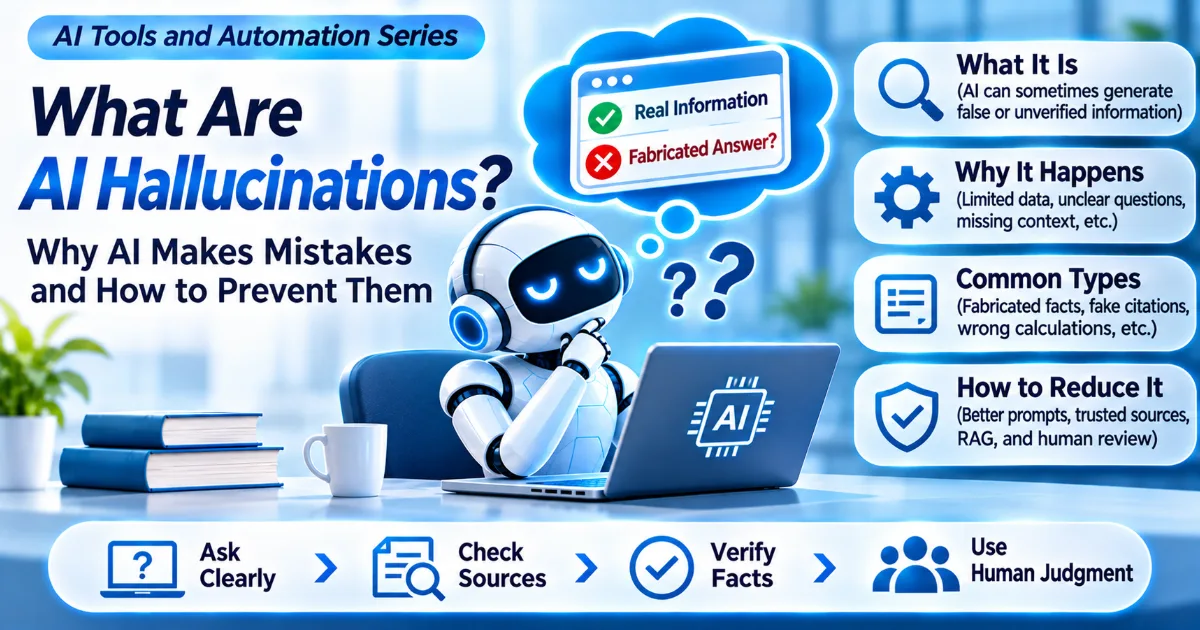
An AI hallucination occurs when an artificial intelligence system generates information that is false, fabricated, unsupported by available evidence, or inconsistent with the information it was expected to use.
The term is commonly associated with generative AI systems, particularly large language models.
These models generate responses based on patterns learned from training data, instructions, and available context. They do not automatically verify every statement against an authoritative source before presenting an answer.
As a result, an AI model may produce a plausible response even when it does not have sufficient information to answer correctly.
For example, suppose someone asks:
"Who founded a fictional technology company called Blue Horizon Systems in 2018?"
If the company does not exist, a reliable response would explain that the information cannot be verified. However, an AI model might generate a person's name, a business background, and a story about how the company was established.
The answer may sound believable, but it is invented.
AI hallucinations can involve several types of errors. A model may invent facts, create nonexistent references, misinterpret supplied documents, generate incorrect calculations, attribute statements to the wrong person, or combine unrelated information into a misleading explanation.
The term does not mean that AI systems literally see or experience something that is not present. It is a technical description of a behaviour in which generated output does not accurately reflect reality or the available evidence.
Why Are AI Hallucinations Important?
AI tools are increasingly being used in situations where people depend on information to make decisions.
A student may use an AI assistant to understand a historical event. A developer may rely on it to generate code. A business owner may use it to analyse market information. A researcher may ask it to summarize scientific studies.
If the generated response contains fabricated information, the user may unknowingly repeat the error or use it as the basis for another decision.
Consider a business that uses an AI assistant to answer customer questions about refund policies. If the assistant invents a refund period, customers may receive incorrect information and the company may face complaints.
Similarly, an AI system that generates an inaccurate financial summary could mislead a management team. An incorrect technical instruction could damage a software application. A fabricated medical explanation could create unnecessary concern or encourage unsafe decisions.
The impact depends on the context.
An inaccurate suggestion for a fictional story may have little consequence. An invented legal requirement, incorrect medical instruction, or fabricated financial figure may create serious problems.
This is why AI reliability is not simply a technical issue. It is also a matter of trust, responsibility, and safe technology adoption.
How Do AI Hallucinations Happen?
To understand why AI systems hallucinate, it is useful to examine how generative AI works.
Large language models are trained using large collections of text and other information. During training, they learn statistical patterns and relationships that help them generate sequences of tokens.
When a user submits a question, the model processes the instruction and available context before generating a response.
Its output is influenced by the learned patterns, model architecture, instructions, and other available information.
However, generating a plausible response is not the same as verifying a fact.
A model may recognize that a question resembles other questions it has encountered and generate an answer that follows a familiar pattern. If the required information is missing or unclear, it may still produce a completion rather than reliably identifying the gap.
Several factors contribute to this behaviour.
1. Incomplete Training Information
AI models learn from training datasets, but no dataset contains every fact, event, document, or development in the world.
A model may not have encountered a particular subject during training. It may have limited information about a niche technical topic, a small organization, or a recently published research paper.
When asked about something outside its reliable knowledge, the model may generate an answer based on related patterns.
For example, if an AI model has learned about several popular software frameworks but has limited information about a newly released framework, it may incorrectly describe the new framework using features from older technologies.
2. Ambiguous Questions
Questions that are unclear or incomplete can increase the likelihood of incorrect responses.
Suppose someone asks:
"Tell me about the founder of the company."
Without knowing which company the user means, the AI does not have enough information to identify the person.
It may make an assumption based on previous context or produce an answer that is unrelated to the user's intention.
Providing the company name, relevant location, and time period can reduce ambiguity.
3. Missing Context
AI models often depend on the information supplied in a conversation or retrieved from external sources.
If important context is missing, the model may misunderstand the task.
For example, a user might ask an AI assistant to summarize a company policy without providing the actual policy document. The model may generate a general explanation of what such policies commonly contain rather than describing the company's real rules.
This can produce an answer that appears useful but is not grounded in the required information.
4. Outdated Information
AI models may have limitations concerning how recently their training information was updated.
A question about current software pricing, recent government regulations, newly appointed officials, or the latest product features may require information that was not available during training.
Some AI products can use web search, connected databases, or other tools to retrieve current information. However, these capabilities must be used correctly, and the retrieved sources must still be evaluated.
Without current information, a model may present outdated details as though they remain accurate.
5. Weak or Conflicting Sources
Information used during training or retrieved through external systems may contain inaccuracies, contradictions, incomplete explanations, or outdated claims.
If the model receives conflicting information, it may generate a response that combines details incorrectly.
For example, two documents may describe different versions of a software API. If the model does not identify which version is relevant, it may combine instructions from both versions and produce code that does not work.
6. Pattern-Based Generation
Language models are designed to generate likely continuations based on learned patterns.
They can produce grammatically correct and logically structured text without necessarily establishing that every statement is factually supported.
For example, a user asks for a list of five academic publications on a particular topic. The model may generate entries that follow the typical structure of academic references, including titles, authors, journals, and dates.
The format may be correct even when some of the publications are fabricated.
This illustrates why professional-looking output should not be confused with verified information.
7. Overly Complicated Requests
A prompt containing multiple tasks, long instructions, and many conditions may create additional opportunities for misunderstanding.
For example, asking an AI to compare several products, calculate costs, evaluate technical specifications, and recommend a purchase in one instruction may produce an answer that mixes information from different products.
Breaking complex tasks into smaller stages can make it easier to review the output and identify errors.
Common Types of AI Hallucinations
AI hallucinations can appear in different forms. Recognizing these patterns helps users identify unreliable responses.
1. Factual Hallucinations
A factual hallucination occurs when an AI system provides information that does not accurately represent reality.
For example, it may give the wrong founding year of a company, identify an incorrect location, or attribute an invention to the wrong person.
These errors can be difficult to identify when the subject is unfamiliar to the user.
2. Fabricated References and Citations
AI systems may generate academic papers, research titles, author names, journal details, publication dates, and website references that do not exist.
This is particularly concerning in academic and professional research.
A reference that looks correctly formatted is not necessarily genuine. Users should verify every important citation by checking the actual publication or source.
3. Incorrect Numerical Information
AI models can make mistakes when performing calculations, interpreting numerical data, or explaining statistical results.
For example, an AI-generated financial report may contain an incorrect percentage, an inconsistent total, or a misleading comparison.
Important calculations should be performed or verified using appropriate computational tools, spreadsheets, or reliable software.
4. Misinterpretation of Documents
When an AI system summarizes a document, it may overlook important details, confuse two sections, or incorrectly interpret the relationship between different statements.
For example, a contract may describe one condition as an exception to a general rule. An AI summary that misses the exception could provide a misleading explanation.
This is why important documents should be reviewed directly rather than relying entirely on generated summaries.
5. Incorrect Technical Information
AI assistants can generate programming instructions, API examples, database queries, and configuration files that contain mistakes.
A model may use an outdated method, invent a function, misunderstand a framework version, or recommend an incorrect configuration.
Developers should test generated code and compare technical instructions with official documentation.
6. Misleading Explanations
Sometimes an AI response contains information that is partly correct but presents the relationship between different facts incorrectly.
For example, it may identify a genuine scientific study but incorrectly describe what the study proves.
This can be more difficult to detect than an entirely fabricated answer because the response contains some legitimate information.
7. Unsupported Conclusions
An AI model may draw conclusions that go beyond the evidence provided.
For example, a company report may show that sales increased during a particular period. The AI may incorrectly claim that a specific marketing campaign caused the increase even though the report does not establish that relationship.
Observations, interpretations, and proven conclusions should be clearly distinguished.
8. Image and Audio Interpretation Errors
Multimodal AI systems can also hallucinate.
An image analysis model may identify an object incorrectly, describe a visual detail that is not present, or overlook something important.
An audio model may misinterpret a spoken word, confuse speakers, or produce an inaccurate transcript.
These errors are especially important when AI systems are used to interpret technical images, medical records, recordings, or other sensitive information.
Practical Examples of AI Hallucinations
The following examples demonstrate how hallucinations can occur in everyday AI usage.
Example 1: A Nonexistent Research Paper
A university student asks an AI assistant:
"Give me five research papers published in 2024 about the effect of AI on rural education."
The assistant provides five references with titles, author names, publication dates, and journal names.
The student assumes the references are genuine and includes them in an assignment.
Later, the student discovers that two of the papers cannot be found in academic databases.
The problem is that the AI generated plausible academic references without verifying their existence.
A safer approach is to ask the AI to help identify search terms and summarize papers that the student has actually retrieved from trusted academic sources.
Example 2: An Incorrect Software Function
A developer asks an AI coding assistant:
"Write a function using the latest version of this library to export data into a spreadsheet."
The assistant generates code using a method that existed in an older release but has since changed.
The code looks correct but fails when executed.
The developer should check the installed library version, consult official documentation, and test the suggested code.
Example 3: An Incorrect Company Policy
An employee asks an internal AI assistant:
"How many days of annual leave can employees carry forward?"
The assistant provides a specific number without having retrieved the company's current leave policy.
The employee may rely on the answer and make an incorrect decision.
A properly designed company assistant should retrieve the relevant policy, identify the applicable conditions, and state when the information cannot be confirmed.
Example 4: A Misleading Financial Calculation
A business owner uploads a sales spreadsheet and asks for the monthly revenue growth rate.
The AI generates a report with a percentage that does not match the actual figures.
If the business owner uses this number in a management presentation, the error may influence planning decisions.
A safer workflow uses spreadsheet formulas or a calculation tool to verify the figures before generating the explanation.
Example 5: Incorrect Image Interpretation
A user uploads a photograph of an electronic circuit and asks the AI to identify a particular component.
The model identifies the component as a resistor when it is actually a different electronic part.
If the user follows the resulting technical instructions without checking the component, the repair process may fail or cause damage.
Visual AI output should therefore be treated as assistance rather than definitive identification when technical accuracy matters.
AI Hallucinations vs Ordinary AI Errors
Not every incorrect AI response is necessarily a hallucination.
AI systems can fail for different reasons, including software bugs, incorrect inputs, data processing problems, outdated information, and limitations in the underlying model.
An ordinary software error might occur because a calculation function contains a programming mistake.
An AI hallucination usually refers to generated content that is unsupported, fabricated, or inconsistent with the available evidence.
Consider a calculator application that displays an incorrect total because of a software defect. This is a computational error.
Now consider a language model that invents a detailed explanation of why a particular calculation is correct, even though the numbers do not support it. This is an example of hallucinated information.
The distinction matters because different problems require different solutions.
Software bugs may require debugging and code correction. AI hallucinations may require better context, improved retrieval, clearer instructions, verification, and model evaluation.
AI Hallucinations vs AI Bias
AI hallucinations and AI bias are also different problems.
A hallucination involves generating information that is false, unsupported, or fabricated.
AI bias involves systematic patterns in model outputs that unfairly favour or disadvantage particular individuals, groups, or perspectives.
For example, an AI recruitment tool may repeatedly recommend candidates from one background over equally qualified candidates from another background. This could indicate a bias problem.
If the same tool invents a qualification that a candidate does not possess, that is a hallucination or factual reliability problem.
Both issues can affect trust and fairness, but they require different evaluation methods and safeguards.
Why AI Models Sometimes Sound Confident Even When They Are Wrong
One of the most challenging aspects of AI hallucinations is the way incorrect information can be presented.
A human who is uncertain may hesitate, use cautious language, or ask for clarification. An AI model may instead generate a complete response with clear headings, professional wording, and detailed explanations.
This happens because language generation and factual verification are different capabilities.
A model can generate a fluent explanation without having independently confirmed that every statement is true.
For example, if someone asks about a historical event that is poorly represented in the model's available information, the system may generate an explanation using patterns from similar historical topics.
The response can appear authoritative even though important details are incorrect.
Confidence in the wording should therefore not be treated as evidence of accuracy.
Users should pay particular attention to claims involving exact dates, statistics, names, quotations, technical specifications, and references.
How to Reduce AI Hallucinations Through Better Prompting
Prompt engineering can help reduce certain types of hallucinations by making instructions clearer and establishing expectations about evidence and uncertainty.
A vague instruction gives the model considerable freedom to make assumptions. A carefully designed instruction can explain which information should be used and how uncertainty should be handled.
1. Ask the AI to Acknowledge Uncertainty
Instead of expecting an answer to every question, instruct the AI to say when information is unavailable or cannot be verified.
For example:
"If the available information does not support an answer, clearly state that you cannot confirm it. Do not invent names, dates, statistics, references, or explanations."
This encourages the model to avoid unsupported completion when the task does not provide enough information.
2. Provide Reliable Context
Supply the documents, policies, technical specifications, or data that the AI should use.
For example:
"Answer the following question using only the attached company policy. If the policy does not contain the requested information, say that it is not specified."
This makes the expected information source clearer.
3. Specify the Relevant Time Period
Questions involving current information should identify the date or period that matters.
For example:
"Explain the current features of this software as of November 2026. Verify important details against the official product documentation."
The AI still needs access to reliable current information, but the prompt establishes the required time frame.
4. Ask for Evidence
When using an AI tool with access to sources, ask it to identify the documents or references supporting important claims.
For example:
"Summarize the main findings and identify the source supporting each major conclusion. Do not include references that cannot be verified."
A citation should be checked against the original source rather than accepted simply because it appears in the response.
5. Separate Facts from Assumptions
Ask the model to distinguish information directly supported by the source from its interpretation.
For example:
"Separate the confirmed findings from possible explanations and recommendations. Clearly identify any assumptions."
This is especially useful in business analysis and research.
6. Break Complex Tasks into Smaller Steps
Instead of asking for a complete research report, financial analysis, and strategic recommendation in one prompt, divide the work into separate stages.
First, identify the relevant information. Next, extract the facts. Then analyze the data. Finally, prepare recommendations based on the verified findings.
This makes it easier to review intermediate results and identify mistakes.
The Role of Retrieval-Augmented Generation in Reducing Hallucinations
Retrieval-Augmented Generation, commonly known as RAG, is one approach used to improve the factual grounding of AI responses.
A conventional language model generates answers based primarily on its learned patterns and the information supplied in its current context.
A RAG system adds an information retrieval process.
When a user asks a question, the system searches an external knowledge source for relevant information. It then supplies the retrieved content to the AI model as additional context.
For example, imagine a company building an AI assistant that answers questions about internal employee policies.
The company stores its official policies in a searchable knowledge system. When an employee asks about annual leave, the system retrieves the relevant policy section and provides it to the AI model.
The model can then prepare an explanation based on the retrieved material.
This approach can reduce hallucinations because the model has access to relevant information rather than relying only on general learned patterns.
However, RAG does not eliminate hallucinations.
The retrieval system may select irrelevant documents, retrieve outdated policies, miss important exceptions, or provide incomplete information. The language model may also misunderstand the retrieved content.
A reliable RAG implementation therefore needs accurate source documents, good retrieval quality, clear instructions, and evaluation.
The Role of Fine-Tuning in Reducing AI Hallucinations
Fine-tuning involves further training an AI model using a specialized dataset.
It can help a model adapt to a particular task, communication style, or domain-specific behaviour.
For example, a company may fine-tune an eligible model using examples of correctly formatted customer support responses.
This may improve consistency in how the model performs that task.
However, fine-tuning does not automatically make a model factually accurate.
A model trained on incomplete or incorrect examples may learn undesirable patterns. It may also generate new information that was not present in the training data.
For questions requiring frequently updated facts, retrieving information from reliable sources may be more appropriate than relying solely on fine-tuning.
In many applications, fine-tuning and RAG can complement each other. Fine-tuning can influence how the model responds, while RAG supplies relevant external information.
How AI Automation Can Help Prevent Hallucinations
AI automation workflows can include additional verification steps before information is accepted or used.
For example, imagine a business automation system that generates customer invoices from order information.
A poorly designed workflow might ask an AI model to interpret the order, calculate the invoice total, and send the invoice automatically.
If the model generates an incorrect amount, the error may reach the customer.
A safer design separates the activities.
The AI component may extract product details from the order. A deterministic calculation process then calculates quantities, prices, taxes, and totals. Validation rules check the output before the invoice is generated.
A human employee may approve the invoice when required.
This illustrates an important principle: tasks that require exact calculations, strict business rules, or guaranteed data consistency should use appropriate deterministic systems rather than depending entirely on language generation.
AI can interpret information and prepare suggestions, while conventional software can perform operations that require precise and repeatable results.
How to Verify AI-Generated Information
Verification is one of the most important skills for anyone using AI.
The method depends on the type of information being checked.
Verify Facts Using Authoritative Sources
For information about government policies, legal requirements, product specifications, and official announcements, check the relevant authoritative source.
A government department's official publication is generally more appropriate for verifying a regulation than an unverified social media post.
Verify Academic References
Search for research papers in trusted academic databases, publisher websites, or institutional repositories.
Check the title, author names, publication date, journal, and identifier where available.
Never assume that a complete-looking reference is genuine.
Verify Technical Information
Compare AI-generated programming instructions with official software documentation.
Check the relevant version, supported methods, parameters, dependencies, and security recommendations.
Run generated code in an appropriate test environment before using it in production.
Verify Calculations
Use a calculator, spreadsheet, database query, or appropriate computational tool to confirm important numerical results.
For financial reporting, verify the source data, formula, units, time period, and assumptions.
Verify Quotes and Statements
If an AI attributes a quotation to a person or organization, locate the original speech, interview, publication, or official statement.
Do not publish quotations merely because they appear in a generated response.
Compare Multiple Sources
For important research, compare information from several reliable and independent sources.
However, several websites repeating the same incorrect claim do not necessarily establish that it is true. Source quality and independence matter.
AI Hallucinations in Different Industries
The consequences of hallucinations vary depending on where AI is used.
Healthcare
AI systems may help summarize medical documents, explain general health information, and organize administrative records.
However, an inaccurate medical explanation or invented clinical detail could create significant risks.
Healthcare applications require strong validation, qualified professional oversight, privacy protection, and appropriate regulatory controls.
Finance
Financial organizations may use AI to analyze documents, summarize reports, and assist with customer communication.
An invented financial figure, incorrect tax explanation, or unsupported investment claim could affect decisions.
Important calculations and financial information should be verified through reliable systems and qualified professionals.
Education
Students may use AI to explain concepts, prepare summaries, and explore research topics.
A hallucinated historical fact or fabricated academic citation can undermine learning and academic integrity.
Students should be encouraged to verify information and use AI as a learning assistant rather than an unquestionable source.
Legal Services
Legal professionals may use AI for document analysis, drafting assistance, and research support.
However, invented court cases, incorrect legal citations, or inaccurate descriptions of legislation can create serious problems.
Legal references and interpretations must be checked against authoritative legal materials by appropriately qualified professionals.
Software Development
Developers may rely on AI to generate code, explain errors, and suggest implementation approaches.
Hallucinated APIs, outdated methods, and insecure code patterns can create technical and security problems.
Testing, code review, and documentation checks remain essential.
Journalism and Media
Journalists may use AI to summarize documents, organize research, and prepare drafts.
A fabricated quotation, incorrect statistic, or misleading summary could damage public trust.
Claims should be verified against original sources before publication.
How Businesses Can Build More Reliable AI Systems
Organizations introducing AI into business operations should treat reliability as a design requirement.
The first step is to identify which tasks require factual accuracy and which tasks are more creative.
For example, generating alternative advertising slogans allows some flexibility. Calculating employee salaries does not.
Different tasks require different safeguards.
For knowledge-based assistants, organizations should maintain accurate and current information sources. Documents should have clear ownership, version control, and appropriate access permissions.
For automated calculations, deterministic functions and validation rules should be used wherever possible.
For customer-facing applications, the system should be tested with realistic questions, ambiguous requests, missing information, and unusual scenarios.
Businesses should also establish clear rules for escalation. If an AI assistant cannot find a reliable answer, it should be able to refer the question to an employee rather than inventing a response.
Performance monitoring should include more than response speed. Organizations should measure factual accuracy, source relevance, unsupported claims, error rates, and the frequency of human corrections.
Finally, employees should receive training on recognizing AI limitations and verifying important information.
How to Evaluate Whether an AI Model Is Hallucinating
Evaluating hallucinations requires a systematic approach.
For a simple AI assistant, an organization can prepare a collection of questions with known answers and compare generated responses with verified information.
For a document-based assistant, evaluation should examine whether the answer is supported by the retrieved documents.
For a research assistant, testing should include checking whether references actually exist and whether they support the claims made.
For a coding assistant, evaluation should include execution tests, compatibility checks, and security reviews.
Some useful evaluation measures include:
Factual accuracy: How often does the model provide correct information?
Groundedness: Are the claims supported by the supplied or retrieved sources?
Citation accuracy: Do the cited sources exist and support the statements?
Completeness: Does the response include the relevant information without omitting important qualifications?
Abstention quality: Does the system appropriately acknowledge when it does not have enough information?
Consistency: Does it provide reliable answers across similar test cases?
An effective evaluation process should also include challenging examples where the correct response is that the information is unavailable.
This is important because a reliable AI system should not be judged only by how often it answers. It should also be judged by whether it knows when not to provide an unsupported answer.
Can AI Hallucinations Be Completely Eliminated?
At present, it would be misleading to claim that hallucinations can be completely eliminated from all generative AI systems.
Different models have different architectures, training methods, data sources, and capabilities. Even advanced systems can misunderstand questions, make reasoning mistakes, retrieve irrelevant information, or generate unsupported details.
Some techniques can reduce the likelihood and impact of hallucinations.
These include better training data, improved prompting, retrieval from reliable sources, specialized tools, structured outputs, deterministic calculations, model evaluation, and human oversight.
However, each method has limitations.
A RAG system may retrieve incorrect information. A carefully written prompt may still receive an inaccurate answer. A model with access to current information may misunderstand a source.
The practical objective is therefore not to assume that AI will never make mistakes. It is to design systems that detect, limit, and recover from mistakes before they cause harm.
The Future of AI Reliability
As AI systems become more capable, improving their reliability will remain a major area of research and development.
One important direction is better uncertainty estimation. AI systems may become more effective at identifying when they have insufficient information or when an answer requires verification.
Another direction is stronger integration with external tools. Instead of relying entirely on generated text, models can use calculators, databases, search systems, programming environments, and other specialized services to obtain or verify information.
Improved RAG systems may also become better at retrieving relevant documents, identifying conflicting sources, and linking answers to supporting evidence.
AI agents will create additional challenges because they can perform multiple actions. A hallucinated answer in a chatbot may mislead a user, but an incorrect instruction executed by an autonomous agent could also change records, send messages, or trigger business operations.
This makes permission controls, approval workflows, audit trails, and error recovery increasingly important.
Organizations will also need better ways to evaluate AI systems in realistic conditions. Measuring performance on simple questions is not enough. Systems should be tested against incomplete information, ambiguous requests, conflicting documents, and unusual scenarios.
The long-term success of AI will depend not only on generating impressive responses but also on producing information and actions that people can trust.
Conclusion
AI hallucinations occur when artificial intelligence systems generate information that is false, fabricated, unsupported, or inconsistent with the available evidence.
They can appear in research references, business reports, programming instructions, financial calculations, document summaries, historical explanations, and multimodal applications.
Several factors contribute to hallucinations, including incomplete information, ambiguous questions, missing context, outdated knowledge, weak sources, and the pattern-based nature of generative models.
Although techniques such as prompt engineering, Retrieval-Augmented Generation, fine-tuning, external verification, and structured automation can reduce certain risks, none provides a universal guarantee of accuracy.
The most important lesson is that AI-generated information should be evaluated according to its purpose and potential consequences.
For creative brainstorming, a suggestion may simply need human refinement. For financial, medical, legal, technical, or academic work, stronger verification is necessary.
AI is a powerful assistant, but fluent language should never be confused with proven knowledge.
The goal should be to use artificial intelligence intelligently, verify important information, recognize uncertainty, and maintain human responsibility.
As AI becomes more integrated into everyday life and business operations, the ability to identify and prevent hallucinations will become an essential part of AI literacy.
Let's Discuss
Have you ever received an AI-generated answer that sounded convincing but turned out to be incorrect?
What kind of mistake did you encounter: fabricated facts, incorrect calculations, nonexistent references, outdated information, or wrong technical instructions?
Share your experience and the methods you use to verify AI-generated information. Understanding these problems can help everyone use artificial intelligence more responsibly.
#AIHallucinations #ArtificialIntelligence #AIAccuracy #GenerativeAI #AITrust