Artificial intelligence has evolved significantly over the past few years. Earlier AI applications were often designed to perform specific tasks, such as recognizing patterns in data, classifying images, translating text, or answering questions. Each system generally focused on a particular type of information and required specialized methods to process it.
Modern AI is moving towards something more advanced: the ability to understand and work with multiple types of information within a single system. This development is known as multimodal artificial intelligence, commonly called multimodal AI.
Think about how humans understand the world. We do not depend only on written language. We observe objects, listen to conversations, recognize sounds, interpret facial expressions, read documents, and combine information from different senses to understand what is happening around us.
Multimodal AI aims to develop similar capabilities in artificial intelligence systems by allowing them to process and connect different forms of information, including text, images, audio, video, and structured data.
For example, imagine uploading a photograph of a damaged machine and asking an AI assistant to identify the visible problem. You could also provide an audio recording of the machine running and ask whether the sound suggests an unusual operating condition. A multimodal AI system may be able to analyze both inputs together and provide a more informative response than a system that only processes text.
Continue Reading
Similarly, a student could upload a photograph of a mathematical problem and ask for an explanation. A business professional could provide a recorded meeting and request a transcript, summary, and list of action items. A developer could share a screenshot of an application error and ask for help understanding the problem.
These examples demonstrate why multimodal AI is becoming important across education, healthcare, business, manufacturing, software development, entertainment, and everyday productivity.
In this article, we will explore what multimodal AI means, how it works, the technologies behind it, how it differs from traditional AI, where it is being used, and what its future may look like.
What Is Multimodal AI?
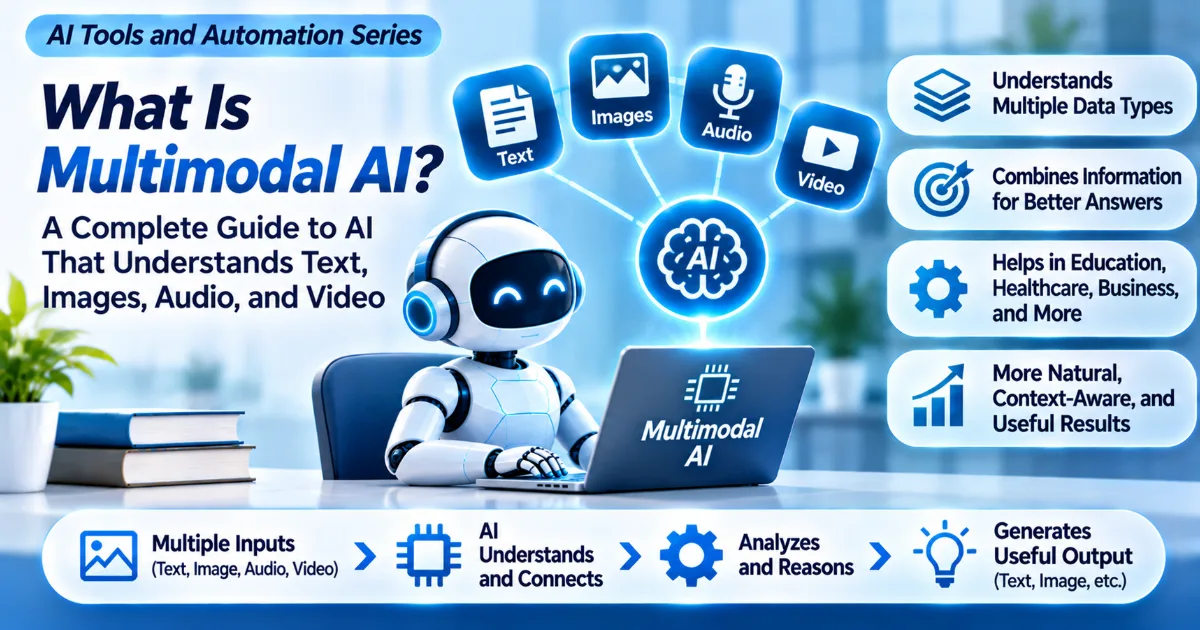
Multimodal AI refers to artificial intelligence systems that can process, interpret, and sometimes generate information across multiple data types or modalities.
A modality is a particular form in which information is represented. Common modalities include:
Text, such as documents, messages, and written instructions.
Images, such as photographs, diagrams, screenshots, and scanned documents.
Audio, such as speech, music, environmental sounds, and recordings.
Video, which combines visual information across time and may include audio.
Structured data, such as tables, numerical records, and database entries.
Spatial information, such as coordinates, movement, and three-dimensional representations.
A traditional text-based AI system primarily works with written language. A computer vision model may focus on identifying objects in images. A speech recognition system may convert spoken words into text.
A multimodal AI system can combine capabilities across different modalities. Depending on its architecture, it may receive an image and a text question, analyze audio and video together, or generate content in more than one format.
For example, consider a photograph of a restaurant menu.
A text-only AI system cannot directly interpret the photograph unless its visual information is first converted into text through another process. A multimodal system with image understanding capabilities may examine the menu, recognize its written content, identify sections, and answer questions about available dishes.
The important characteristic is not simply that an AI product supports several separate features. It is the ability to process relationships between different types of information in a coordinated way.
What Does the Term Modality Mean in Artificial Intelligence?
To understand multimodal AI properly, it is useful to understand the concept of modality.
A modality describes the form in which information is presented to a system.
Humans naturally combine several modalities when interacting with the world. When someone explains a process while demonstrating it, we receive spoken language and visual information simultaneously.
AI systems can also work with multiple modalities, but each type of information requires different processing methods.
Text Modality
Text is one of the most widely used forms of information in artificial intelligence.
It includes written sentences, documents, emails, articles, code, messages, and structured textual content.
Language models process text to understand instructions, generate responses, summarize information, translate languages, and assist with writing.
Text is particularly useful because it can describe ideas, relationships, instructions, and events in a flexible way.
Image Modality
Images contain visual information about objects, people, scenes, diagrams, documents, and environments.
Computer vision techniques allow AI systems to identify visual patterns and interpret image content.
An image-based AI application may recognize objects, extract text from a photograph, detect defects in products, or explain a diagram.
For example, a student could upload an image of a biology diagram and ask the AI to explain its components.
Audio Modality
Audio includes spoken language, environmental sounds, music, and other acoustic information.
AI systems can process audio to recognize speech, identify speakers where supported, classify sounds, generate transcripts, and produce spoken responses.
Audio understanding is useful for voice assistants, meeting transcription, call analysis, accessibility applications, and language learning.
Video Modality
Video contains a sequence of visual frames over time. It may also include audio, subtitles, and other information.
Understanding video requires more than recognizing individual images. An AI system may need to interpret movement, changes in scenes, actions, and the relationship between events.
For example, a video analysis system may identify when a vehicle enters a parking area, summarize the main activities in a recorded presentation, or locate a particular event in a training video.
Spatial and Motion Modality
Spatial information represents the position, shape, movement, or relationships between objects in physical or virtual environments.
It may include coordinates, depth information, object orientation, motion data, and three-dimensional structures.
This modality is particularly important for robotics, autonomous systems, augmented reality, virtual reality, and applications that need to understand physical environments.
How Does Multimodal AI Work?
Multimodal AI systems combine different methods of processing information so that data from multiple modalities can be understood and used together.
The exact architecture depends on the model, but a typical multimodal system involves several stages.
1. Receiving Multiple Inputs
The process begins when the system receives one or more types of information.
A user may provide a written question, upload a photograph, record an audio message, or submit a video.
For example, a user may upload a picture of a damaged electronic component and write:
"Can you identify the visible damage and explain what might have caused it?"
The system receives both the image and the text instruction.
2. Processing Each Modality
Different data types require different processing techniques.
Text may be converted into tokens. Images may be divided into smaller visual regions or patches. Audio may be processed as a waveform or converted into a sequence of learned representations. Video may be analyzed through selected frames and temporal information.
The model uses appropriate processing components to extract useful information from each input.
3. Converting Information into Representations
Many multimodal architectures convert information from different modalities into numerical representations that can be processed by neural networks.
These representations are often called embeddings or feature representations.
For example, an image encoder may convert visual information into numerical features, while a text encoder may convert written language into another set of features.
The representations allow the model to identify patterns and relationships between information sources.
4. Connecting Different Modalities
One of the most important parts of multimodal AI is connecting information from different modalities.
The system may learn that a written description corresponds to a particular image, that spoken words relate to objects in a video, or that a particular sound is associated with a specific activity.
This relationship is important because the meaning of one input may depend on another.
For example, a photograph of a person holding an object may not explain what the person is doing. A short video and accompanying audio may provide additional context.
5. Generating an Output
After processing and connecting the available information, the model generates a response.
The output may be text, an image, speech, video, structured information, or another supported format.
For example, a multimodal assistant may analyze an image and answer a question in text. A speech-enabled assistant may receive spoken instructions and respond with generated audio.
6. Refining the Response Through Interaction
Many multimodal systems support follow-up interactions.
A user may ask additional questions, provide another image, clarify an instruction, or request the output in a different format.
This makes multimodal AI useful for tasks that require several rounds of analysis rather than a single response.
The Main Architectures Behind Multimodal AI
There is no single architecture used by every multimodal AI system. Different approaches have been developed to combine information from multiple modalities.
Understanding these approaches provides a useful foundation for learning how modern multimodal models are designed.
Early Fusion
Early fusion combines information from different modalities relatively early in the model's processing pipeline.
For example, a system may extract features from images and text and combine them before passing the information through additional neural network layers.
The model can then learn relationships between the different inputs.
Early fusion can be useful when the modalities are closely related and the system needs to learn their interactions together.
However, different modalities may have very different structures. Combining them too early can create technical challenges and require careful representation design.
Late Fusion
Late fusion processes different modalities separately and combines their outputs at a later stage.
For example, an image model may identify visual objects, while an audio model may recognize spoken instructions. A later component can combine the results to produce a final interpretation.
This approach allows specialized models to focus on their respective data types.
Late fusion can be useful when different input sources have distinct processing requirements or when existing models need to be integrated.
Intermediate Fusion
Intermediate fusion combines information at selected stages within the model.
Instead of combining everything immediately or waiting until the end, the system exchanges information between modality-specific components during processing.
This can allow the model to learn more complex relationships while preserving some of the specialized processing capabilities of each modality.
Shared Representation Models
Some multimodal systems learn representations that place different types of information into a related embedding space.
For example, an image of a dog and the written description "a dog playing in a park" may be represented in a way that allows the model to recognize their semantic similarity.
This approach supports tasks such as image-text matching, semantic search, and cross-modal retrieval.
Cross-Attention Mechanisms
Attention mechanisms allow models to identify which parts of the available information are relevant to a particular task.
Cross-attention allows information from one modality to influence the processing of another.
For example, when answering a question about an image, a model may use the text question to focus on relevant visual regions.
This can help connect written instructions with visual information.
Important Technologies Used in Multimodal AI
Multimodal AI is built on several areas of artificial intelligence and machine learning.
Deep Learning
Deep learning uses neural networks with multiple layers to learn complex patterns from data.
It provides the foundation for many modern systems that process images, language, audio, and other forms of information.
Deep learning models can learn useful representations from large datasets without requiring every feature to be manually specified.
Transformers
Transformers are neural network architectures that use attention mechanisms to process relationships between elements in a sequence or representation.
They became especially important in natural language processing and are now used in many multimodal systems.
Transformers can help models connect textual instructions with visual information and process relationships across different modalities.
Computer Vision
Computer vision enables machines to interpret visual information.
It supports image classification, object detection, image segmentation, scene understanding, and other visual tasks.
Multimodal AI systems may use computer vision components to understand photographs, diagrams, screenshots, and video frames.
Natural Language Processing
Natural language processing focuses on enabling computers to work with human language.
It supports text understanding, translation, summarization, sentiment analysis, and language generation.
In multimodal systems, NLP capabilities allow the model to interpret instructions and communicate its findings through language.
Speech Recognition and Audio Processing
Speech recognition converts spoken language into text or another representation that can be processed by an AI system.
Audio processing can also identify sounds, analyze speech characteristics, and support speech generation.
These capabilities allow multimodal systems to interact through voice.
Embeddings
Embeddings are numerical representations of information.
They can represent words, sentences, images, and other data in a form that makes it possible to compare relationships and similarities.
Multimodal embeddings are particularly useful for connecting information across different formats.
For example, a search system may retrieve images based on a written description by comparing text and image representations.
Multimodal AI vs Unimodal AI
The difference between multimodal and unimodal AI is based on the types of information a system can process.
Unimodal AI is designed to work primarily with one modality. Examples include a text classification model, an image recognition system, or a speech recognition model.
Multimodal AI can process and connect two or more modalities.
Comparison | Unimodal AI | Multimodal AI |
|---|---|---|
Information types | Primarily one modality | Multiple modalities |
Input | Text, image, audio, or another single type | Combinations of supported types |
Processing | Specialized for a particular format | Coordinates different formats |
Applications | Image recognition, text classification | Image question answering, audio-video understanding |
Complexity | Often narrower in scope | Usually requires more complex integration |
Example | Recognizing objects in a photograph | Understanding a photograph using a written question |
Unimodal systems remain extremely useful. A specialized image recognition model may be more appropriate for a narrow visual inspection task than a general multimodal model.
The choice depends on the problem, required accuracy, cost, available data, and system constraints.
Multimodal AI vs Generative AI
Multimodal AI and generative AI are related, but they describe different characteristics.
Generative AI refers to systems that create new content based on learned patterns and input instructions.
Multimodal AI refers to systems that work with multiple types of information.
A generative AI model may create text from text prompts. A multimodal generative model may accept an image and a written instruction, then generate a textual explanation or another supported output.
Similarly, an AI system may understand images and audio without necessarily generating new content in those formats.
Area | Generative AI | Multimodal AI |
|---|---|---|
Main focus | Creating new content | Processing multiple information types |
Input | Depends on the model | Multiple supported modalities |
Output | Generated content | Analysis or generated content |
Example | Writing an article | Answering questions about an image and audio recording |
Relationship | Can be unimodal or multimodal | Can include generative capabilities |
Many modern AI products combine both approaches.
Multimodal AI vs Large Language Models
Large language models are primarily designed to process and generate language.
They learn patterns in text and use those patterns to understand instructions, answer questions, summarize documents, and generate written content.
Some modern language-model-based systems have been extended with multimodal capabilities. They may process images, audio, or video alongside text.
However, not every large language model is multimodal.
A text-only language model may be unable to directly interpret a photograph or audio recording. It would need an additional system to convert that information into a format it can process.
A multimodal model is designed to handle multiple information types within its supported architecture.
The distinction is important when selecting AI technology for a particular application.
Real-World Applications of Multimodal AI
Multimodal AI has applications across industries because real-world information rarely exists in only one format.
1. Healthcare and Medical Imaging
Healthcare professionals work with medical images, written reports, clinical notes, audio recordings, and patient information.
Multimodal AI research explores how systems can combine different information sources to support medical analysis.
For example, a system may analyze a medical image alongside a written clinical description and relevant structured information.
Such technology could help organize information, highlight patterns for further examination, and support research.
However, medical applications require particularly strong validation, privacy protection, and clinical oversight. AI-generated interpretations should not be treated as a replacement for qualified healthcare professionals.
2. Education and Learning
Multimodal AI can make learning more interactive by allowing students to use different types of information.
A student may upload a photograph of a science experiment, ask a question about the process, and receive a written explanation.
A language learner may practise speaking, receive feedback on pronunciation, and review written corrections.
A teacher may use an AI system to explain a diagram, summarize an educational video, or prepare questions based on a lesson.
These capabilities can make educational assistance more accessible to different learning styles and needs.
3. Manufacturing and Quality Inspection
Manufacturing environments produce large amounts of visual, numerical, and sensor information.
Multimodal AI may combine product images, machine sounds, operating measurements, and maintenance records to help identify potential problems.
For example, a quality inspection system may examine a product photograph and compare it with known defect patterns. Additional sensor information may help provide context about the production process.
This can support inspection, maintenance planning, and quality monitoring.
4. Autonomous Vehicles
Autonomous driving systems need to understand their surrounding environment.
They may process camera images, radar information, lidar measurements, GPS data, and other sensor inputs.
These different information sources help the system identify vehicles, pedestrians, road markings, obstacles, and environmental conditions.
Combining information from multiple sensors can provide a more comprehensive understanding of the driving environment than relying on a single input source.
Autonomous vehicle systems require rigorous safety engineering and validation because mistakes can have serious consequences.
5. Retail and E-Commerce
Online retailers can use multimodal AI to improve product discovery and customer support.
A customer may upload a photograph of an item and ask for similar products. A multimodal search system can compare the visual characteristics of the image with product catalog information.
Another application involves analyzing product photographs, written descriptions, and customer reviews together.
This can help retailers organize product information and improve the shopping experience.
6. Agriculture
Agricultural operations generate information from satellite images, drone photographs, weather measurements, soil sensors, and field observations.
Multimodal AI can help combine these sources to support crop monitoring and agricultural planning.
For example, a system may analyze aerial photographs alongside weather and soil information to identify areas that require closer inspection.
Such systems can support farmers and agricultural specialists, although their recommendations need to account for local conditions and reliable field data.
7. Security and Surveillance
Security applications may involve video footage, audio information, sensor data, and access records.
Multimodal AI research explores how these inputs can be combined to identify events and summarize activities.
For example, an authorized monitoring system may analyze video and sensor information to identify an unusual event that requires human investigation.
These applications raise significant privacy, fairness, and surveillance concerns. Organizations should establish lawful purposes, access restrictions, retention policies, and appropriate oversight.
8. Media and Entertainment
The entertainment industry uses text, images, audio, animation, and video throughout content production.
Multimodal AI can help generate storyboards, analyze footage, create captions, synchronize audio, and support editing workflows.
For example, a content creator may provide a video and request a summary of its main scenes, suggested chapter markers, and a draft description.
Creators still need to review outputs for accuracy, originality, copyright considerations, and artistic quality.
9. Accessibility
Multimodal AI can support people who interact with digital content in different ways.
Image understanding systems can describe visual information for users who cannot easily access it visually.
Speech technologies can convert spoken language into text or generate audio from written content.
Video understanding can support captions, scene descriptions, and navigation through recorded material.
These applications can improve access to information, although quality, language coverage, and accessibility testing remain important.
10. Robotics
Robots need to understand their physical environment and interact with objects.
Multimodal AI can help combine camera images, depth measurements, speech instructions, sensor information, and movement data.
For example, a service robot may receive a spoken instruction, identify an object through its camera, and use spatial information to navigate towards it.
This combination of perception, language understanding, and physical interaction is an important area of AI research.
Popular Multimodal AI Models and Platforms
Several AI platforms provide multimodal capabilities. Their supported inputs, outputs, features, and availability differ by model and product.
OpenAI
Develops AI models and products with multimodal capabilities across supported text, image, and audio workflows. Its offerings include conversational AI and developer APIs.
Google Gemini
Provides multimodal AI capabilities across supported text, image, audio, video, and other workflows, depending on the model and product.
Claude
Supports language-based tasks and image understanding in supported models, with applications in document analysis, reasoning, writing, and coding.
Meta AI
Provides AI assistant capabilities and develops multimodal model technologies through its broader AI ecosystem.
Microsoft Azure AI
Offers cloud-based AI services and tools that developers can use to build applications involving language, vision, speech, and other supported capabilities.
These platforms are examples of the wider multimodal AI ecosystem. Before choosing a model, developers should check its actual supported modalities, input limits, output formats, latency, cost, privacy terms, and integration requirements.
How to Build a Simple Multimodal AI Application
You can understand multimodal AI more clearly by exploring a small practical project.
Consider building an application that allows users to upload a photograph of an object and ask questions about it.
Step 1: Define the Purpose
The application should allow users to upload an image and ask questions about its contents.
For example, a user may upload a photograph of a plant and ask for a description of its visible characteristics.
Step 2: Create the User Interface
Build a simple interface with an image upload area, a text input field, and a response section.
The user should be able to select a photograph and enter a question.
Step 3: Select a Multimodal Model
Choose a model or API that supports both image input and text instructions.
Review the platform's documentation to understand its accepted image formats, request structure, limitations, and pricing.
Step 4: Send the Image and Question
The application sends the uploaded image and user question to the selected model through the supported API.
For example, the instruction might be:
"Describe the visible objects in this photograph and answer the user's question using only information supported by the image. Mention any uncertainty."
Step 5: Display the Response
The application receives the model's response and displays it to the user.
Depending on the model, the response may include a description, identified objects, or an explanation of the visible content.
Step 6: Test with Different Images
Test the application using photographs with different lighting, backgrounds, object sizes, and image quality.
Check whether the model identifies important information correctly and whether it communicates uncertainty when details are unclear.
This simple project demonstrates how text instructions and visual information can be processed together.
Challenges and Limitations of Multimodal AI
Multimodal AI offers significant possibilities, but combining different data types creates additional technical and practical challenges.
1. Data Complexity
Text, images, audio, and video have different structures and processing requirements.
A model must learn useful representations for each modality and connect them effectively.
Video can be particularly challenging because it contains large amounts of information across time.
2. High Computational Requirements
Processing multiple modalities can require substantial computing resources.
High-resolution images, long audio recordings, and lengthy videos may increase processing time and infrastructure costs.
Organizations must consider performance and cost when designing multimodal applications.
3. Synchronization Problems
Some tasks require different modalities to be aligned correctly.
For example, a system analyzing a video and its audio must understand which sounds correspond to which visual events.
Poor synchronization can lead to incorrect interpretations.
4. Inaccurate Interpretation
Multimodal AI can misunderstand visual details, misinterpret audio, overlook important events, or combine information incorrectly.
A model may identify an object incorrectly or describe something that is not actually present.
Important results should be verified, especially in high-impact applications.
5. Bias in Training Data
Multimodal models learn from training data that may contain gaps, biases, and unequal representation.
This can affect how they recognize people, interpret scenes, understand languages, or respond to different cultural contexts.
Testing across diverse situations is important.
6. Privacy Concerns
Images, audio recordings, and videos may contain sensitive personal information.
For example, a photograph may include faces, addresses, documents, or location details.
Organizations must establish appropriate policies for data collection, storage, processing, and sharing.
7. Copyright and Ownership
Training and generating content using images, music, recordings, and videos can raise questions about copyright and ownership.
Users and businesses should understand the relevant permissions and licensing requirements before using generated or analyzed content commercially.
8. Difficult Evaluation
Evaluating a multimodal model can be more complicated than checking a simple text response.
A system may produce a fluent explanation while misinterpreting the image or overlooking important audio information.
Testing should evaluate each modality and the accuracy of the relationships the model identifies between them.
Best Practices for Using Multimodal AI
To use multimodal AI effectively, begin by defining the task clearly.
A system designed to analyze product photographs has different requirements from one designed to summarize meetings or understand videos.
Provide clear instructions that explain what the AI should examine and what output is expected.
Use good-quality inputs whenever possible. Blurry photographs, noisy recordings, incomplete documents, and poorly captured video can reduce the reliability of results.
Make sure the system receives only the information necessary for the task. Avoid uploading sensitive personal or business information unless its use is authorized.
When multiple modalities are involved, explain how they should be related. For example, if an AI system receives a video and a transcript, specify whether the transcript should be used to identify spoken information or whether the video should be examined independently.
Ask the model to communicate uncertainty instead of guessing when the available information is insufficient.
Finally, validate important outputs using reliable sources, specialist tools, or qualified human reviewers.
The Future of Multimodal AI
The future of multimodal AI is closely connected to the development of more capable and interactive artificial intelligence systems.
One important direction is real-time interaction. AI systems may increasingly process spoken instructions, visual scenes, and other information while responding continuously.
This could support applications such as interactive education, voice-based assistance, robotics, accessibility, and hands-free workplace tools.
Another direction is more advanced video understanding. Instead of analyzing isolated frames, future systems may become better at understanding activities, sequences, relationships, and events across longer recordings.
Multimodal AI may also become more deeply integrated into physical environments. Robots, smart devices, vehicles, and industrial systems could use multiple sensors to understand their surroundings and respond to changing conditions.
In business, multimodal AI may support workflows involving documents, images, voice recordings, spreadsheets, and video meetings. Employees could interact with organizational information through more natural and flexible interfaces.
Personalized AI assistants may also use different forms of information to understand user requests and provide context-aware support, subject to appropriate privacy controls.
However, greater capability will also increase the importance of safety, transparency, security, and accountability.
The future of multimodal AI will depend not only on how much information models can process, but also on how reliably they interpret that information and how responsibly their capabilities are used.
Conclusion
Multimodal AI represents an important development in artificial intelligence because it allows systems to work with multiple types of information rather than relying on only one format.
By combining text, images, audio, video, and other data types, multimodal systems can support applications that require a broader understanding of the world.
Their capabilities are relevant to education, healthcare, manufacturing, retail, agriculture, robotics, autonomous vehicles, accessibility, and entertainment.
Technologies such as deep learning, transformers, computer vision, natural language processing, speech recognition, and multimodal embeddings make these applications possible.
However, multimodal AI also introduces challenges involving computational requirements, data quality, privacy, bias, synchronization, and reliability.
For beginners, the best way to understand this technology is to experiment with practical applications. Upload an image and ask questions about it, explore voice-based AI interactions, or try summarizing a video using a supported AI tool.
These simple experiments demonstrate how artificial intelligence can combine different forms of information to provide more flexible assistance.
As AI systems continue to develop, multimodal capabilities will play an increasingly important role in making technology more interactive, accessible, and useful in everyday life.
Let's Discuss
Have you tried an AI tool that can understand both text and images, or one that can work with voice and video?
Which multimodal AI application interests you most: image understanding, video analysis, voice assistants, education, healthcare, robotics, or business automation?
Share your experiences and ideas. What would you like to explore next in the world of AI?
#MultimodalAI #ArtificialIntelligence #GenerativeAI #AITools #FutureOfAI