Artificial Intelligence is evolving beyond systems that simply respond to questions, generate content, or perform individual tasks. A new approach is emerging in which AI systems can understand objectives, plan actions, interact with software tools, evaluate results, and continue working towards a defined outcome. This approach is commonly known as Agentic AI.
Traditional AI applications are generally designed to perform specific tasks. A chatbot answers questions, an image generation model creates pictures, and a predictive model estimates possible outcomes based on data. These applications can be extremely useful, but they usually depend on a person or another system to decide what should happen next.
Agentic AI introduces a different way of working. Instead of asking an AI system to complete only one isolated task, a user can provide an objective and allow an AI-powered system to determine the steps needed to pursue it. Depending on its design and permissions, the system may gather information, use external tools, analyse results, revise its approach, and complete multiple connected operations.
For example, consider a business owner who wants to prepare a market research report about a new product category. A conventional chatbot may explain how to conduct market research or generate a report based on information supplied by the user. An agentic AI system could be designed to break the objective into smaller tasks, search approved sources, collect relevant information, organise findings, identify patterns, and prepare a structured report for review.
This does not mean that Agentic AI is automatically capable of doing everything independently. Its performance depends on the quality of its underlying models, available tools, instructions, permissions, information sources, and safeguards. It can also make mistakes, misunderstand objectives, or take unsuitable actions if the workflow is poorly designed.
Continue Reading
Agentic AI is therefore an important development in the broader field of Artificial Intelligence, but understanding it requires distinguishing genuine autonomous behaviour from ordinary automation and simple AI assistance.
This guide explores what Agentic AI means, how it works, how it differs from AI agents and traditional automation, its architecture, real-world applications, benefits, limitations, implementation challenges, and possible future developments.
What Is Agentic AI?
Agentic AI refers to AI systems designed to pursue objectives through a sequence of actions, decisions, and interactions with available tools or environments.
Rather than producing only one response to a user instruction, an agentic system can work through a multi-step process.
It may interpret an objective, develop a plan, choose an appropriate action, execute that action, observe the result, and decide what to do next.
The term agentic describes the system's ability to demonstrate goal-directed behaviour within the boundaries established by its developers and users.
For example, a user may request that an AI system prepare a summary of customer feedback from the previous month.
A basic AI assistant might summarise feedback that the user manually provides.
An agentic AI system connected to authorised business applications may be able to retrieve the relevant feedback, organise it by topic, identify recurring complaints, compare categories, and prepare a report.
The system is not simply generating text. It is coordinating several operations to achieve a broader objective.
Agentic AI can use Large Language Models, machine learning, APIs, external tools, memory mechanisms, planning methods, and automated workflows.
However, an AI system does not need to be completely autonomous to be agentic. Many practical implementations operate with human approval at important decision points.
The defining idea is the ability to pursue an objective through a sequence of context-dependent actions rather than merely executing one fixed instruction.
Understanding the Difference Between AI, AI Agents, and Agentic AI
These terms are closely connected, but they describe different concepts.
Artificial Intelligence is the broad field of creating systems capable of performing tasks associated with human intelligence, such as understanding language, recognising images, identifying patterns, and making predictions.
An AI agent is a system that receives information from its environment and performs actions to achieve an objective. Depending on its design, an agent may use rules, machine learning, or a Large Language Model.
Agentic AI describes the broader approach of building AI systems that demonstrate goal-directed behaviour through planning, action, observation, and adaptation.
Consider a travel planning example.
A conventional AI assistant may answer a question about popular destinations.
An AI agent may use a weather service or travel database to retrieve information and provide recommendations.
An agentic travel planning system may receive an objective, identify possible destinations, compare travel requirements, organise an itinerary, and prepare booking options for the user to review.
The distinction is not simply about how intelligent the model appears. It is about how the system operates, how many steps it can coordinate, and how it responds to the results of its actions.
Agentic AI is not a completely separate form of intelligence that replaces machine learning or generative AI. It is an approach that uses existing AI capabilities to create systems capable of pursuing more complex objectives.
How Does Agentic AI Work?
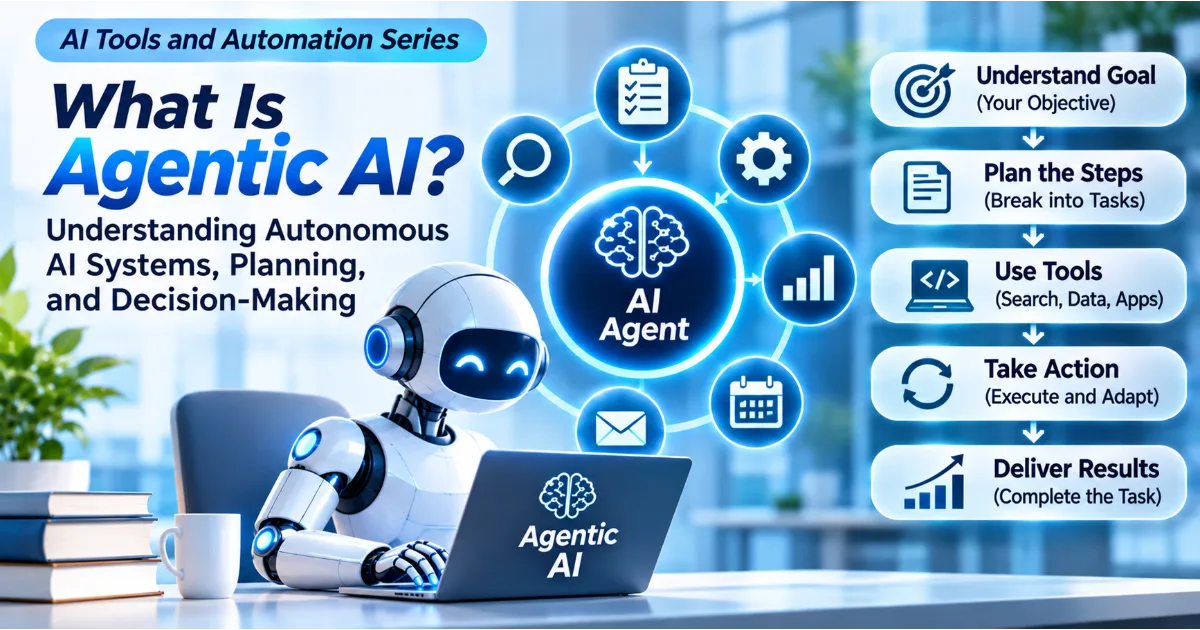
Agentic AI generally operates through a continuous cycle involving understanding, planning, action, observation, and adjustment.
The exact implementation differs between systems, but the following stages explain the basic process.
1. Understanding the Objective
The process begins when a user provides an objective.
The instruction may be relatively simple, such as organising customer enquiries, or more complex, such as preparing a research report.
The system interprets the request and identifies the expected outcome.
A clearly defined objective helps reduce confusion and makes it easier to evaluate whether the task has been completed successfully.
2. Breaking the Objective into Smaller Tasks
Complex objectives usually require multiple operations.
The AI system may divide the main objective into smaller tasks and organise them into a sequence.
For example, preparing a competitor analysis may involve identifying competitors, gathering product information, comparing features, examining pricing, and organising the findings.
This process is known as task decomposition.
The quality of the plan depends on whether the system correctly understands the objective and identifies the necessary steps.
3. Selecting Tools and Resources
An agentic system may have access to tools such as search services, databases, spreadsheets, email applications, APIs, document processors, or internal business systems.
It determines which available tools may help complete the next step.
For example, a research workflow may use an approved search tool to collect information and a spreadsheet application to organise the findings.
Tool availability does not automatically mean that every action is permitted. Access should be restricted according to the user's permissions and the system's responsibilities.
4. Executing an Action
After selecting a suitable tool, the system performs an operation.
This may involve retrieving information, creating a record, preparing a document, updating a task, or analysing data.
The action should be appropriate to the objective and within the permissions granted to the system.
5. Observing the Result
After executing an action, the system receives information about what happened.
A search may return useful sources, an API may return a database record, or a document processor may extract information.
The agent uses these results to understand the current state of the task.
This feedback is important because an action may fail, return incomplete information, or produce a result that requires further investigation.
6. Evaluating Progress
The system compares the observed result with the objective.
It may determine that a task has been completed, that more information is needed, or that an earlier approach should be changed.
For example, if a research search returns insufficient information about a competitor, the system may try a different query or consult another authorised source.
7. Adjusting the Plan
Agentic systems can modify their approach based on intermediate results.
They may reorder tasks, request clarification, select another tool, or repeat a failed operation under suitable conditions.
This ability to respond to changing information is one of the important differences between agentic systems and strictly fixed workflows.
8. Completing the Objective
The system stops when it reaches a defined completion condition, when further action is unnecessary, or when it encounters a limitation that requires human intervention.
A useful agentic system should provide a clear result and explain any incomplete steps.
It should not claim that an operation was completed when it only prepared a recommendation or draft.
Core Components of an Agentic AI System
An agentic AI system generally combines several components that work together.
1. AI Model
The underlying AI model provides capabilities such as language understanding, reasoning support, planning, classification, and content generation.
Large Language Models are commonly used because they can interpret natural language instructions and generate structured responses.
However, the model alone does not create a complete agentic system. It needs an execution environment, tools, instructions, and appropriate controls.
2. Instructions and Objectives
The system requires clear instructions about its role, responsibilities, and expected results.
Instructions may define which tools are available, which actions are permitted, and when human approval is necessary.
A well-defined objective also provides a basis for evaluating completion.
3. Planning Mechanism
The planning component determines how to approach a task.
It may divide the objective into smaller operations, identify dependencies, and decide which action should happen first.
Some systems create explicit task lists, while others determine the next step dynamically.
4. Tool Integration
Tools allow the agent to interact with external systems.
These may include APIs, databases, search engines, document applications, calendars, and business software.
Tool integration expands what an AI system can accomplish beyond generating responses.
5. Memory and Context
Memory mechanisms allow an agentic system to retain relevant information during a task or across supported interactions.
Short-term context may include previous steps, tool results, and current task status.
Longer-term memory may store approved preferences, reference information, or task-related knowledge.
Memory must be managed carefully. Storing unnecessary information can create privacy and security risks.
6. Observation and Feedback
The system needs to receive information about the results of its actions.
Without feedback, an agent may continue operating without understanding whether its previous action succeeded.
Observations help the system identify errors and adjust its approach.
7. Evaluation and Validation
An agentic workflow should have methods for checking the quality of its outputs.
Validation may involve predefined rules, comparisons with reliable information sources, automated tests, or human review.
8. Permission and Safety Controls
The system should operate within clearly defined boundaries.
For example, it may be allowed to read customer records but not modify them without approval.
It may prepare a payment instruction without having permission to execute the transaction.
These boundaries help reduce the risks associated with autonomous actions.
What Makes Agentic AI Different from Traditional Automation?
Traditional automation is generally designed around predefined triggers, conditions, and actions.
For example, when a new customer submits a form, an automation workflow may create a record and send a confirmation email.
The process is predictable because the steps have been configured in advance.
Agentic AI introduces greater flexibility.
Instead of following only one fixed sequence, an agentic system may determine the next action based on the current objective and the results of previous actions.
Consider a technical support example.
A traditional workflow may route every password-related enquiry to a particular support team.
An AI-powered workflow may analyse the message and classify the issue before routing it.
An agentic support system may retrieve authorised troubleshooting instructions, check permitted account information, perform approved diagnostic steps, and prepare a resolution or escalation.
The important distinction is that traditional automation executes a configured process, while agentic AI can select and coordinate actions according to an objective and changing information.
Both approaches can work together.
In fact, agentic systems often depend on traditional automation to execute reliable, repeatable operations.
What Is the Difference Between Agentic AI and Generative AI?
Generative AI focuses on producing new content.
It can generate text, images, audio, video, and code based on a prompt or other input.
Agentic AI focuses on pursuing an objective through actions and decisions.
Generative AI may provide the language and reasoning capabilities used by an agentic system, but generating content is not the same as completing a multi-step task.
For example, a generative AI model may write a draft email.
An agentic system may identify the intended recipient from an authorised CRM record, gather relevant information, prepare the email, request approval, and send it through an authorised email integration.
The generated email is only one component of the broader workflow.
Agentic AI and generative AI therefore complement each other rather than representing mutually exclusive technologies.
Agentic AI and Multi-Agent Systems
Some complex tasks can benefit from multiple specialised agents working together.
A multi-agent system contains two or more agents that coordinate to complete a broader objective.
Each agent may have a specific responsibility.
For example, a business research system could contain a research agent, a data analysis agent, and a report preparation agent.
The research agent collects information from approved sources.
The analysis agent organises the information and identifies relevant patterns.
The reporting agent prepares a structured document based on the results.
A coordinating component may assign tasks, exchange information, and evaluate whether the overall objective has been achieved.
Multi-agent systems can help divide complex work into manageable responsibilities.
However, adding more agents also introduces challenges. Agents may produce conflicting results, duplicate work, misunderstand one another, or pass incorrect information between stages.
A multi-agent architecture should therefore include clear responsibilities, shared data standards, validation, and coordination rules.
More agents do not automatically produce better results. The architecture should remain as simple as the task allows.
Real-World Applications of Agentic AI
Agentic AI has potential applications across industries where objectives involve several connected operations.
1. Customer Service
Customer support often requires more than answering a question.
An agentic support system may understand an enquiry, retrieve relevant information, examine authorised account records, and determine whether the issue can be resolved through an approved process.
For example, a customer may report that an order has not arrived.
The system could retrieve the order status, check the available delivery information, prepare an explanation, and recommend the next step.
Actions such as issuing refunds, changing account details, or making financial adjustments should follow appropriate approval requirements.
2. Sales and Lead Management
Sales processes involve identifying opportunities, organising information, preparing communication, and managing follow-ups.
An agentic system may review new enquiries, identify the customer's requirements, retrieve relevant product information, and prepare a recommended follow-up.
It may also help sales representatives organise tasks and maintain CRM records.
Human sales professionals remain important for relationship building, negotiation, and consequential decisions.
3. Marketing and Content Operations
Marketing teams coordinate research, content planning, writing, editing, publishing, and performance analysis.
Agentic AI can help manage several connected stages.
For example, a system may receive an approved campaign objective, research a topic, prepare a content outline, draft an article, create social media variations, and organise the content for editorial review.
It may also analyse campaign information and prepare a performance summary.
Human review remains essential for factual accuracy, brand consistency, originality, and publishing approval.
4. Software Development
Software development involves understanding requirements, writing code, running tests, identifying errors, and maintaining applications.
Agentic coding systems can assist with several connected activities.
They may examine a codebase, identify relevant files, suggest modifications, execute approved tests, and analyse error messages.
Developers must review code changes, security implications, and test results before deploying software.
5. Research and Knowledge Management
Research often requires collecting information from multiple sources, organising findings, comparing evidence, and preparing conclusions.
An agentic research system may divide a research objective into smaller questions and retrieve information from approved sources.
It can organise the findings and prepare a draft report.
Researchers should verify important claims and ensure that conclusions are supported by reliable evidence.
6. Finance Operations
Financial teams handle reports, invoices, transaction records, and reconciliations.
Agentic AI may help collect relevant records, identify unusual entries, prepare reconciliation summaries, and flag exceptions.
Financial actions should remain subject to appropriate authorisation, validation, and audit controls.
7. Human Resources
HR departments coordinate recruitment, onboarding, employee enquiries, and internal documentation.
Agentic systems may help organise applications, prepare interview schedules, retrieve approved policy information, and coordinate onboarding tasks.
Employment decisions require fairness, transparency, and meaningful human oversight.
8. Project Management
Project management involves tracking progress, coordinating tasks, managing dependencies, and communicating updates.
An agentic system may examine project records, identify incomplete tasks, prepare status summaries, and suggest possible next actions.
Project managers remain responsible for priorities, resource allocation, and important decisions.
9. E-Commerce Operations
Online businesses coordinate product information, customer enquiries, inventory, orders, and returns.
Agentic AI may retrieve product information, analyse customer requirements, prepare recommendations, and coordinate selected order-related workflows.
Real-time stock, pricing, delivery, and payment information should be retrieved from reliable business systems.
10. IT Operations
IT teams manage incidents, system alerts, access requests, and infrastructure issues.
Agentic systems may analyse incident information, retrieve troubleshooting instructions, and coordinate approved diagnostic operations.
Changes to production infrastructure, security settings, or user permissions should follow strict approval and monitoring procedures.
11. Education
Educational systems may use agentic AI to organise learning activities, recommend resources, prepare exercises, and support student enquiries.
A learning assistant could identify a student's learning objective and organise suitable educational material.
Educators should review important educational content and ensure that automated recommendations remain appropriate.
12. Supply Chain Management
Supply chains involve inventory, procurement, supplier communication, logistics, and demand planning.
Agentic systems may help monitor authorised information, identify potential shortages, prepare supplier enquiries, and organise operational reports.
Purchasing commitments and other consequential decisions should require suitable approval.
Practical Examples of Agentic AI in Everyday Work
Understanding Agentic AI becomes easier when we examine how it may be used in ordinary business activities.
Example 1: Preparing a Market Research Report
A business owner requests a report about a new market opportunity.
An agentic system may divide the objective into research tasks, collect information from approved sources, organise market trends, compare competitors, and prepare a structured document.
The owner reviews the findings and verifies important claims before using the report.
Example 2: Managing Customer Enquiries
A company receives enquiries through its website.
An agentic system may classify each message, retrieve relevant product information, identify whether a question can be answered using approved documentation, and prepare a response.
Complex requests are assigned to employees.
Example 3: Organising a Business Meeting
A user asks an AI system to help organise a meeting.
Depending on its permissions, the system may identify participants, retrieve calendar availability, suggest suitable time slots, prepare an invitation, and request confirmation before sending it.
The actual booking should only occur through an authorised calendar integration.
Example 4: Preparing a Software Release
A development team wants to prepare a release checklist.
An agentic coding system may review the assigned development tasks, examine test results, organise outstanding issues, and prepare a release summary.
The team reviews the results before approving deployment.
Example 5: Organising Marketing Campaigns
A marketing manager provides a campaign objective.
An agentic system may organise research, prepare content drafts, create channel-specific variations, and generate a publishing checklist.
The marketing team reviews the content and approves each publication.
These examples show how Agentic AI can coordinate multiple operations without removing the need for human supervision.
Popular Technologies and Frameworks Used to Build Agentic AI
Agentic AI systems can be developed using several technologies, frameworks, and model platforms.
The right choice depends on the complexity of the task, technical expertise, security requirements, available integrations, and deployment environment.
1. LangChain
<Entity value="LangChain" category="software" disambig="Framework for building applications with language models"/> provides components for building applications that connect language models with tools, data sources, and other services.
It can support the development of AI applications that require multiple connected operations.
2. LangGraph
<Entity value="LangGraph" category="software" disambig="Framework for building stateful agent workflows"/> supports the development of stateful workflows involving multiple steps, decisions, and agent interactions.
It can be useful when developers need greater control over execution flow and coordination.
3. CrewAI
<Entity value="CrewAI" category="software" disambig="Framework for orchestrating collaborative AI agents"/> supports systems in which multiple specialised agents coordinate to complete tasks.
Developers can define agent responsibilities and organise their collaboration.
4. Microsoft AutoGen
<Entity value="Microsoft AutoGen" category="software" disambig="Framework for building multi-agent AI applications"/> provides capabilities for creating applications involving AI agents and coordinated conversations.
It can support experimentation with collaborative agent architectures.
5. OpenAI APIs
<Entity value="OpenAI API" category="software" disambig="Developer platform for integrating OpenAI models"/> can be used to develop applications that combine AI models with tools and external services.
Developers can create workflows in which AI systems process instructions and interact with authorised tools.
6. Semantic Kernel
<Entity value="Microsoft Semantic Kernel" category="software" disambig="SDK for integrating AI models with applications and plugins"/> provides development capabilities for connecting AI models with software applications, functions, and other services.
It can help developers integrate AI capabilities into existing business systems.
7. n8n
<Entity value="n8n" category="software" disambig="Workflow automation and integration platform"/> can connect applications, APIs, and AI services through configurable workflows.
It can be used to create AI-powered business processes and integrate different systems.
8. Zapier
<Entity value="Zapier" category="software" disambig="Workflow automation platform"/> supports connections between applications and automated actions.
It can help coordinate business processes that incorporate supported AI services.
9. Make
<Entity value="Make" category="software" disambig="Visual workflow automation platform"/> provides a visual environment for building connected workflows involving applications, data, and automated operations.
10. Cloud AI Platforms
Cloud providers offer infrastructure and services for developing, deploying, and managing AI applications.
Businesses may use these platforms to host models, process data, connect applications, and manage production workloads.
The framework should be selected according to the actual requirements rather than popularity alone.
Challenges and Risks of Agentic AI
Agentic AI introduces capabilities that can make complex workflows more flexible, but these capabilities also create additional risks.
1. Incorrect Decisions
An AI agent may misunderstand a request, select an unsuitable tool, or make an incorrect decision.
If it continues executing actions based on that mistake, the impact may increase.
Important actions should therefore include validation and approval.
2. Hallucinations
Large Language Models can produce information that sounds convincing but is incorrect.
An agent may use this information while preparing reports, communicating with customers, or interacting with business applications.
Reliable source retrieval and output verification are essential.
3. Excessive Permissions
An agent may have access to more information or actions than it needs.
This increases the possible impact of errors, misuse, or security incidents.
Systems should follow the principle of least privilege and separate read access from permission to make changes.
4. Prompt Injection
An agent may encounter instructions embedded in external documents, web pages, emails, or other untrusted information.
Such content could attempt to influence the agent's behaviour or make it reveal information.
Systems should distinguish trusted instructions from untrusted data and apply appropriate security controls.
5. Data Privacy
Agentic systems may interact with customer records, internal documents, financial data, and other sensitive information.
Businesses need to understand how information is accessed, processed, stored, and shared.
6. Uncontrolled Tool Usage
An agent may repeatedly call tools or perform unnecessary operations if its workflow lacks suitable limits.
This can increase costs and create unexpected changes in connected applications.
Execution limits, approval requirements, and clear stopping conditions are important.
7. Cost and Performance
Complex agentic workflows may require several model requests and external tool calls.
The total cost can increase with task complexity, usage volume, and the amount of information processed.
Businesses should measure the cost of completing each workflow and compare it with the value produced.
8. Difficult Debugging
A traditional workflow may follow a predictable sequence, making it easier to investigate errors.
An agentic system may choose different actions depending on the information it receives.
Developers need suitable logs, execution traces, evaluation methods, and monitoring to understand why an action occurred.
9. Reliability
An agent may encounter unavailable APIs, incomplete data, changing application interfaces, or failed operations.
Reliable systems should detect failures and use appropriate recovery methods rather than assuming that every action succeeds.
10. Accountability
When an AI system performs multiple operations, it may become difficult to determine who approved a particular action.
Organisations should define responsibility for system ownership, approval, monitoring, and incident management.
Human-in-the-Loop: Why Human Oversight Still Matters
Human-in-the-loop design means that people remain involved in selected stages of an AI workflow.
This is particularly important when actions have financial, legal, security, employment, or reputational consequences.
For example, an agentic system may prepare a supplier payment recommendation after reviewing an invoice.
The system can organise the information and identify possible discrepancies, but an authorised employee should approve the payment.
Similarly, an AI system may prepare a customer communication, but a representative may need to review the message before it is sent.
Human oversight does not eliminate the value of automation. It helps ensure that the system operates within acceptable boundaries.
The level of oversight should reflect the risk of the action.
Low-risk tasks, such as preparing internal summaries, may require limited review after appropriate testing.
High-impact tasks should have stronger approval and verification requirements.
How to Build an Agentic AI System
Developing an agentic system requires more planning than creating a basic chatbot or connecting two applications.
A structured approach helps reduce complexity and improve reliability.
Step 1: Define a Clear Objective
Start with a specific business problem.
Avoid broad instructions such as making the entire business autonomous.
Instead, define a focused objective, such as preparing weekly customer feedback reports from authorised records.
Step 2: Identify the Required Tasks
Break the objective into smaller operations.
Identify which tasks involve information retrieval, analysis, content generation, or external actions.
This makes the workflow easier to design and test.
Step 3: Identify Available Data Sources
Determine where the system will obtain information.
These sources may include databases, internal documents, APIs, spreadsheets, and approved external services.
Evaluate the reliability and permissions associated with each source.
Step 4: Select the AI Model
Choose a model that suits the required tasks.
Consider language understanding, structured output, tool use, speed, cost, security, and deployment requirements.
A more expensive or complex model is not automatically the best choice.
Step 5: Define Tool Access
Identify which tools the system needs.
For example, a research agent may require access to approved search services and document creation tools.
Avoid granting unnecessary permissions.
Step 6: Design the Planning Process
Define how the system should divide objectives into tasks and determine the next action.
For complex workflows, developers may use explicit state transitions and structured task management.
Step 7: Add Memory and Context Management
Determine which information needs to be retained during execution.
Store only information that is necessary and appropriate.
Step 8: Establish Approval Rules
Identify actions that require human approval.
These may include sending external communications, modifying records, processing payments, or changing permissions.
Step 9: Test the System
Test ordinary situations, incomplete information, unexpected inputs, failed tools, and security-related scenarios.
Evaluate whether the agent follows instructions and stops when it reaches a limitation.
Step 10: Monitor and Improve
Track task completion, accuracy, tool usage, cost, errors, and human intervention.
Use these observations to improve instructions, tools, and workflow design.
Begin with a limited deployment and expand only after the system demonstrates reliable performance.
Best Practices for Implementing Agentic AI
Successful agentic AI implementation requires a balance between flexibility and control.
Start with a clearly defined use case that offers measurable value.
Keep the system's responsibilities narrow enough to test and evaluate.
Use trusted data sources and ensure that external information is treated as untrusted input unless independently verified.
Provide only the permissions required for the task.
Define clear conditions for task completion, failure, and escalation.
Use structured outputs where possible so that important information can be validated before it is used.
Maintain records of decisions, tool calls, approvals, and completed operations.
Test the system regularly, especially after changes to models, instructions, integrations, or business processes.
Keep humans involved in consequential decisions.
Finally, measure whether the system actually improves the business process. An agentic architecture should solve a real problem rather than introduce complexity simply because the technology is available.
How to Measure Agentic AI Performance
Evaluating agentic AI requires more than checking whether the system produced a response.
The system must be assessed across the entire workflow.
Task completion rate: Measure how frequently the agent completes its assigned objective successfully.
Accuracy: Evaluate whether retrieved information, classifications, calculations, and generated outputs are correct.
Tool execution success: Measure whether connected tools and APIs perform the requested operations successfully.
Human intervention rate: Track how often employees need to correct, approve, or complete tasks manually.
Time to completion: Compare the time required to complete a workflow with the previous process.
Cost per completed task: Include model usage, infrastructure, external services, maintenance, and human review.
Error severity: Examine not only how often errors occur but also their potential consequences.
Security compliance: Evaluate whether the system follows its permission boundaries and handles information appropriately.
User satisfaction: Collect feedback from employees and customers who interact with the workflow.
These measures help organisations determine whether Agentic AI is delivering meaningful value.
The Future of Agentic AI
Agentic AI is likely to become an increasingly important part of software applications and business operations.
One major direction is the development of more capable tool-using systems. AI applications may become better at coordinating APIs, databases, documents, and business software through controlled workflows.
Another direction is multi-agent collaboration. Specialised agents may coordinate research, analysis, software development, and operational activities.
Multimodal capabilities may also expand the range of tasks that agents can handle. Systems may combine text, images, audio, video, and structured data when pursuing an objective.
Agentic systems may become more integrated with existing enterprise software. Rather than operating as separate chat interfaces, they may become part of CRM systems, project management applications, customer support platforms, and development environments.
At the same time, governance will become increasingly important.
Businesses will need to understand which actions an agent can perform, what information it can access, how decisions are recorded, and when human approval is required.
Evaluation methods will also need to improve. Organisations must be able to test agentic systems across different situations and understand how changes in models or instructions affect their behaviour.
The future is unlikely to involve every task being handled by a fully independent AI agent. More practical systems will probably combine AI capabilities, traditional automation, specialised software, and human decision-making.
The most useful agentic applications will be those that solve well-defined problems reliably and operate within clear boundaries.
Conclusion: Agentic AI Is Moving Artificial Intelligence Towards Goal-Driven Work
Agentic AI represents an important development in the way Artificial Intelligence systems can operate.
Instead of responding to individual instructions alone, agentic systems can pursue objectives through planning, tool usage, observation, and adjustments based on intermediate results.
They can help coordinate complex workflows across research, customer support, sales, marketing, software development, finance, and other business functions.
However, greater flexibility also introduces additional responsibilities. Agentic systems need reliable information, appropriate tools, clear instructions, limited permissions, validation, monitoring, and human oversight.
Businesses should not begin by trying to automate every decision. They should identify a practical problem, define the desired outcome, build a limited workflow, and evaluate its performance.
Agentic AI is not simply another name for a chatbot or a traditional automation tool. It represents an approach to creating AI-powered systems that can coordinate multiple actions towards a goal.
As the technology develops, the important question will not simply be what an AI agent can do, but whether it can do the right work accurately, securely, responsibly, and consistently.
Continue the Discussion
Where do you think Agentic AI will make the biggest difference: business operations, customer support, software development, marketing, research, or personal productivity?
Would you trust an AI agent to complete a multi-step task independently, or would you prefer to approve every important action?
Share your thoughts and experiences as we continue exploring AI tools and automation.
#AgenticAI #ArtificialIntelligence #AIAgents #AIInnovation #IntelligentAutomation