Artificial intelligence has changed how people search for information, create content, solve problems, write code, analyze data, and complete everyday tasks. AI tools can now generate detailed articles, summarize lengthy documents, create images, explain complex subjects, assist with programming, and support business decisions. However, the quality of their output often depends on something surprisingly simple: the instructions we give them.
You may have used an AI chatbot and received an answer that was too general, irrelevant, incomplete, or different from what you expected. You may have asked it to write an article and received a short summary instead. Perhaps you requested a professional email but received something that sounded robotic. In many situations, the problem is not necessarily the AI model itself. The instructions may not have provided enough information about the task, context, expectations, or desired result.
This is where prompt engineering becomes important.
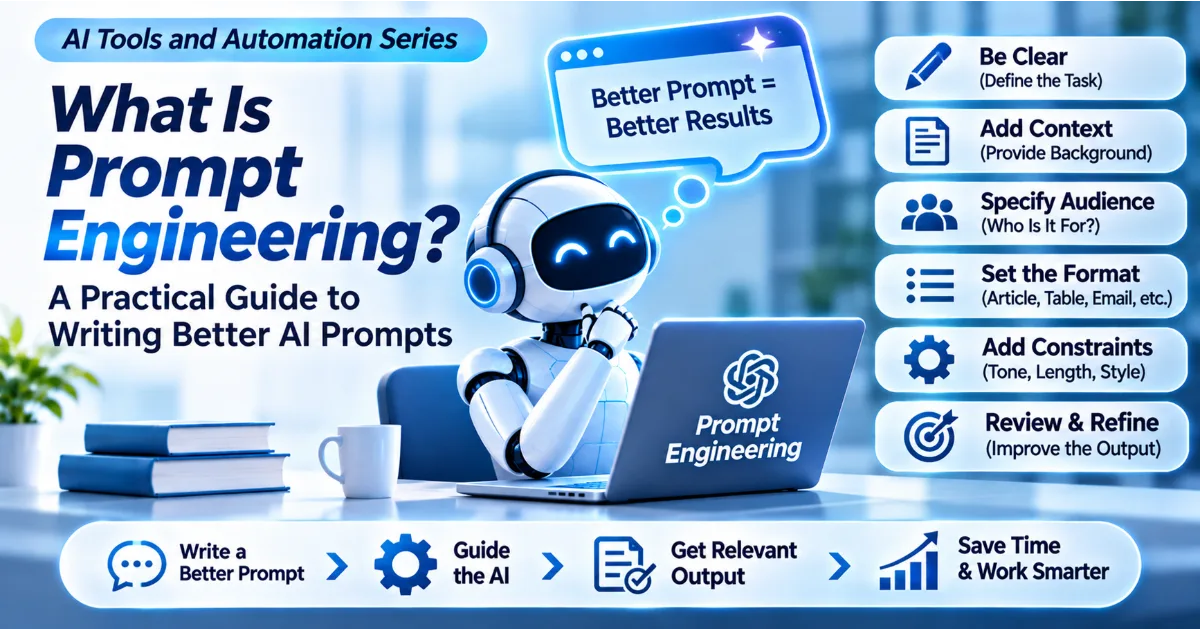
Prompt engineering is the practice of designing, structuring, and improving instructions given to artificial intelligence systems to obtain more relevant, accurate, useful, and consistent results. It helps people communicate their intentions more effectively to AI tools. Instead of asking vague questions and accepting whatever response appears, users learn how to provide clear objectives, relevant context, examples, constraints, and output requirements.
Prompt engineering is not limited to software developers or artificial intelligence researchers. Students can use it to understand difficult subjects, professionals can use it to improve productivity, businesses can use it to automate repetitive work, marketers can use it to create better campaigns, and developers can use it to work more efficiently with code.
As AI becomes part of everyday work, the ability to communicate effectively with AI systems is becoming an increasingly valuable skill. Understanding prompt engineering helps people move beyond basic chatbot interactions and use artificial intelligence as a more capable working assistant.
What Is Prompt Engineering?
Prompt engineering is the process of creating and refining instructions, questions, or contextual inputs that guide an artificial intelligence model towards a desired result. These instructions are called prompts. A prompt can be a simple question, a detailed paragraph, a structured set of requirements, an example, or a combination of several elements.
For example, consider the following request:
"Write about artificial intelligence."
This is a basic prompt. It gives the AI a subject but does not explain the audience, purpose, length, writing style, level of detail, or expected structure. As a result, the AI must make several assumptions. It might produce a short explanation, a technical article, a beginner's guide, or a list of applications.
Now consider a more detailed prompt:
"Write a beginner-friendly article explaining artificial intelligence to college students. Start with a simple definition, explain how AI works, describe common applications in education, healthcare, business, and transportation, and discuss its advantages and limitations. Use meaningful headings, practical examples, and natural language. Keep the explanation accessible to readers without a technical background."
The second prompt communicates much more information. It establishes the topic, audience, purpose, structure, tone, and expected coverage.
The AI model can now generate a response that is more closely aligned with the user's intention.
Prompt engineering does not mean finding secret words that force an AI system to produce perfect answers. It is about communicating requirements clearly, understanding the model's capabilities, evaluating its output, and improving instructions when necessary.
How Does Prompt Engineering Work?
AI models process the information provided in a prompt and generate responses based on patterns learned during training, their architecture, available context, and other system-level instructions. A language model, for example, processes text as tokens and generates a continuation based on the relationships it has learned between those tokens.
When a user submits a prompt, the model interprets the available information and predicts an appropriate response. The model does not necessarily understand the user's intention in the same way a human colleague would. It works from the information available in the conversation and the capabilities built into the system.
This makes the quality of the input important.
A well-designed prompt reduces ambiguity by giving the model useful information about what it should accomplish. It can also establish boundaries that help prevent irrelevant responses.
Imagine asking an AI assistant to prepare a marketing strategy. Without additional context, the assistant does not know whether the strategy is intended for a small local business, a technology startup, an established international company, or a nonprofit organization. It also does not know the target audience, available budget, marketing channels, or business objectives.
A more useful prompt would describe the company, its products, target customers, available resources, marketing goals, and expected deliverables. The AI can then produce a strategy that better reflects the actual business situation.
Prompt engineering therefore works by improving the information available to the model before it generates a response.
The Essential Elements of a Good Prompt
A good prompt does not always need to be long. A short instruction can be highly effective when the task is straightforward. However, complex tasks usually benefit from additional structure.
Several elements can make prompts more effective.
1. Role or Perspective
A role instruction tells the AI what perspective or professional approach it should adopt while completing a task.
For example:
"Act as an experienced digital marketing strategist."
This establishes the type of expertise and approach expected from the response. The model can use this instruction to frame its explanation around marketing strategy rather than providing a generic overview.
Other examples include asking the AI to respond as a programming tutor, business analyst, research assistant, career coach, technical writer, or customer support specialist.
Role instructions are particularly useful when a task requires a particular professional perspective. However, assigning a role does not make the AI a qualified professional or guarantee that its advice is correct. Important information should still be checked.
2. Task or Objective
The task explains exactly what the AI should do.
A prompt should communicate whether the user wants an explanation, comparison, summary, recommendation, article, analysis, translation, calculation, or another specific output.
For example, "Explain cloud computing" is less specific than "Compare public, private, and hybrid cloud computing and explain when a small business should consider each option."
The second instruction establishes a clear objective and gives the model a defined task.
When several actions are required, list them in a logical order. This is especially helpful for complicated work involving research, analysis, writing, and recommendations.
3. Context
Context provides the background information needed to complete the task properly.
Suppose a business asks an AI system to create a customer retention strategy. The result will be more useful if the prompt explains the business model, customer segment, existing challenges, available resources, and current retention approach.
Without context, the AI may generate recommendations that sound reasonable but are unsuitable for the actual situation.
Context can include background information, previous decisions, product details, customer profiles, technical requirements, business objectives, or information from supplied documents.
For long-running projects, maintaining consistent context across prompts can also help preserve the intended direction.
4. Audience
The audience determines how the response should be written.
An explanation for school students should be different from an explanation for software engineers. A presentation for business executives may need concise insights and strategic implications, while a tutorial for beginners may require definitions, examples, and step-by-step explanations.
A prompt can specify the audience directly:
"Explain machine learning to a person who has never studied computer science."
This helps the model choose suitable terminology and an appropriate level of detail.
5. Format
Format instructions describe how the result should be organized.
A user may want a paragraph-based article, a comparison table, a numbered tutorial, a checklist, a presentation outline, a JSON response, or a professional email.
For example:
"Present the comparison in a table with columns for features, advantages, disadvantages, and suitable use cases."
Providing the expected format makes the result easier to use and reduces the need for additional editing.
6. Constraints
Constraints define what the AI should include, avoid, or follow.
Examples include word limits, language preferences, writing style, technical restrictions, formatting rules, budget limits, and requirements for particular sections.
A prompt might say:
"Write in plain English, avoid unnecessary technical terminology, include three practical examples, and keep the response under 800 words."
Constraints are useful because they establish boundaries around the output. However, important constraints should be realistic and clearly expressed.
7. Examples
Examples show the AI what a successful response should look like.
If a company wants product descriptions written in a particular style, it can provide a sample description. If a developer wants code to follow a specific convention, the prompt can include an example of the expected structure.
Examples are especially useful when describing a writing style or output pattern is difficult.
The AI can use the examples as guidance when generating a new response. This technique is closely connected to few-shot prompting, which involves providing a small number of examples to demonstrate the desired task.
Common Types of Prompting Techniques
Prompt engineering includes several techniques that help guide AI models. Different techniques are useful for different tasks, and not every technique is necessary for everyday conversations.
Zero-Shot Prompting
Zero-shot prompting means asking an AI model to perform a task without providing examples of the expected output.
For example:
"Translate this paragraph into French."
The model receives the instruction and attempts to complete the task using its existing capabilities.
Zero-shot prompting is suitable for straightforward activities such as translation, summarization, explanations, brainstorming, and simple classification.
It is often the easiest starting point because it requires minimal preparation. If the output is not satisfactory, the user can add context, constraints, or examples.
One-Shot Prompting
One-shot prompting provides one example of the expected input and output before asking the model to complete a similar task.
For example, a user may provide one product description written in the desired style and then ask the AI to write another description for a different product.
The example gives the model a clearer understanding of the desired structure and tone.
One-shot prompting can be useful when consistency matters, particularly in product descriptions, email formatting, content generation, and structured information extraction.
Few-Shot Prompting
Few-shot prompting provides multiple examples to demonstrate a pattern.
For example, a company might provide five examples of customer feedback and their corresponding categories. The AI can then classify new feedback using the demonstrated pattern.
This approach is useful when the task has specific rules that are not easily communicated through a short instruction.
Few-shot prompting can improve consistency, but the examples must be relevant and representative. Poor examples can teach the model the wrong pattern.
Chain-of-Thought Prompting
Some complex tasks benefit from instructions that encourage structured reasoning or a step-by-step explanation.
For example:
"Solve this mathematics problem and provide a clear explanation of the main steps, including the formula used and the final answer."
This asks for a structured solution rather than only a final result.
Step-by-step explanations can be useful for education, mathematical problem-solving, troubleshooting, and technical learning. However, a detailed explanation is not automatically correct. Important calculations and conclusions should be verified.
Users should focus on requesting useful reasoning summaries, assumptions, calculations, and verifiable steps rather than assuming that every generated explanation accurately represents the model's internal reasoning.
Role-Based Prompting
Role-based prompting asks the AI to respond from a particular professional or functional perspective.
For example:
"Act as a senior software engineer and review this code for readability, maintainability, and potential performance issues."
The role establishes the intended review perspective and helps focus the response on relevant criteria.
This approach is useful for writing, technical reviews, business analysis, marketing, education, and customer communication.
Contextual Prompting
Contextual prompting provides background information that helps the model understand the situation.
For example:
"Our company sells project management software to small businesses. We want to reach business owners who currently manage projects using spreadsheets. Suggest a content marketing strategy for this audience."
The context makes the request more specific and allows the AI to produce more relevant suggestions.
Instruction-Based Prompting
Instruction-based prompting focuses on clearly defining the actions and requirements.
For example:
"Summarize the following report in five sections. Identify the main findings, supporting evidence, risks, recommendations, and unanswered questions."
This technique is particularly helpful for professional documents and analytical tasks.
Iterative Prompting
Iterative prompting involves improving a response through multiple interactions rather than expecting a perfect result from the first instruction.
A user might first request an article outline, then ask the AI to expand each section, improve the examples, verify the structure, and refine the conclusion.
This process resembles collaborating with a human assistant. The first output becomes a starting point, and subsequent prompts help move the result closer to the intended outcome.
Iterative prompting is particularly effective for complex projects because it allows users to review intermediate results and correct misunderstandings early.
Practical Examples of Better Prompt Writing
Understanding prompt engineering becomes easier when comparing weak and improved prompts.
Example 1: Writing an Article
Basic prompt
"Write an article about digital marketing."
"Write a detailed beginner-friendly article explaining digital marketing for small business owners. Cover search engine optimization, social media marketing, email marketing, content marketing, paid advertising, and performance measurement. Explain each concept with practical business examples. Use meaningful headings and natural language."
The improved prompt identifies the audience, subject coverage, depth, and writing style. This gives the model a much clearer direction.
Example 2: Learning a Technical Subject
Basic prompt
"Explain APIs."
"Explain what an API is to someone with no programming experience. Use a restaurant analogy to explain how requests and responses work. Then explain REST APIs, HTTP methods, endpoints, status codes, and JSON with simple examples. End with a practical example of how a website communicates with a server."
The improved prompt establishes the reader's knowledge level and provides a teaching structure.
Example 3: Generating Business Ideas
Basic prompt
"Give me startup ideas."
"Suggest ten software startup ideas for small businesses. Focus on problems involving productivity, customer management, recruitment, marketing, and business automation. For each idea, explain the problem, proposed solution, target customers, potential revenue model, and main implementation challenges."
The improved prompt makes the suggestions more actionable and easier to evaluate.
Example 4: Writing Professional Emails
Basic prompt
"Write an email asking for feedback."
"Write a short, friendly, and professional email introducing our software platform to a potential user. Ask them to visit the website, explore its features, and share honest feedback. Keep the tone conversational, avoid aggressive sales language, and finish with a simple call to action."
The improved prompt communicates the relationship, purpose, tone, and desired action.
Example 5: Analyzing Data
Basic prompt
"Analyze this sales data."
"Analyze the attached monthly sales data. Identify revenue trends, the best-performing products, changes in customer demand, and unusual fluctuations. Explain the main findings in plain English, distinguish observations from possible explanations, and suggest three areas that management should investigate further. Do not invent missing figures."
The improved prompt establishes the analytical objectives and explicitly discourages unsupported conclusions.
Prompt Engineering for Different AI Applications
Prompt engineering is not limited to text-based chatbots. It is relevant to several categories of AI applications.
Prompt Engineering for Text Generation
Text generation tools can create articles, reports, summaries, descriptions, emails, social media posts, and other written materials.
Effective prompts should specify the intended audience, purpose, tone, length, structure, and key information.
For example, a marketing team creating social media content may need different prompts for LinkedIn, Instagram, Facebook, and X because each platform has different audience expectations and content formats.
A prompt that specifies the platform, campaign objective, target audience, brand voice, and call to action is more useful than a generic request to write a social media post.
Prompt Engineering for Image Generation
AI image generation tools convert text instructions into visual outputs. These systems often respond to descriptions of subjects, environments, composition, lighting, artistic style, colors, and visual relationships.
For example:
"Create a professional technology illustration showing a futuristic office where an AI assistant helps employees analyze business data. Use a clean blue-and-white color palette, realistic lighting, a wide landscape composition, and minimal visual clutter."
A more detailed prompt may also specify the image's aspect ratio, intended use, background, camera perspective, and elements that should be excluded.
Image prompting requires a different approach from ordinary text generation because visual relationships and composition matter significantly.
Prompt Engineering for Coding
Developers use AI assistants to explain code, generate functions, identify bugs, write tests, document software, and explore implementation approaches.
A useful coding prompt should include the programming language, framework, environment, expected behavior, input and output requirements, and relevant code.
For example:
"Write a Python function that reads a CSV file, checks for missing values, removes duplicate records, and returns a cleaned data frame. Use pandas, include error handling, and provide a short example showing how to call the function."
When debugging, developers should provide the error message, relevant code, expected behavior, actual behavior, and steps required to reproduce the problem.
AI-generated code should always be reviewed, tested, and checked for security issues before being used in production.
Prompt Engineering for Data Analysis
AI tools can assist with data interpretation, spreadsheet formulas, statistical explanations, and report preparation.
A strong data analysis prompt should specify the dataset, business question, variables of interest, desired calculations, and output format.
It is also important to distinguish between actual observations and interpretations. An AI model should not be encouraged to invent missing values or claim that a correlation proves causation.
Prompt Engineering for Customer Support
Businesses can use AI systems to draft customer replies, classify support requests, summarize complaints, and help support teams retrieve information.
For customer support applications, prompts should define the brand's communication style, escalation rules, information sources, and boundaries.
For example, an AI assistant should not promise a refund or make a policy exception unless the relevant business rules and authorization allow it.
What Is the Difference Between Prompt Engineering and Fine-Tuning?
Prompt engineering and fine-tuning are two different ways of influencing AI model behavior.
Prompt engineering works by changing the instructions and contextual information provided to a model. The underlying model parameters remain unchanged.
Fine-tuning involves additional training on a prepared dataset to adjust a model's parameters for a particular task, style, or domain.
Consider a business that wants an AI assistant to write product descriptions.
With prompt engineering, the business can provide brand guidelines, product details, writing examples, and formatting requirements each time it requests a description.
With fine-tuning, the business may train an eligible model using a curated collection of examples so that the model learns a more consistent task-specific behavior.
Area | Prompt engineering | Fine-tuning |
|---|---|---|
Main approach | Improves instructions and context | Further trains a model |
Model parameters | Remain unchanged | Are adjusted |
Data requirements | Often relatively small | Requires a suitable training dataset |
Implementation | Usually easier to begin | Requires additional preparation and technical work |
Best suited for | Flexible instructions and changing tasks | Repeated specialized behaviors |
Maintenance | Prompts may need refinement | Training may need updating |
Prompt engineering is generally a sensible starting point because it is accessible and allows rapid experimentation. Fine-tuning becomes worth considering when a task requires consistent specialized behavior that cannot be achieved efficiently through instructions alone.
The two approaches can also be combined.
What Is the Difference Between Prompt Engineering and Context Engineering?
Prompt engineering and context engineering are closely related, but they are not identical.
Prompt engineering primarily focuses on the instructions given to an AI model. Context engineering focuses on the broader information supplied to the model so it can complete a task effectively.
Context can include user instructions, conversation history, retrieved documents, database information, tool outputs, application state, and relevant business rules.
For example, a customer support assistant may receive a prompt instructing it to answer customer questions politely. However, the assistant also needs access to the company's current policies, product documentation, and relevant customer information to answer correctly.
The prompt establishes how the assistant should behave, while context provides the information needed to answer.
This distinction becomes especially important when building AI applications, agents, and retrieval-augmented generation systems. Good instructions alone cannot compensate for missing, outdated, or irrelevant information.
Prompt Engineering and Retrieval-Augmented Generation
Retrieval-Augmented Generation, commonly called RAG, is a technique that allows an AI system to retrieve relevant information from external knowledge sources and use that information when generating a response.
Prompt engineering plays an important role in RAG applications because retrieved information must be presented to the model with clear instructions.
Imagine a company building an internal knowledge assistant. Employees ask questions about company policies, leave procedures, software documentation, and internal processes.
The system retrieves relevant documents and includes them in the context provided to the AI model.
The prompt might instruct the model to answer using the supplied documents, identify when information is missing, avoid inventing company policies, and explain the answer clearly.
In this situation, prompt engineering helps establish how retrieved information should be used.
RAG and prompt engineering solve different problems. RAG supplies additional information, while prompt engineering guides the model in using that information.
Together, they can support more useful AI assistants for organizations that need responses grounded in their own information.
What Are System Prompts, User Prompts, and Developer Instructions?
In many AI applications, instructions can come from different sources. Understanding their roles is useful when building chatbots, assistants, and AI-powered software.
System Prompts
System instructions establish high-level behavior for an AI assistant. They may define the assistant's purpose, boundaries, communication style, and general operating requirements.
For example, an educational assistant may be instructed to explain difficult concepts in accessible language and encourage learning rather than simply providing unexplained answers.
Developer Instructions
Developer instructions are provided by the application builder to define how the AI should behave within a particular product or workflow.
For example, a customer service application may instruct the assistant to use approved support documentation, follow escalation procedures, and avoid promising actions it cannot perform.
User Prompts
User prompts contain the requests and information supplied by the person interacting with the AI system.
For example:
"Explain how to reset my account password."
The assistant combines the applicable instructions with the user's request and available context to produce a response.
The exact instruction hierarchy and behavior depend on the model and platform. In application development, it is important to understand how different instruction sources are handled and to avoid assuming that ordinary user input can safely override application rules.
Common Prompt Engineering Mistakes
Even experienced users can write ineffective prompts. Recognizing common mistakes helps improve results.
1. Asking Questions That Are Too Vague
A request such as "Tell me about business" leaves too much room for interpretation. The AI may produce a broad overview that does not address the user's actual objective.
A better approach is to identify the specific business topic, intended audience, and purpose.
2. Providing Too Little Context
An AI system cannot reliably account for information it has not received or cannot access.
If a user asks for a marketing plan without describing the business, target audience, or available budget, the response may contain unsuitable recommendations.
Providing relevant background information improves the chances of receiving a useful answer.
3. Combining Too Many Unrelated Tasks
A single prompt that requests market research, competitor analysis, financial projections, a marketing strategy, a website design, and a recruitment plan may produce a shallow response.
Complex projects are often better divided into smaller tasks. Each stage can be reviewed before moving to the next.
4. Ignoring Output Requirements
If the user does not specify the expected format, the AI may choose an unsuitable structure.
For example, someone who needs a comparison table may receive several paragraphs instead.
Stating the required format early can prevent unnecessary revisions.
5. Assuming AI Responses Are Always Correct
A well-written answer can still contain incorrect facts, fabricated references, outdated information, or flawed reasoning.
Users should verify important information, especially in financial, legal, medical, technical, and business contexts.
6. Giving Contradictory Instructions
A prompt that asks for a detailed 2,000-word explanation while also requiring a response of fewer than 100 words creates conflicting expectations.
Instructions should be consistent. When requirements compete, explain which one takes priority.
7. Failing to Review the Result
Prompt engineering is not finished when the AI generates an answer.
The user should check whether the response satisfies the original objective, includes the necessary information, follows the requested format, and avoids unsupported claims.
Revision is an important part of the process.
How to Build a Reusable Prompt Template
One useful way to improve productivity is to create reusable prompt templates for tasks performed regularly.
Instead of writing instructions from scratch every time, users can prepare a structure and replace the relevant information.
A general-purpose template might look like this:
Reusable AI prompt template
Role: Define the perspective or professional approach.
Objective: Explain exactly what the AI needs to accomplish.
Context: Provide relevant background information.
Audience: Identify who will use or read the result.
Requirements: List the important topics or actions to include.
Constraints: Specify limits, restrictions, and things to avoid.
Output format: Describe the expected structure.
Quality criteria: Explain what makes the result successful.
Replace each instruction with details relevant to your task.
For example, a reusable content-writing template can specify the target audience, topic, writing style, search intent, article structure, word count, and publishing requirements.
A reusable coding template can specify the language, framework, environment, functionality, error handling, security expectations, and testing requirements.
Templates help maintain consistency, particularly when multiple people use AI tools for the same business process.
How to Evaluate the Quality of a Prompt
A prompt should be evaluated by the usefulness of the output it produces, not simply by how sophisticated the instruction sounds.
There are several practical criteria to consider.
Clarity: Does the prompt communicate the intended task without unnecessary ambiguity?
Relevance: Does the response address the actual problem rather than discussing unrelated subjects?
Completeness: Does the output include the required information and sections?
Accuracy: Are the factual claims, calculations, and recommendations supported by reliable information?
Consistency: Does the model produce similar quality across repeated tasks?
Usability: Can the output be applied directly, or does it require extensive editing?
For repeated business workflows, teams can create a small collection of test cases and evaluate prompt changes against the same examples. This makes it easier to understand whether a revised prompt genuinely improves performance.
For high-impact applications, evaluation should also consider safety, privacy, bias, security, and how the system behaves when it does not have enough information.
Prompt Engineering for AI Agents and Automation
Prompt engineering becomes particularly important when AI systems move beyond generating answers and begin performing actions.
An AI agent may receive a goal, interpret the request, select tools, retrieve information, execute operations, and report the result. The instructions governing the agent influence how it approaches these tasks.
For example, consider an AI assistant designed to help manage customer inquiries. It may need to identify the customer's issue, retrieve relevant account information, check approved policies, draft a response, and escalate complex requests.
The prompt and application instructions should define the assistant's responsibilities, permitted tools, decision boundaries, and escalation conditions.
A poorly designed instruction could lead to unnecessary actions, incorrect decisions, or responses based on incomplete information.
For systems that can send emails, update records, process transactions, or interact with external services, prompts alone are not sufficient protection. Developers should also implement permission controls, validation, audit logs, confirmation requirements, and appropriate human oversight.
This is an important distinction between using AI to generate information and using AI to operate within a real business workflow.
Useful Tools for Practising Prompt Engineering
Several AI platforms provide opportunities to experiment with prompts and learn how different models respond.
ChatGPT can assist with writing, explanations, brainstorming, analysis, coding, and structured problem-solving. Users can refine prompts through follow-up instructions and compare different approaches.
Google Gemini supports a range of text and multimodal tasks. It can be used to explore different prompt structures and work with supported information sources.
Claude can assist with writing, reasoning, document analysis, and coding-related tasks. It is useful for experimenting with detailed instructions and long-form content.
Microsoft Copilot provides AI assistance across supported Microsoft products and workflows. It can help users explore prompting in productivity applications.
Perplexity can support research-oriented questions by presenting information with sources. Users should still examine the cited material and verify important claims.
Google AI Studio offers a development environment for experimenting with supported generative AI models and their configurations.
The availability, capabilities, and pricing of these platforms may change. Users should select tools based on their requirements, data policies, supported features, and intended applications.
A Beginner's Roadmap to Learning Prompt Engineering
Prompt engineering can be learned through regular practice. Beginners do not need to start by studying advanced machine learning mathematics or developing their own AI models.
A practical learning journey can be divided into stages.
Stage 1: Understand How AI Tools Respond
Begin by using an AI assistant for simple tasks such as explanations, summaries, translations, and brainstorming.
Observe how the wording of a question affects the response. Try asking the same question in different ways and compare the results.
This helps build an understanding of the model's strengths and limitations.
Stage 2: Learn to Provide Context
Choose a familiar topic and write two prompts. The first should contain only a basic request. The second should include relevant background information, an audience, and a clear objective.
Compare the responses and identify what improved.
Stage 3: Practise Different Prompting Techniques
Experiment with zero-shot, one-shot, few-shot, role-based, and iterative prompting.
Use simple examples first. Once you understand the differences, apply these techniques to more complicated activities.
Stage 4: Work with Different AI Applications
Practise writing prompts for text generation, image generation, coding, research, and data analysis.
Each application has different requirements. Learning how to adapt instructions to the task is more valuable than memorizing a collection of generic prompts.
Stage 5: Create Reusable Templates
Identify tasks that you perform regularly and create templates for them.
Examples include writing professional emails, preparing reports, summarizing meetings, generating product descriptions, and reviewing code.
Test the templates with different inputs and improve them over time.
Stage 6: Learn to Evaluate AI Output
Do not focus only on getting an answer. Learn to check its accuracy, relevance, completeness, and usefulness.
Practise identifying unsupported claims, missing information, incorrect calculations, and unsuitable recommendations.
Stage 7: Explore Advanced AI Workflows
Once you are comfortable with basic prompting, explore RAG, AI agents, APIs, structured outputs, tool calling, and automated workflows.
These areas demonstrate how prompts can become part of larger AI-powered applications.
The Future of Prompt Engineering
Prompt engineering is likely to evolve as AI systems become more capable and integrated into software applications.
In the early stages of generative AI adoption, users often had to write detailed instructions manually to obtain useful results. As models improve, they may become better at understanding natural language, asking clarification questions, adapting to user preferences, and interpreting complex requests.
This could reduce the need for users to learn specialized prompting techniques for everyday activities.
However, the underlying need to communicate objectives, provide relevant context, define constraints, and evaluate results is unlikely to disappear.
Businesses will continue to need people who understand how to translate real-world requirements into instructions that AI systems can follow. Developers will need to design prompts that work reliably within applications. Organizations using AI agents will need to establish clear permissions, safety boundaries, and evaluation procedures.
Another important development is the movement towards context engineering. As AI applications gain access to documents, databases, tools, and application data, the challenge will increasingly involve selecting and organizing the right information at the right time.
Multimodal AI will also expand the scope of prompting. Users will increasingly provide combinations of text, images, audio, video, and structured data to communicate complex tasks.
Prompt engineering may therefore become less about memorizing clever phrases and more about understanding how to work effectively with intelligent systems.
Why Prompt Engineering Is an Important Skill for Professionals and Businesses
The value of prompt engineering extends beyond the ability to write better chatbot questions. It can influence productivity, communication, decision-making, and the quality of work performed with AI tools.
For students, it can make difficult subjects easier to understand by encouraging explanations suited to their learning level.
For teachers, it can support lesson preparation, educational examples, practice questions, and learning materials.
For software developers, it can accelerate coding assistance, debugging, documentation, and technical exploration.
For marketers, it can help generate campaign ideas, content plans, audience-specific messaging, and performance summaries.
For business owners, it can support market research, customer communication, operational documentation, and business planning.
For recruiters, it can assist with job description drafts, interview question preparation, and structured candidate communication, provided that important hiring decisions remain subject to appropriate human review.
For entrepreneurs, it can help transform early ideas into research questions, product concepts, business plans, and practical implementation steps.
However, the greatest value comes when people combine AI capabilities with their own knowledge, experience, and judgment. Prompt engineering does not eliminate the need for expertise. It helps people communicate their requirements and use AI assistance more effectively.
Conclusion
Prompt engineering is the practice of communicating clearly and effectively with artificial intelligence systems. It involves defining tasks, providing context, identifying audiences, specifying formats, establishing constraints, using examples, and refining instructions based on the results.
It is one of the most accessible ways to improve the usefulness of generative AI tools. A simple improvement in how a question is written can make a meaningful difference to the relevance and structure of the response.
As AI becomes increasingly integrated into education, software development, marketing, business operations, research, and everyday productivity, the ability to work effectively with AI will become an important professional skill.
You do not need to become an AI researcher to learn prompt engineering. Start with everyday tasks, experiment with different instructions, compare the results, and gradually build reusable workflows.
The goal is not to write the longest possible prompt. The goal is to provide the right information, communicate the desired outcome, and evaluate whether the AI has actually delivered what you need.
The better you communicate your requirements, the more effectively you can use AI as a working partner.
Let's Discuss
How do you currently use AI tools in your daily life or professional work? Have you noticed a difference between asking a simple question and providing a detailed prompt?
Share your experiences, favourite prompting techniques, and challenges. What would you like to learn next: advanced prompt engineering, AI automation, building AI assistants, or using prompts with AI agents?
#PromptEngineering #ArtificialIntelligence #AITools #GenerativeAI #Automation